
TENOR: Beyond Binary Labels — Using Music Creation to Rethink Mood Self-Tracking
Exploring Emotional Reappraisal and Repression through Acoustic Mood Self-Tracking
2021-09-21
Summary
Problem
Method
Results
Takeaways
Abstract
This paper introduces TENOR, an acoustic mood-tracking tool that utilizes a virtual drum pad for music creation to facilitate emotional self-reflection. By moving beyond traditional "good vs. bad" labels, the method aims to improve user engagement and emotional reappraisal through creative expression.
## TL;DR
Researchers have developed **TENOR**, an innovative acoustic mood-tracking application that replaces boring checkboxes with a **256-key virtual drum pad**. By allowing users to "compose" their emotions into music, the tool addresses the engagement crisis in mental health apps and shifts the focus from judging emotions (Good vs. Bad) to understanding them through **Emotional Reappraisal**.
## Problem: The "Data Fetishization" and Binary Bias of Current Apps
In the world of the Quantified Self (QS), we often treat our bodies and minds like machines to be optimized. Most mood-tracking apps on the market today suffer from two fatal flaws:
1. **Normative Bias**: They use colors (Green = Good, Red = Bad) and emojis that suggest negative emotions are a "failure." For someone with Bipolar Disorder, extreme positivity might actually be a warning sign of mania, while "negative" emotions can be healthy signals for processing trauma.
2. **Engagement Fatigue**: Tracking a mental illness is hard. Reading long materials and maintaining a rigid routine is difficult for those struggling with affective disorders, leading to high abandonment rates.
## Methodology: Mapping Affect to Acoustics
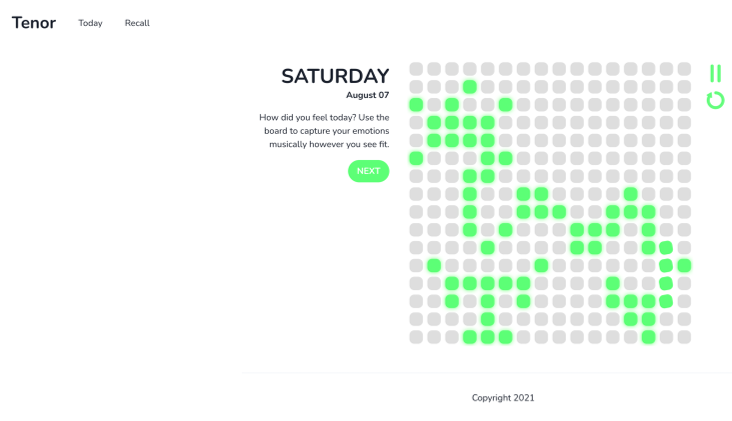
To solve this, the authors propose a **creativity-based approach**. Instead of asking "How sad are you on a scale of 1-10?", TENOR provides a 256-key music grid.
### 1. The Interface Design
The tool uses a neutral, balanced aesthetic with gray and green tones to avoid pre-biasing the user. The primary interaction is the **Music Grid**, where users map their affective states to sounds that only they are best suited to interpret.
### 2. The Four-Stage Workflow
* **Preparation & Collection**: Users create songs on the drum pad to represent their day.
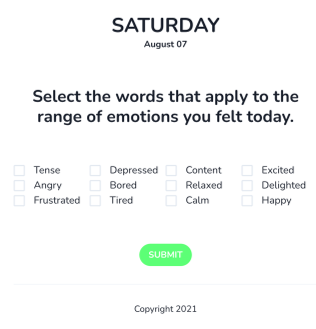
* **Action**: Users select words from a 12-item **Valence-Arousal Word Bank** to tag their tunes.
* **Reflection**: A weekly "Song List" view allows users to revisit their creations.
* **Reappraisal**: At the end of the week, users listen to their songs to see if they can accurately recall and re-process the emotions they felt days earlier.
## Experiments & Results: Stability in Recalling Emotion
The researchers conducted a two-week pilot study with 17 participants, comparing TENOR’s music interface (Experimental) against a standard word-bank-only interface (Control).
**Key Findings:**
* **Consistency**: The music interface showed "stability" in recall across all emotional quadrants. Users were more consistently attuned to their past feelings when prompted by their own musical creations.
* **The "Delight" Trade-off**: Interestingly, users were slightly *worse* at recalling high-negative emotions in the music mode. The authors suspect the "delight" of making music creates an emotional dampening effect on negative memories—a fascinating UX challenge.
* **Improved Low-Arousal Recall**: Low-negative emotions (like melancholy or boredom) were recalled significantly better via the music interface than positive emotions in the standard text interface.

## Critical Analysis & Conclusion
**Takeaway**: TENOR proves that self-tracking doesn't have to be a sterile, clinical experience. By turning data entry into **artistic expression**, we can lower the barriers for people with mental illnesses to engage with their own data.
**Limitations**: The study is a "pilot," meaning the sample size (N=17) is small. Furthermore, the "arousal decay" caused by the fun of the interface is a double-edged sword: it makes the app more usable, but it might "wash away" the raw intensity of the emotions it’s trying to track.
**Future Outlook**: For the next generation of HCI (Human-Computer Interaction) tools, the focus should shift from **quantifying** the self to **qualifying** the experience. TENOR opens the door for "affective health" tools that prioritize personal meaning over social standards.