
NEWFM: Decoding Human Emotion Through Neuro-Fuzzy Networks
Emotional-speech recognition using the neuro-fuzzy network
The paper introduces an emotional-speech recognition system utilizing a Neuro-Fuzzy network with Weighted Fuzzy Membership functions (NEWFM). By implementing a two-stage classification hierarchy and the Non-overlap Area Distribution Measurement (NADM) for feature selection, the method achieves a state-of-the-art 86% overall accuracy on the Berlin Emotional-Speech Database.
TL;DR
Researchers have developed a sophisticated speech emotion recognition system called NEWFM (Neuro-Fuzzy network with Weighted Fuzzy Membership function). By combining the adaptive learning of neural networks with the linguistic interpretability of fuzzy logic, this system reaches 86% overall accuracy and an incredible 97.5% detection rate for sadness, outperforming traditional Support Vector Machine (SVM) baselines.
Problem & Motivation
Recognizing emotion in speech is a "hard" problem for AI because human feelings are rarely discrete. A "happy" voice and an "angry" voice might both exhibit high pitch and high volume (high arousal), making them difficult for standard algorithms to distinguish.
The authors argue that previous SOTA methods, such as Support Vector Machines (SVM), operate as "black boxes" that struggle with generalization in classification domains. They identified a need for a system that is not only accurate but also interpretable—one that can explain which acoustic features (jitter, shimmer, or pitch) are actually driving the emotional classification.
Methodology: The Core Architecture
The secret sauce of this paper lies in the NEWFM framework and its two-stage classification strategy.
1. The Two-Stage Hierarchy
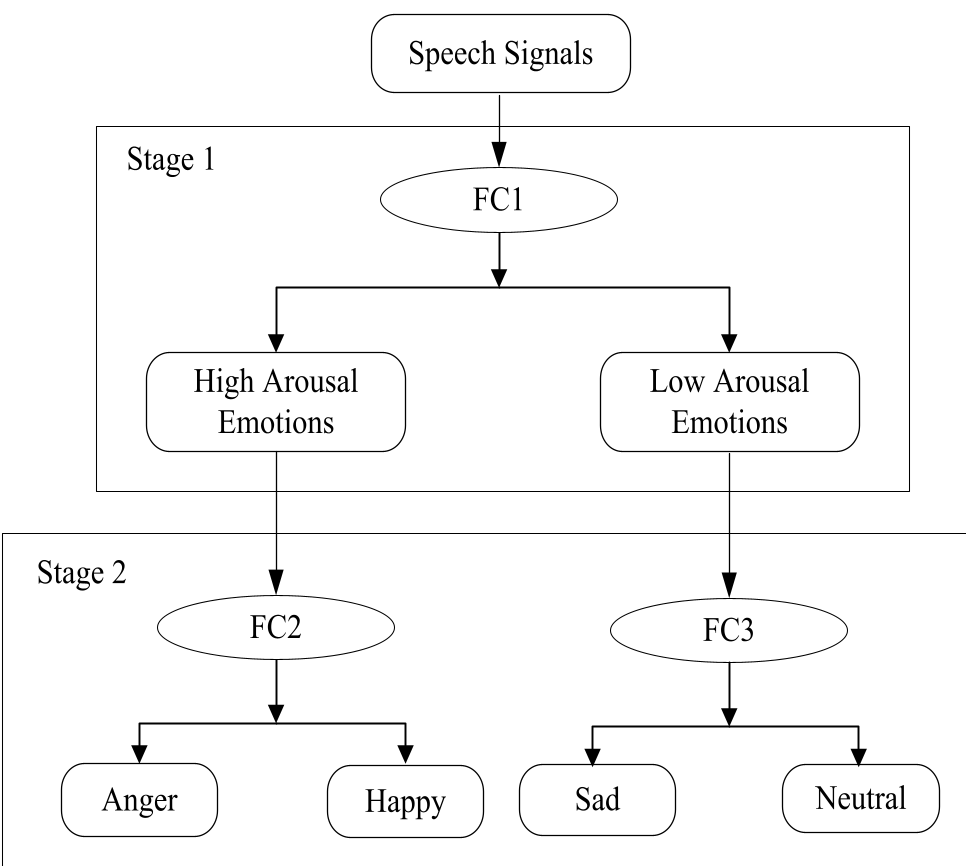
Rather than trying to classify all emotions at once, the system uses a divide-and-conquer approach:
- Stage 1 (Arousal Check): Segregates speech into High-Arousal (Anger, Happiness) and Low-Arousal (Sadness, Neutral).
- Stage 2 (Refinement): Uses dedicated Fuzzy Classifiers (FC2 and FC3) to pinpoint the specific emotion within those arousal categories.
2. Feature Selection via NADM
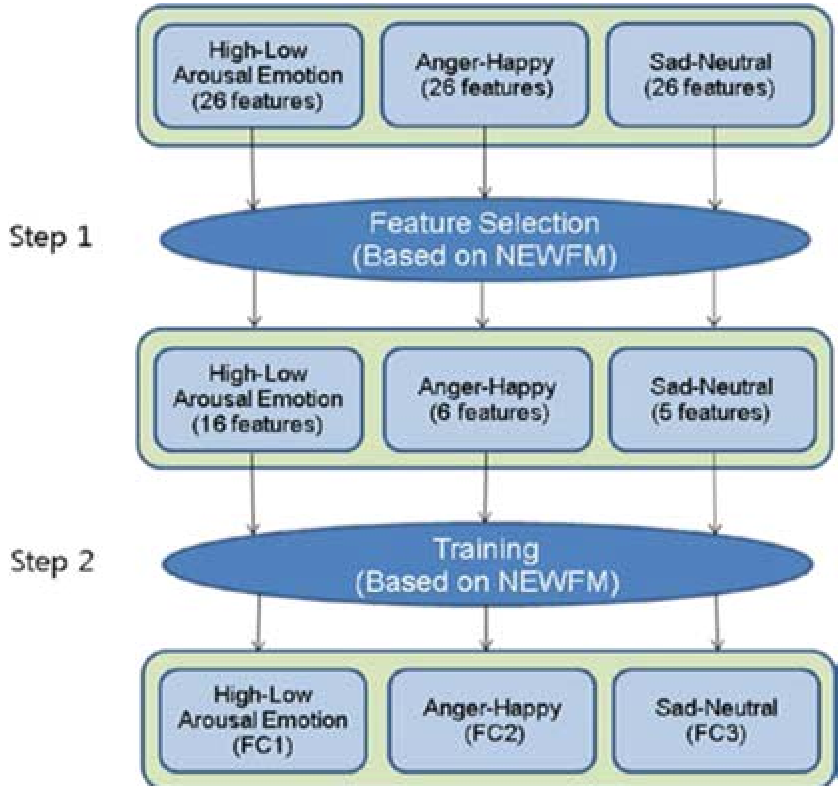
The researchers used PRAAT software to extract 26 initial acoustic features. To prevent "overfitting" and improve efficiency, they used Non-overlap Area Distribution Measurement (NADM). This method calculates how much the fuzzy membership functions of two classes don't overlap; the larger the non-overlap, the more "discriminative" the feature is.
3. Fuzzy Membership Functions
Unlike binary logic (0 or 1), NEWFM uses weighted fuzzy functions. This allows the model to handle the "fuzziness" of human speech, where a voice might be "80% likely to be sad" based on its pitch variance and "20% neutral."
Experiments & Results
The model was tested using the Berlin Emotional-Speech Database. The results show a significant leap in precision:
- Overall Accuracy: 86% (beating the CrossCorr-SVM's 85%).
- Sadness Recognition: A nearly perfect 97.5%.
- Anger Recognition: 95.52%.
The most challenging task remained distinguishing Happiness from Anger, as Happiness was often confused with Anger (40.9% error rate in that specific sub-pair). This is a known phenomenon in acoustic research where high-energy positive and negative emotions share similar "prosodic signatures."
Comparison Table
| Emotion | NEWFM Accuracy | CrossCorr-SVM Accuracy |
|---|---|---|
| Anger | 95.52% | 95.04% |
| Sadness | 97.50% | 85.07% |
| Neutral | 91.89% | 84.34% |
| Overall | 86.0% | 85.0% |
Critical Analysis & Conclusion
The Takeaway
The NEWFM approach proves that interpretable AI can be just as powerful as complex statistical models. By visualizing fuzzy membership functions, researchers can actually see the acoustic boundaries of human emotion.
Limitations
- Gender Bias: This specific study focused only on female speech samples, noting that gender significantly affects pitch-based features.
- The Happiness Gap: The confusion between high-arousal emotions (Happiness vs. Anger) suggests that additional features beyond traditional prosody (perhaps spectral or semantic features) are needed.
Future Outlook
This technology has massive potential for smartphones, interactive toys, and healthcare monitoring. Imagine a smartphone that detects a user's rising stress levels through voice analysis and suggests a calming intervention, or an AI counselor that can objectively track a patient’s emotional recovery over time.