
Elevating Mental Health Diagnostics: Enhancing Emotion Recognition via Handwriting Signal Processing
Emotional State Recognition Performance Improvement on a Handwriting and Drawing Task
This paper proposes a multi-domain feature extraction framework combining time, spectral, and cepstral signals to improve the recognition of depression, anxiety, and stress from handwriting and drawing tasks. By utilizing a radial basis SVM and data augmentation on the EMOTHAW database, the method achieves an average accuracy improvement of 15% over previous benchmarks.
TL;DR
This research significantly advances the field of behavioral biometrics by proving that "how" we write is as telling as "what" we write. By applying advanced signal processing—specifically spectral and cepstral analysis—to pen pressure and movement data, the authors improved the detection of depression, anxiety, and stress by an average of 15% over previous state-of-the-art methods, reaching over 80% accuracy for depression.
Problem & Motivation: The Subtle Signals of the Pen
Traditional mental health assessments rely heavily on self-reporting or clinician observation, which can be subjective and costly. While previous studies identified that handwriting (a complex cognitive-motor task) changes under emotional distress, they primarily focused on "macro" features like total time or the number of pen strokes.
The authors recognized a significant gap: these macro features ignore the "micro" nuances—the subtle oscillations in frequency and pressure that carry the signature of a patient's neurological and emotional state. The challenge lies in extracting these signals from small datasets (only 129 users) without overfitting.
Methodology: From Time to Frequency Domains
The core innovation of this work is the transition from simple time-domain metrics to a multi-domain approach.
1. The Multi-Domain Feature Pipeline
For every handwriting task (like drawing a clock or repeating a sentence), the authors captured raw signals including X-Y coordinates, pen status (on-air/on-surface), and pressure. These were transformed through:
- Time-Domain Features (TDF): Basic duration and stroke counts.
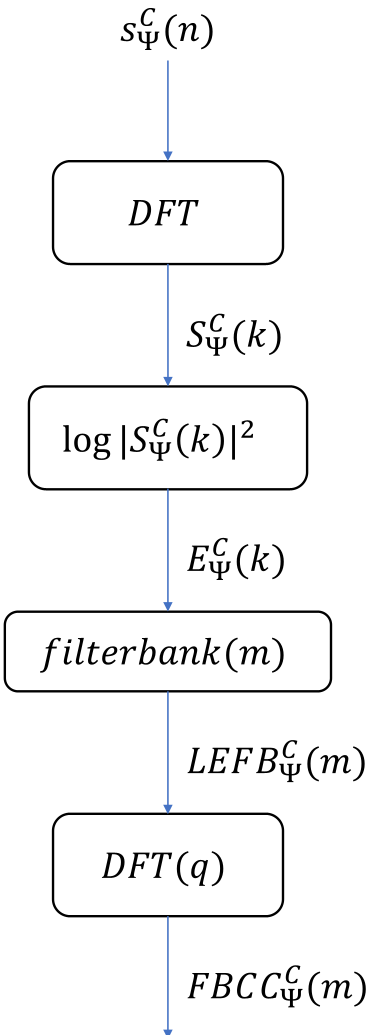
- Spectral-Domain Features (SDF): Using Discrete Fourier Transforms (DFT) to analyze the frequency of pen movements.
- Cepstral-Domain Features (CDF): Applying a linear Filterbank and then another DFT to identify periodicities in the spectrum—a technique borrowed from speech processing that is excellent at capturing the "source" characteristics of a signal.
2. mFCBF: The "Smart" Filter
To prevent "The Curse of Dimensionality," the authors used a modified Fast Correlation-Based Filtering (mFCBF). This algorithm ensures that only features with high correlations to the target emotion and low correlations to each other are kept, effectively removing redundant noise.
3. Data Augmentation
To handle the small sample size, Gaussian noise was added to the extracted features, creating synthetic training examples that forced the SVM (Support Vector Machine) classifier to learn more robust decision boundaries.
Experiments & Results
The study utilized the EMOTHAW database, which maps handwriting tasks to the Depression, Anxiety, and Stress Scale (DASS).
Key Breakthroughs:
- Depression Detection: Achieved the highest accuracy at 80.31% using writing tasks.
- Spectral Advantage: Adding spectral coefficients alone increased depression recognition by 9.2%.
- Stress Recognition: Witnessed a massive 34% improvement over the baseline for writing tasks.
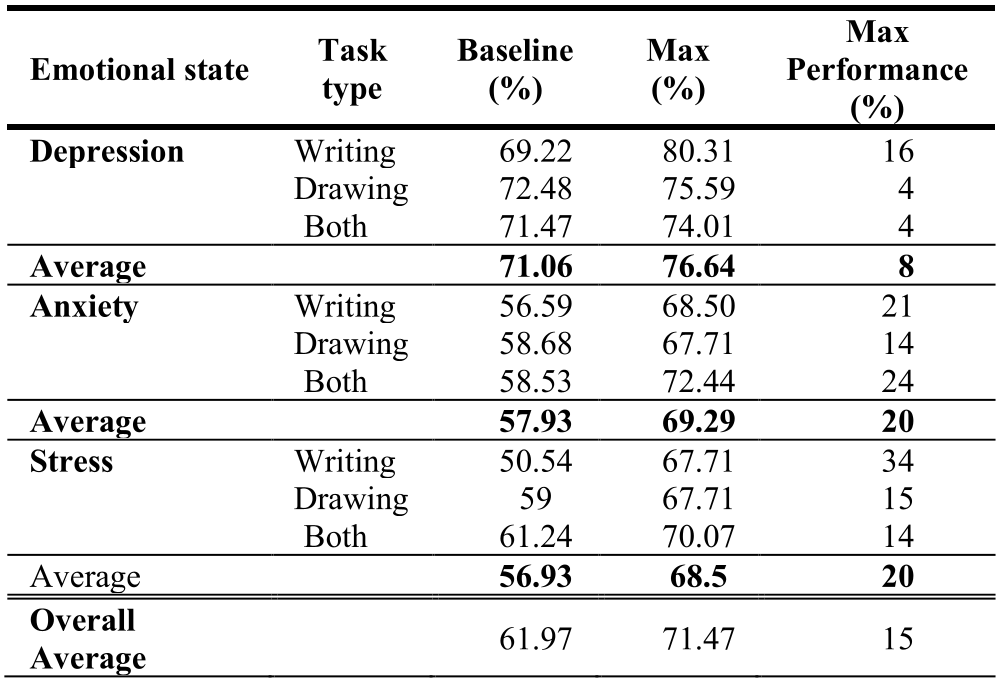
The results (Table 4) reveal a fascinating insight: Writing tasks are superior for detecting depression, whereas a combination of writing and drawing is necessary to accurately capture the physiological arousal associated with anxiety and stress.
Critical Analysis & Conclusion
This work demonstrates that signal processing techniques originally designed for audio (Cepstrum) are remarkably effective for motor-control signals.
Takeaway: The study proves that fine-grained pressure and velocity variations are high-value biomarkers. Limitations: The dataset is relatively small and age-restricted (21-32 years). Future work must validate these spectral "signatures" across broader demographics and explore whether these patterns can predict treatment response. Future Outlook: We are moving toward a world where a simple tablet-based drawing test in a primary care office could provide an objective "emotional vital sign," enabling earlier intervention for mental health disorders.