
Beyond the Recognition Plateau: Why Some Emotions Elude Machine Learning
Why Some Emotional States Are Easier to be Recognized Than Others: A thorough data analysis and a very accurate rough set classifier
This paper investigates why certain emotional states (like Anger) are significantly easier to recognize than others in physiological data-based systems. It evaluates standard machine learning models against a Rough Set Data Analysis (RSDA) approach, achieving a top predictive accuracy of over 82% using an unbiased, rule-based classifier.
TL;DR
Despite the proliferation of complex neural networks, emotion recognition from physiological data often hits a "glass ceiling" of roughly 80% accuracy. This paper demonstrates that this limit isn't caused by weak algorithms, but by the physiological signals themselves—which are great at detecting "excitement" (Arousal) but terrible at distinguishing "good" from "bad" feelings (Valence). By applying Rough Set Data Analysis (RSDA), the author achieves SOTA results using simple, transparent rules while exposing the structural flaws in how we collect affective data.
Background: The Affective Wall
In the quest for seamless Human-Computer Interaction (HCI), recognizing a user's emotional state—be it Joy, Anger, Sadness, or Bliss—is the holy grail. Most systems map these onto a 2D Cartesian plane: Arousal (Intensity) and Valence (Positivity/Negativity). However, whether researchers use LSTMs, SVMs, or Decision Trees, they all seem to stall at the same accuracy levels.
The author asks a critical question: Is our model of emotion actually compatible with the data we are feeding it?
Methodology: The Power of Rough Sets
While most researchers try to "force" data into complex models, this paper takes a step back using Rough Set Data Analysis. RSDA is an approach that deals with vagueness and uncertainty by identifying "reducts"—the minimal subset of features that preserves the classification power of the entire dataset.
1. Data Constraints
The study used 32 features derived from:
- Skin Conductivity (SC)
- Respiration (RSP)
- Electrocardiogram (ECG)
- Electromygogram (EMG)
2. The RSDA Advantage
Unlike Multilayer Perceptrons (MLPs) or Naive Bayesian Classifiers, RSDA doesn't require assumptions about hidden layers or probabilistic independence. It simply looks at the "granularity" of the data.
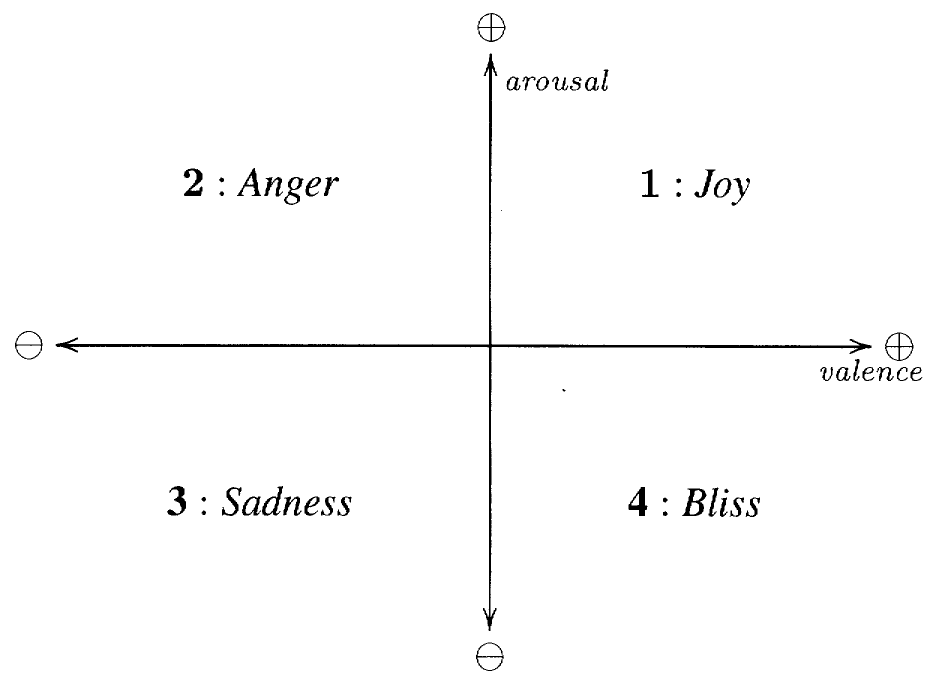 Fig 1: The 2D Emotion Model used for labeling.
Why Anger is the "Easiest" Emotion
Through exhaustive testing, the author found that Anger (Class 2) is consistently the most recognizable. Why?
- Arousal Dominance: Physiological sensors like Skin Conductivity are highly sensitive to stress and arousal. Anger is a high-arousal state, creating a distinct "fingerprint" in the data.
- Valence Blindness: Signals like respiration and heart rate are surprisingly poor at telling if someone is experiencing "eustress" (good stress like Joy) or "distress" (bad stress like Anger).
In the visualization below, you can see that while the algorithm can separate one cluster easily, the other three classes (Joy, Bliss, Sadness) are hopelessly entangled.
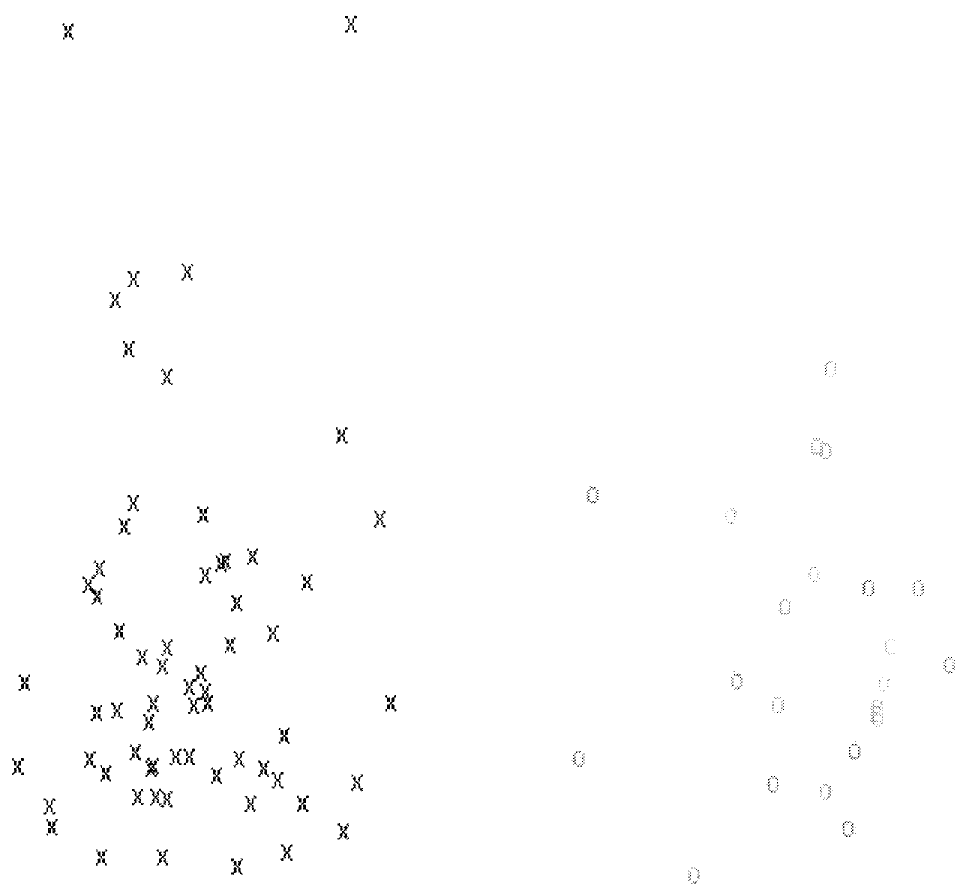 Fig 6: Unbiased clustering showing the data naturally forms two groups, not four.
Experiments and Results
The author compared a suite of standard algorithms (MLP, SVM, DTI, NBC) against the RSDA approach.
| Algorithm | Accuracy | Key Insight |
|---|---|---|
| MLP | 81-86% | High performance but prone to overfitting. |
| SVM | 82% | Best with a simple linear kernel. |
| RSDA (Proposed) | ≥82% | Matches SOTA with only 3 simple rules. |
The RSDA "rules" were remarkably simple. For example:
- If Feature 17 (Respiration) is high, the emotion is likely Anger.
- If Feature 24 (ECG) is extremely low, it’s likely Bliss.
Critical Insight: The "Valence" Problem
The most profound takeaway is that Valence and Arousal are not independent. The data suggests that at low arousal, humans don't show enough physiological variation for sensors to tell Bliss from Sadness. This isn't a failure of AI; it's a fundamental biological constraint of the signals we choose to measure.
Future Outlook
This paper serves as a warning against "blindly" applying deeper neural networks to affective datasets. If the features (SC, RSP) are biologically indifferent to the target labels (Valence), no amount of parameters will solve the problem. The future of the field lies in:
- Relational Learning: Using RSDA to build hierarchical classifiers.
- New Bio-markers: Finding signals that respond specifically to the "Positivity" of an experience, rather than just its intensity.
Conclusion
Rough Set Data Analysis proves that a "thin" model with high logic can outperform a "deep" model with weak logic. By understanding the physical intuition of our features, we can build AI that understands not just that we are feeling something, but what we are feeling.