
Deciphering the Courtroom: A Hierarchical Approach to Real-World Emotion Recognition
6041_Emotional states in judicial courtrooms An experimental investigation.
This paper introduces a specialized approach for emotion recognition in judicial courtrooms using a novel "Italian Emotional DB (Real Emotions)" dataset. The authors propose a Multi-layer Support Vector Machines (SVM) framework that hierarchically classifies gender, arousal, and specific emotional states, significantly outperforming traditional flat machine learning models.
TL;DR
The judicial courtroom is an emotional powder keg where witnesses, lawyers, and defendants often reach high states of arousal. This study presents a breakthrough in Affective Computing by introducing the first corpus of real courtroom audio and a Multi-layer Support Vector Machine (SVM) architecture. By breaking down classification into a hierarchy of gender, arousal, and specific emotion, the authors achieve superior accuracy compared to traditional "flat" machine learning models.
The Judicial Pain Point: Why "Flat" Models Fail
Modern courtrooms generate vast amounts of audio/video data, but retrieving specific emotional segments (e.g., a moment of anger during a cross-examination) is a manual, labor-intensive task.
Previous research relied heavily on acted emotions (professional actors simulating anger or fear), which lacks the "uncontaminated" signature of real-world stress. Furthermore, standard classifiers attempt to distinguish between "Anger" and "Happiness" in one step. This is problematic because:
- Gender Bias: Acoustic features like Fundamental Frequency (F0) vary significantly between men and women, confusing single-layer models.
- Overlap (Fuzziness): Neutral states often overlap with "low-arousal" emotions like boredom or sadness, leading to high misclassification rates.
Methodology: The Power of Hierarchy
The core innovation lies in the Multi-layer SVM framework. Instead of asking the machine "What emotion is this?", the framework asks a series of logical questions.
1. The Architecture
The classification process follows a three-tier tree structure:
- Layer 1: Gender Recognizer: Separates Male and Female voices to normalize gender-specific variables.
- Layer 2: Arousal Detection: Distinguishes "excited" states from "not-excited" (Neutral) states for each gender.
- Layer 3: Fine-grained Recognition: Distinguishes specific emotions (Anger, Sadness, etc.) only among the "excited" samples.
2. Feature Engineering
The authors mapped speech signals into a 240-dimensional feature space. They extracted Pitch (F0), Formants (F1-F3), Energy, and MFCCs, applying statistical measures (mean, variance, median) across time series to capture the dynamic nature of the human voice.
Experimental Results: Real-World Performance
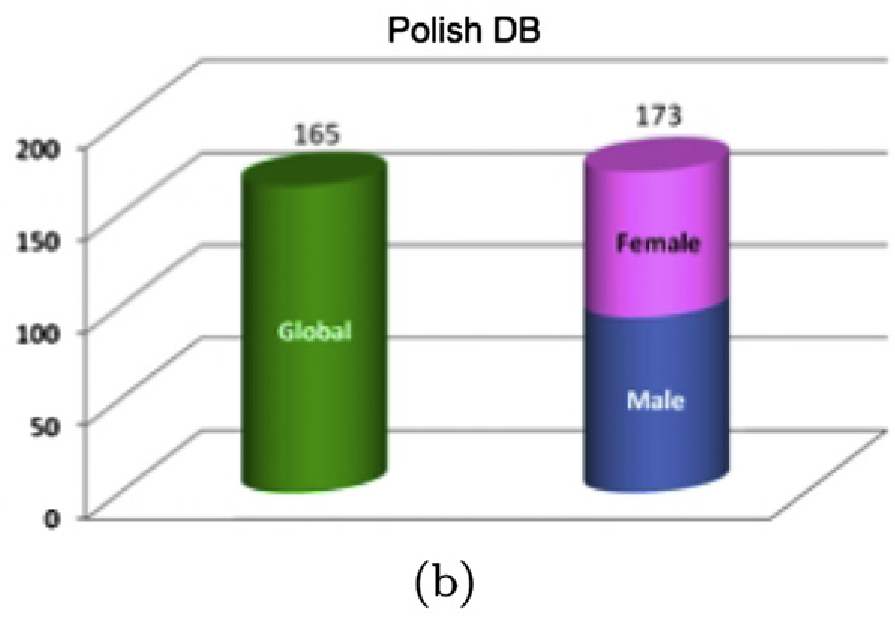
The researchers tested their approach against two benchmark datasets (German Berlin DB and Polish DB) and their own Italian Courtroom (Real Emotions) DB.
Comparative Success
In the "Real Emotions" courtroom dataset, the Multi-layer SVM significantly outperformed standard baselines:
- Multi-layer SVM: 82.9% Accuracy
- Traditional SVM: 59.3% - 68.7% (on benchmarks)
- Naive Bayes / Decision Trees: Consistently trailed the hierarchical approach.
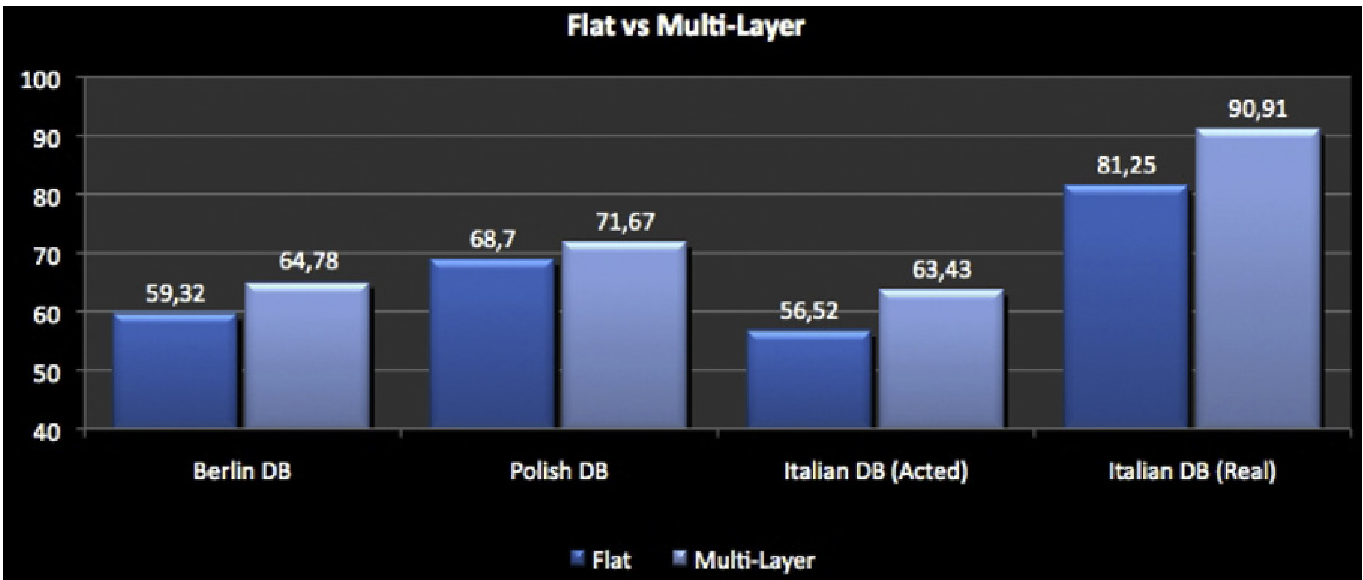
The results proved that Gender Specialization is the linchpin of accuracy. By training specialized models for male and female voices, the system captured nuances that a combined model simply couldn't see.
Critical Insight & Conclusion
This paper shifts the paradigm from what is being said to how it is being said in one of the most stressful environments in society.
Key Takeaways:
- The Hierarchy Advantage: Hierarchical models allow for "error correction" where lower layers can compensate for high-level misclassifications.
- Real Data is King: The introduction of the Italian Courtroom database provides a vital resource for moving beyond-acted datasets.
Limitations: The study focuses on static segments of audio. Future work must address the temporal dynamics—how emotions evolve over the course of an hour-long testimony. As it stands, this Multi-layer SVM approach provides a robust blueprint for semantic retrieval of legal multimedia, potentially changing how legal professionals review and understand the "affective" history of a trial.