
Enhancing Continuous Emotion Recognition: The Power of Emotional Tone
Emotional Tone-Based Audio Continuous Emotion Recognition
The paper proposes an Emotional Tone-Based Two-Stage GMM-HMM algorithm for continuous audio emotion recognition across the dimensions of Arousal, Valence, and Dominance. Using the AVEC 2014 database, the method achieves an average correlation of 0.458, significantly outperforming the SVR baseline (0.362).
TL;DR
Researchers from the Chinese Academy of Sciences have developed a two-stage algorithm that leverages "emotional tone" to improve continuous audio emotion recognition. By first determining if a segment is generally positive or negative, and then applying specialized GMM-HMM classifiers, they achieved a significant performance boost over standard Support Vector Regression (SVR) on the AVEC 2014 benchmark.
Context: Moving Beyond Basic Emotions
In the world of Human-Computer Interaction (HCI), recognizing "happy" or "sad" isn't enough. Human emotions are fluid, existing in a continuous space defined by Arousal (energy), Valence (pleasure), and Dominance (control). However, modeling these continuous values directly from audio is notoriously difficult due to the "noise" of natural speech.
The Core Insight: Emotional Tone
The authors hypothesize that while specific ratings fluctuate every second, a person's emotional tone remains relatively stable over a short period. Imagine a person sharing a sad memory; even if their energy (arousal) spikes momentarily, the underlying negative "tone" persists.
Existing SOTA methods often treat every frame as an independent point or use a single model for the entire range. This paper suggests that separate models for "Positive" and "Negative" tones can better capture the nuances of speech.
Methodology: The Two-Stage Framework
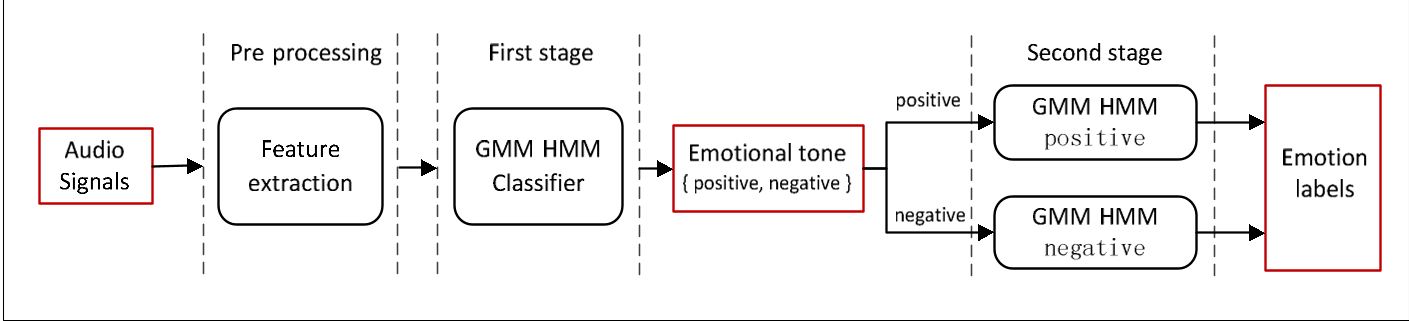
The system operates in a structured pipeline:
- Feature Extraction & Selection: Using 2268-dimensional features (spectral and voice-related) reduced via a hybrid CFS-PCA (Correlation-based Feature Selection and Principal Component Analysis) approach.
- Stage 1 - Tone Detection: A GMM-HMM determines the global tone of an audio clip.
- Stage 2 - Refined Recognition: Depending on the tone found in Stage 1, the system selects either a "Positive Classifier" or a "Negative Classifier" to predict the final continuous labels.
Why GMM-HMM?
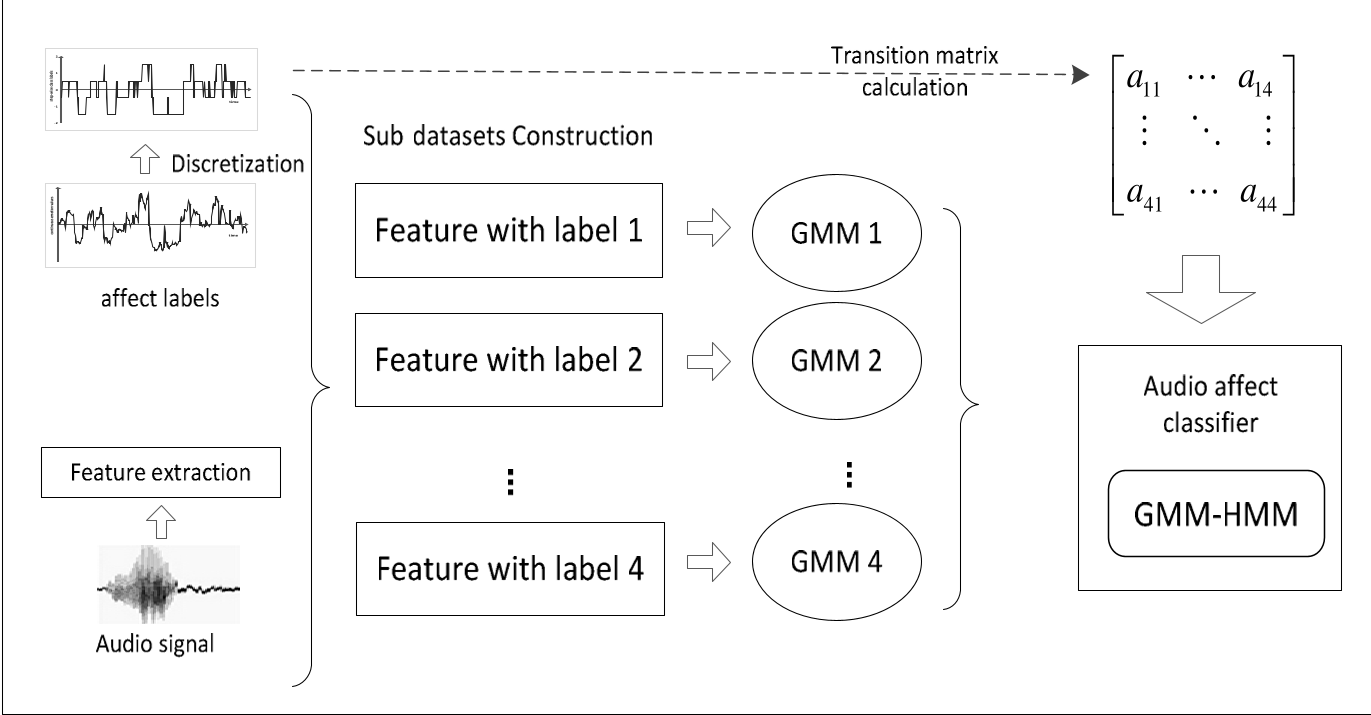
Unlike simple regression, the GMM-HMM (Gaussian Mixture Model - Hidden Markov Model) can model the temporal transitions between emotional states. By discretizing the continuous labels into "bins," the researchers transformed a regression problem into a sequence-finding problem via the Viterbi algorithm.
Experimental Battleground: AVEC 2014
The team tested their method on two datasets: Northwind (reading a fable) and Freeform (spontaneous speech).
Key Results:
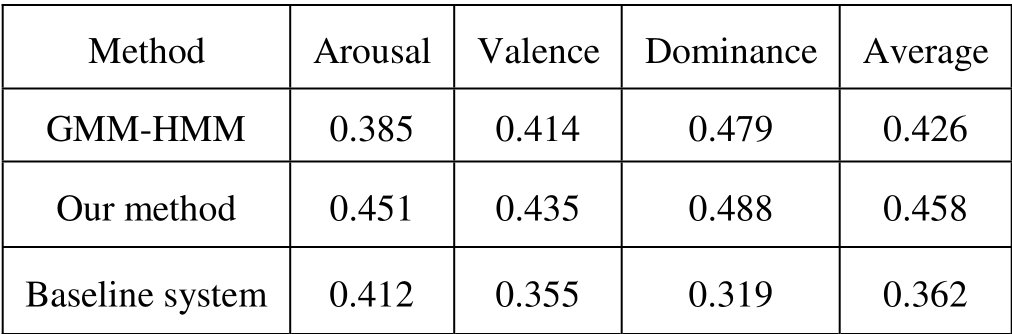
- Average Correlation: Our method hit 0.458, compared to the Baseline SVR's 0.362.
- Dimension Mastery: The improvement was particularly strong in the Dominance (0.488) and Arousal (0.451) dimensions.
- Ablation: The two-stage approach consistently outperformed a single-stage GMM-HMM, proving that "Tone" is a valuable inductive bias.
Critical Insight & Conclusion
The success of this method lies in the divide-and-conquer strategy. By splitting the emotional space based on tone, the GMMs in the second stage only need to model a subset of the feature distribution, leading to much cleaner decision boundaries.
Limitations: The "Freeform" dataset saw smaller gains than "Northwind," likely because spontaneous speech is more emotionally "neutral," making it harder to assign a definitive positive or negative tone.
Future Outlook: While HMMs are classical, this "two-stage" logic is highly applicable to modern Deep Learning. Future systems might use a global "Tone Embedding" to condition a Transformer or LSTM for more precise affective tracking.