
The Power of Positivity: How Emotional Tweets Shape Our Social Graph
Analyzing influence of emotional tweets on user relationships using Naive Bayes and dependency parsing
This paper investigates how emotional expressions in tweets influence long-term user relationships on Twitter. By combining Naive Bayes classification with dependency parsing to weight emotional intensity, the authors quantify user sentiment (Composite Index) and demonstrate that positive emotional behavior significantly correlates with better social networking outcomes.
TL;DR
Does being a "Negative Nancy" on Twitter actually cost you followers? According to a recent study by Tago et al., the answer is a resounding yes. By deploying a Naive Bayes classifier enhanced with Dependency Parsing, the researchers found that users who post positive content not only grow their follower counts faster but also build more mutual relationships compared to their negative counterparts.
Contextual Positioning
Within the landscape of Social Network Analysis (SNA), most research focuses on topology (who follows whom) or topic modeling (what is being discussed). This work bridges the gap by focusing on the psychological incentives of network formation. It moves beyond simple dictionary-based sentiment analysis into a structurally-aware NLP framework.
The Problem: Why Simple Word Lists Fail
Traditional sentiment analysis often uses "bag-of-words" models. However, language is nuanced. Consider the difference between:
- "I am happy."
- "I am not happy."
- "I am very happy."
A simple dictionary sees "happy" in all three. To solve this, the authors integrated Dependency Parsing to identify relationships between "emphasizing" words (like totemo/very) and "denying" words (like nai/not), adjusting the emotional weight of a tweet accordingly.
Methodology: Beyond Binary Sentiment
The researchers developed a sophisticated framework to move from raw text to a statistical "Composite Index" (CI).
1. Structural Scoring
By using the Yahoo Japanese dependency parsing API, the system identifies the "modifier-modified" structure of a sentence.
- Emphasizing words: 1.5x score multiplier.
- Weakening words: 0.5x score multiplier.
- Denying words: -1.0x score multiplier (reversing the valence).
2. The Overall Framework
The researchers processed a Twitter corpus through this weighted Naive Bayes pipeline to calculate the Composite Index (CI), which normalizes a user's emotional output between 0 (Negative) and 1 (Positive).
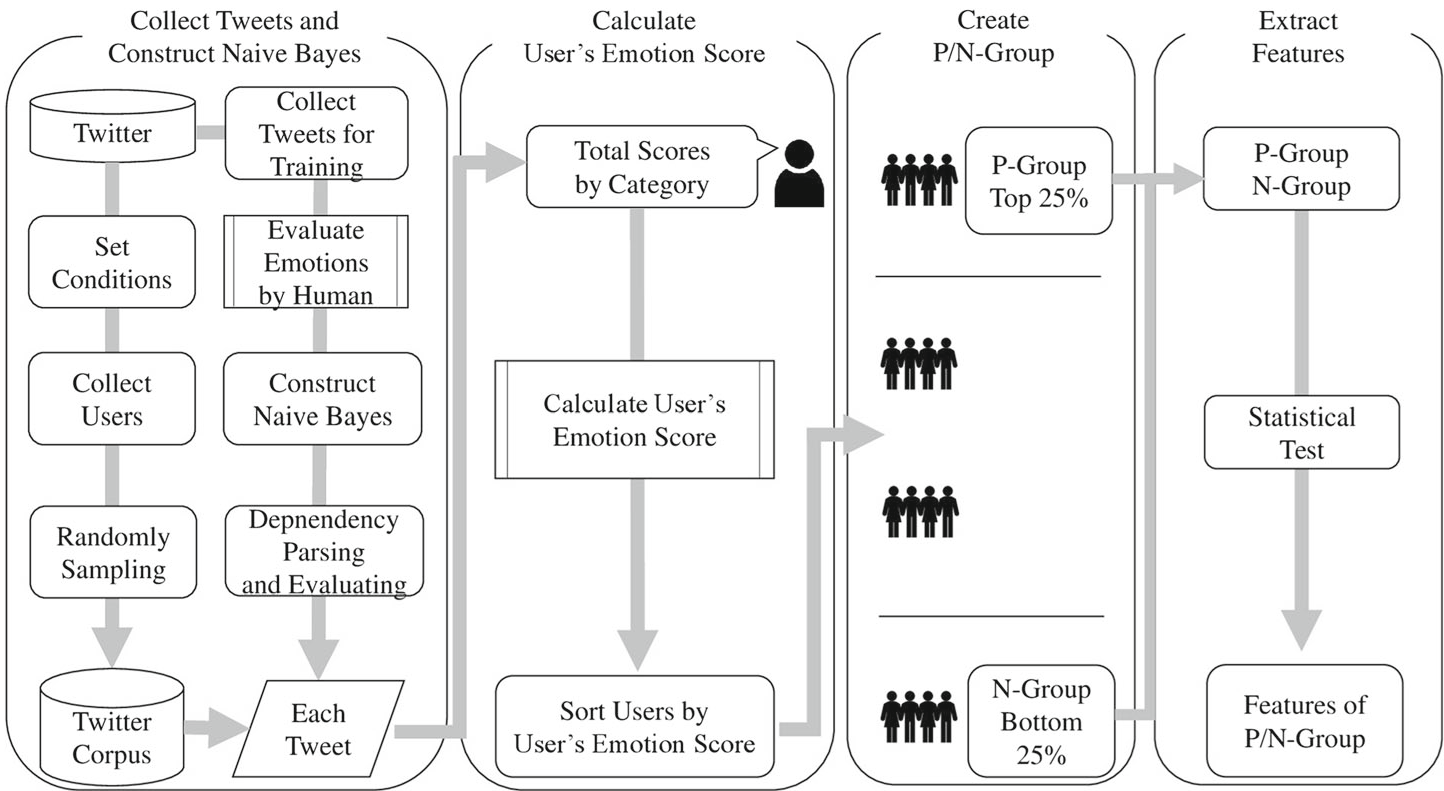 Figure 1: The proposed workflow from tweet acquisition to statistical testing.
Experiments and Concrete Evidence
The study analyzed 298 active Twitter users over a one-month period. They used the Brunner–Munzel test, a robust statistical method that doesn't assume a normal distribution of data.
Key Result: The "Positivity Dividend"
The data showed that the "P-Group" (Top 25% most positive) outperformed the "N-Group" (Bottom 25%) in every social metric:
| Metric | P-Group (Mean) | N-Group (Mean) | t-value |
|---|---|---|---|
| Follower Fluctuation | +13.91 | +1.17 | -5.230** |
| Mutual Follow Growth | +10.76 | +0.80 | -5.007** |
| Followee Fluctuation | +12.84 | +2.52 | -3.707** |
 Table 1: Statistical significance between Positive and Negative groups.
Critical Insights
The most striking finding is the Mutual Follow Fluctuation. Positive users don't just broadcast; they build networks. The p-value (<0.01) indicates that the tendency for positive users to gain mutual followers is nearly certain.
Limitations & The "Uncertain" Factor
The authors honestly note that negative sentiment classification remains challenging. Negative tweets often use "collapsed" styles (slang, sarcasm, or fragmented grammar), which breaks the dependency parsing logic. They suggest a future "Uncertain" category to handle ambiguous greetings and context-heavy phrases that currently muddy the "Neutral" category.
Conclusion: Why This Matters
This research provides empirical proof for the "Social Contagion" of joy. In an era where social media is often criticized for toxicity, this study highlights a natural corrective mechanism: users who provide positive emotional value are rewarded with stronger, more reciprocal social networks. For developers and researchers, this underscores the importance of "Sentiment Weighting"—understanding that words like "very" or "not" are just as important as the emotional nouns they modify.