
Beyond the Vacuum: Why AI Needs Social Context to Truly Master Emotion
Towards Emotionally Intelligent Machines: Taking Social Contexts into Account
Towards Emotionally Intelligent Machines: Taking Social Contexts into Account presents a framework for incorporating social network structures (size and density) into computational emotion models. The study utilizes empirical data from Facebook and scenario-based experiments to demonstrate how interpersonal relationships influence emotional expression.
TL;DR
For decades, emotional AI has focused on what triggers an emotion (appraisal) and how it feels (state), but it has largely ignored where it is expressed. This paper argues that "Social Context"—quantified through the size and density of an individual's social network—is the missing link. By analyzing Facebook behavior and experimental scenarios, the authors demonstrate that our network structure dictates our emotional honesty, modulated heavily by our personality traits.
The "Solitary Agent" Problem
Traditional computational models, like the widely used OCC model or the PAD (Pleasure, Arousal, Dominance) space, treat agents as if they exist in a vacuum. If a stimulus occurs, an emotion is generated. However, human psychology tells a different story: we suppress tears at a corporate gala but share them freely in a close-knit group of five.
The core pain point identified here is that current AI lacks a social filter. Without understanding the "audience," artificial agents cannot maintain believability or build long-term trust in complex multi-user environments.
Methodology: Quantifying the Social Fabric
The researchers move beyond vague definitions of "context" by adopting two rigorous metrics from Social Network Analysis (SNA):
- Network Size: The total number of connections (Quantity of resources).
- Network Density: The ratio of actual connections among friends to all possible connections (Quality/Cohesiveness).
The Two-Study Approach
- Study 1 (Scenarios): Controlled factors (Size: 10/50/200; Density: Sparse/Dense) to measure the intention to share.
- Study 2 (Facebook API): Real-world validation using the
NameWebGenapp to scrape actual status updates and correlate them with Big Five Inventory personality traits.
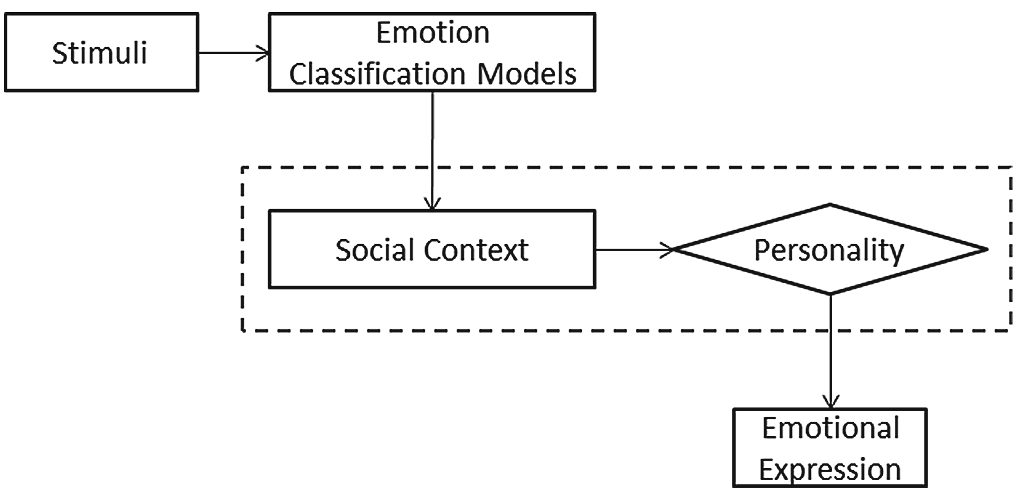 Figure: The proposed framework where Social Context and Personality act as filters between emotion activation and expression.
Key Insights: The Social Dynamics of Disclosure
The findings challenge the idea that more friends simply mean more sharing:
- The U-Curve of Positivity: People are most likely to share positive news in very small networks (intimacy) or very large ones (broadcasting for status).
- Impression Concern: In a network of 200+, negative emotion sharing drops off a cliff. The risk to one's "popular and competent" self-image is too high.
- The Density-Personality Interaction: This is the paper's "secret sauce." Network density (how much your friends know each other) doesn't affect everyone equally.
- Extroverts feel "safer" sharing negative emotions in dense networks.
- Conscientious individuals do the opposite; they suppress negativity in dense networks to avoid "burdening" the cohesive group.
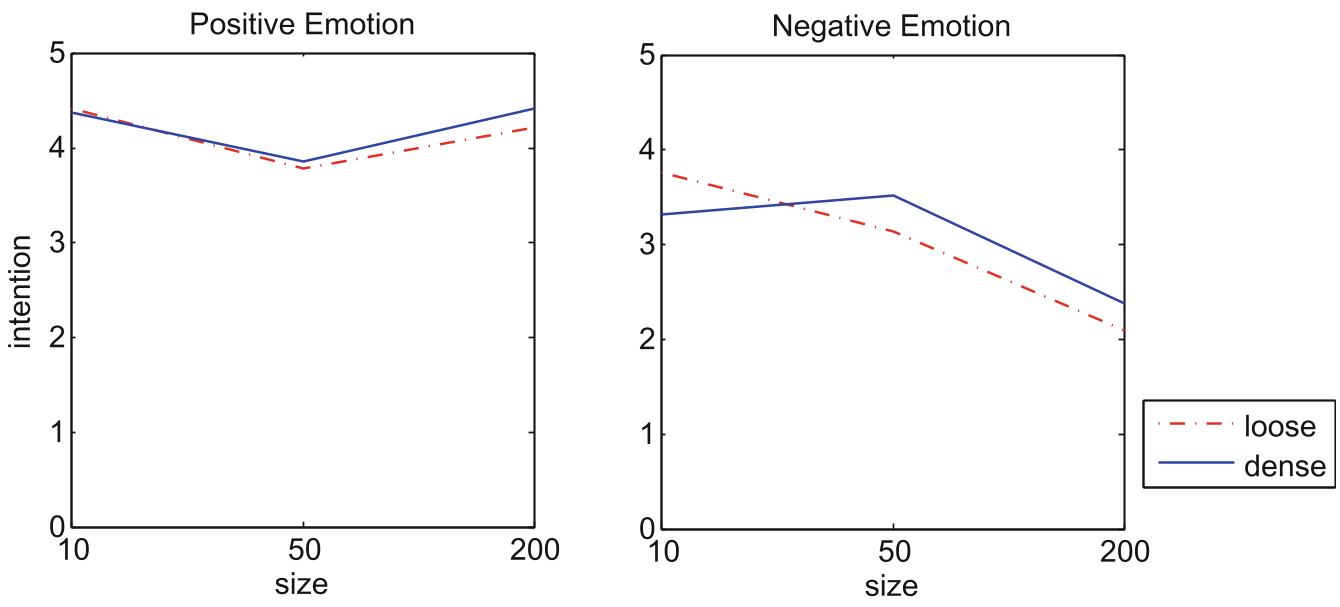 Figure: Interaction between Network Size and the intention to express positive vs. negative emotions.
Implications for Affective Computing
The authors propose a radical shift in how we build "Emotional Intelligent Machines." Instead of a direct pipeline from Stimuli to Expression, we must implement a Social Context Profile.
Practical Applications:
- Empathetic Agents: A virtual assistant in a large Slack channel should be programmed with "high impression concern," avoiding excessive negativity, whereas a 1-on-1 coaching bot should prioritize "density-driven trust."
- Community Management: Online health forums could use these insights to automatically "shard" groups into smaller sizes if they detect that users are becoming too hesitant to share problems due to network growth.
Critical Analysis & Future Work
While the paper provides a ground-breaking bridge between SNA and Emotion Modeling, it primarily focuses on valence (positive vs. negative). Future AI needs to distinguish between "Anger" and "Sadness"—two negative emotions that have very different social costs. Furthermore, as we move into the era of LLMs, integrating these SNA metrics into the prompting or fine-tuning of agents will be the next frontier for human-centered design.
Takeaway: An agent that doesn't know its audience isn't truly "intelligent"; it's just loud. By quantifying the social network, we give AI the "etiquette" required to survive in the human world.