
EmotionGAN: Pioneering Unsupervised Domain Adaptation for Subjective Image Emotions
EmotionGAN: Unsupervised Domain Adaptation for Learning Discrete Probability Distributions of Image Emotions
This paper introduces EmotionGAN, a novel unsupervised domain adaptation (UDA) framework designed to learn the discrete probability distributions (DPD) of image emotions. By combining GAN losses with a unique semantic consistency constraint, it achieves state-of-the-art performance in transferring emotion recognition capabilities from labeled source datasets (e.g., FlickrLDL) to unlabeled target datasets (e.g., TwitterLDL).
TL;DR
Recognizing emotions in images is inherently subjective—different people see different things. EmotionGAN is the first framework to tackle this by using Unsupervised Domain Adaptation (UDA) to predict discrete probability distributions of emotions. By utilizing a "Semantic Consistency Loss," it successfully transfers knowledge from labeled datasets to unlabeled ones, drastically reducing the performance drop caused by domain shift.
Problem & Motivation: The Subjectivity Challenge
Most computer vision tasks seek an objective truth (e.g., "Is this a cat?"). Emotion recognition is different. As shown in the paper's motivation, a single image might induce joy in one person but sadness in another. This leads to two major hurdles:
- The Affective Gap: The disconnect between low-level pixels and high-level feelings.
- Perception Subjectivity: The need for probability distributions (DPD) rather than a single label.
Furthermore, deep learning models are notoriously brittle. A model trained on high-quality Flickr photos often fails on noisy Twitter images due to Domain Shift. Since labeling emotions is expensive, "bridging" these domains without new labels is the holy grail of affective computing.
Methodology: The Architecture of EmotionGAN
The authors didn't just apply a standard GAN. They recognized that if you transform an image to look like it belongs to a new domain (e.g., from Flickr to Twitter style), you might lose the very features that triggered the original emotion.
The Triple-Loss Strategy
EmotionGAN optimizes three distinct components simultaneously:
- Adversarial Loss (GAN): A Generator () creates "adapted" images, while a Discriminator () tries to distinguish them from real target images.
- Semantic Consistency Loss: This is the "secret sauce." It ensures the emotion distribution of the adapted image remains identical to the source image through Symmetrised KL Divergence.
- Regression Loss: A Regressor () is trained to predict the actual emotion distribution from these adapted images.
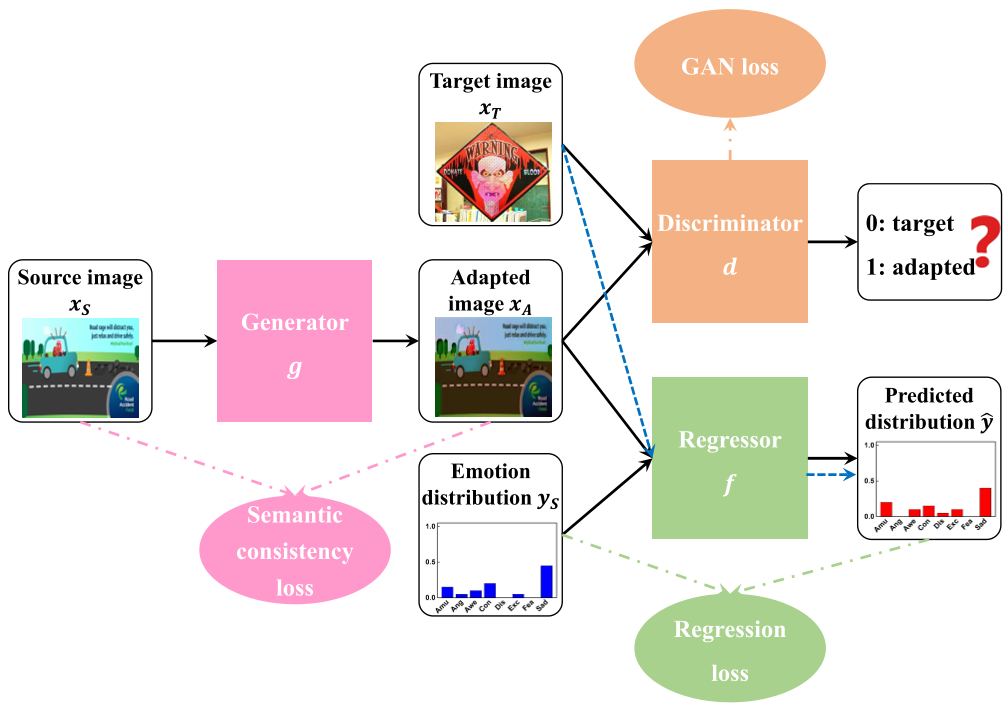
In this architecture, the generator works to "style-transfer" the image while the consistency loop locks the emotional meaning in place.
Experiments & Results
The model was tested using the FlickrLDL and TwitterLDL datasets. These datasets represent a significant challenge because they contain real-world social media imagery with multi-user votes for labels.
Performance Gains
EmotionGAN crushed the "Source-only" baseline (direct transfer without adaptation) and outperformed SimGAN, a popular UDA method at the time.
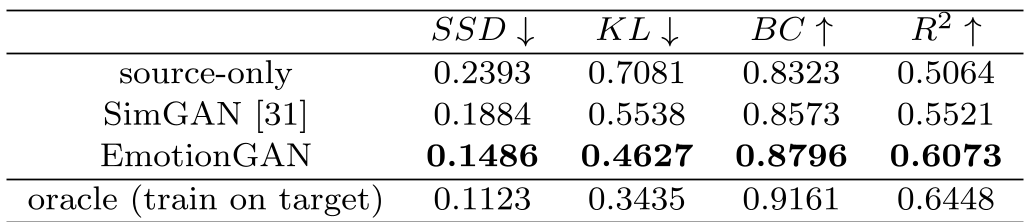 Table: Results from FlickrLDL (Source) to TwitterLDL (Target). Lower SSD and KL values indicate the predicted distribution is closer to the human ground truth.
The Importance of Consistency
In the ablation study, the authors removed the Semantic Consistency Loss. The result? A massive drop in performance. This proves that for subjective tasks, visual adaptation alone isn't enough; you must explicitly preserve the "emotional semantics" during the transformation.
Critical Analysis & Conclusion
Takeaway
EmotionGAN is a landmark paper because it shifts the UDA focus from "object classes" to "probability distributions." It proves that we can train models on one platform and deploy them on another without needing a single new label, provided we respect the semantic integrity of the data.
Limitations & Future Work
While powerful, EmotionGAN currently requires both domains to use the same emotion categories (e.g., both must use Mikels' 8-emotion model). The authors suggest that future work should look into adapting across different taxonomies—for instance, converting a model trained on "Joy/Sad/Angry" to one that predicts "Valence/Arousal."
Closing Thought
As social media continues to be the primary medium for human expression, tools like EmotionGAN will be vital for products ranging from personalized marketing to mental health monitoring.