
EmotionO+: Bridging Semantic Knowledge and Random Forests for Mental Health Monitoring
EmotionO+: Physiological signals knowledge representation and emotion reasoning model for mental health monitoring
The paper introduces EmotionO+, an advanced ontology-based model for mental health monitoring that integrates EEG and fNIRS physiological signals. It combines semantic knowledge representation with a Random Forest-based reasoning engine to achieve a state-of-the-art accuracy of 99.11% in subject-dependent emotion recognition.
TL;DR
The research team from Lanzhou University has unveiled EmotionO+, a sophisticated framework that merges the structured world of Ontology with the predictive power of Random Forests. By processing multi-modal brain signals (EEG and fNIRS), the system achieves a staggering 99.11% accuracy in identifying emotional states, providing a robust foundation for early-stage depression monitoring and intervention.
Problem & Motivation: The Data Silo in Mental Health
In the digital health era, physiological signals like EEG (electroencephalogram) and fNIRS (functional near-infrared spectroscopy) are gold mines for detecting emotional shifts linked to depression. However, two major walls stand in the way:
- Semantic Gap: Data from different hospitals or labs often use conflicting formats, making sharing and "real-world" clinical integration nearly impossible.
- Model Fragility: Traditional classifiers like SVM often struggle with the high-dimensional noise inherent in brain signals, leading to over-fitting or poor accuracy in multi-class scenarios.
The authors' insight was to create a "common language" (Ontology) that describes what the data is, and a "logical brain" (Random Forest) that reasons what the data means.
Methodology: The Hybrid Intelligence Framework
The EmotionO+ architecture is split into two distinct yet synergistic layers: Knowledge Modeling and Knowledge Reasoning.
1. Descriptive Knowledge (The Ontology)
Using Protégé, the team built a hierarchical structure that defines relationships between subjects, scalp regions, and specific spectral features (e.g., HbO for fNIRS or Alpha/Beta power for EEG). This ensures that any healthcare system can interpret the data correctly.
2. Procedural Knowledge (The Random Forest)
Why Random Forest? Unlike individual decision trees, RF is an ensemble method. It is highly resistant to the noise typical of EEG signals and doesn't require the exhaustive parameter tuning that Deep Learning models often demand. The paths from the root to the leaves in these trees are converted into semantic rules (e.g., "If Theta power > X on electrode Y, then Emotion = Z").
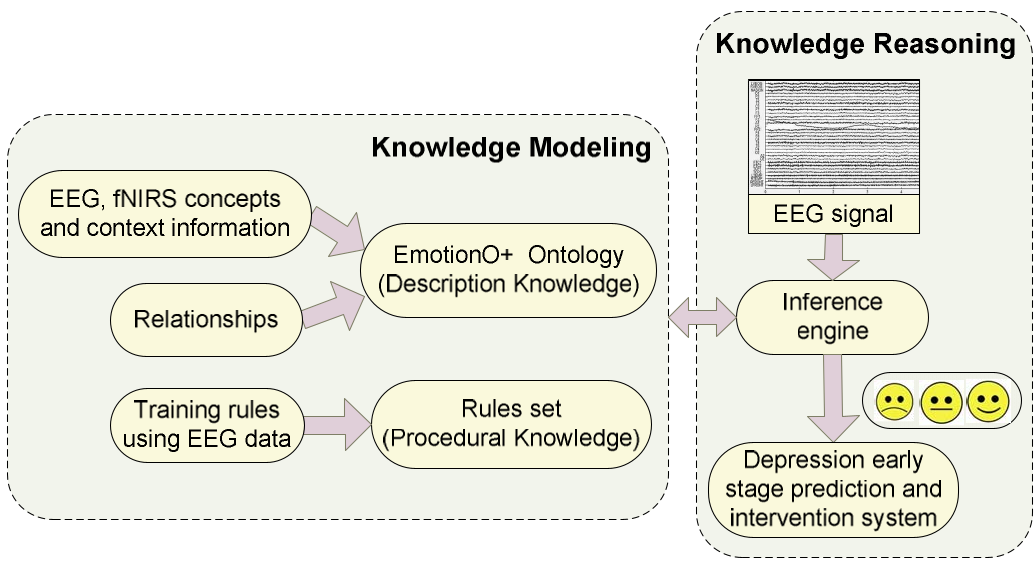 Figure 1: The dual-layer framework of EmotionO+ combining Knowledge Modeling and Reasoning.
Experiments: Breaking the 99% Barrier
The researchers tested the model using the eNTERFACE’06 dataset, focusing on three emotional states: calm, exciting positive, and exciting negative.
Results Breakdown:
- EmotionO+ (RF-based): 99.11%
- Prior EmotionO (C4.5-based): 97.80%
- Standard ANN (BP): 96.92%
- SVM: 83.17%
The significant lead over SVM is attributed to the fact that SVM is fundamentally a binary classifier and struggles with the complexity of multi-class brain dynamics.
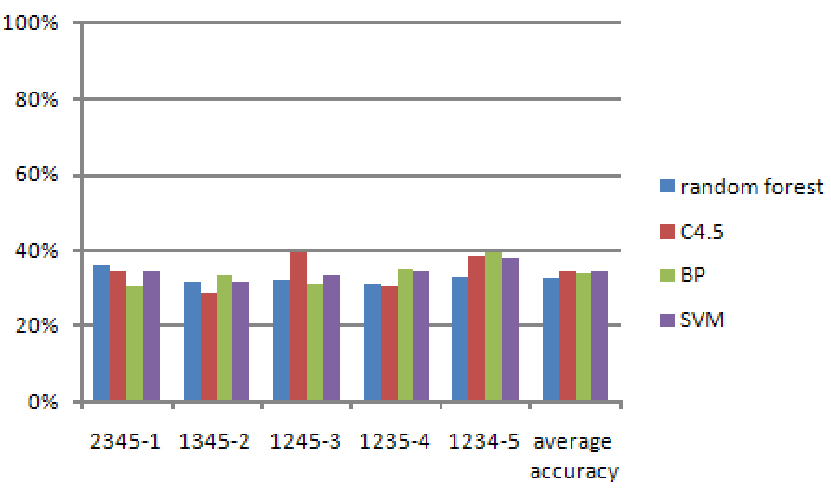 Figure 2: Subject-dependent recognition accuracy across different machine learning algorithms.
Deep Insight: Why Does This Matter?
The real value of EmotionO+ isn't just the high accuracy—it's interpretability. In a medical setting, a "black box" AI is hard to trust. Because EmotionO+ transforms Random Forest trees into Jena-readable rules, a doctor can actually see why the system flagged a patient as having a "negative emotional state" (e.g., specific power surges in the CP4 electrode).
Limitations & Future Work
While the subject-dependent results are near-perfect, the subject-independent scores (shown in Figure 5 of the paper) highlight the "universal" challenge of affective computing: everyone's brain is different. Future iterations aim to improve cross-subject generalization by fusing EEG and fNIRS signals more deeply.
Conclusion
EmotionO+ represents a significant leap toward standardized mental health monitoring. By treating physiological signals as "knowledge" rather than just "raw numbers," the authors have created a system that is not only accurate but also interoperable across the global healthcare landscape.