
Beyond Conventional Bands: Optimizing Subject-Independent EEG Emotion Recognition
Abstract² Emotions are fundamental for everyday life affecting our communication, learning, perception, and decision making. Including emotions into the human-computer interaction (HCI) could be seen as a significant step forward offering a great potential for developing advanced future technologies. While the electrical activity of the brain is affected by emotions, offers electroencephalogram (EEG) an interesting channel to improve the HCI. In this paper, the selection of subject-independent feature set for EEG-based emotion recognition is studied. We investigate the effect of GLIIHUHQWIHDWXUHVHWVLQFODVVLI\LQJSHUVRQ ¶VDURXVDODQGYDOHQFH while watching videos with emotional content. The classification performance is optimized by applying a sequential forward floating search algorithm for feature selection. The best classification rate (65.1% for arousal and 63.0% for valence) is obtained with a feature set containing power spectral features from the frequency band of 1-32 Hz. The proposed approach substantially improves the classification rate reported in the literature. In future, further analysis of the video-induced EEG changes including the topographical differences in the spectral features is needed
The paper presents a framework for subject-independent emotion recognition using EEG signals, specifically targeting Arousal and Valence classification. By employing a Sequential Forward Floating Search (SFFS) algorithm for feature selection on the MAHNOB-HCI database, the authors achieved SOTA-level classification rates of 65.1% for arousal and 63.0% for valence in a leave-one-subject-out setting.
Executive Summary
TL;DR: This research tackles the challenge of identifying human emotions from brainwaves (EEG) across different individuals without the need for subject-specific calibration. By moving away from rigid, pre-defined frequency bands and employing a Sequential Forward Floating Search (SFFS) algorithm, the authors achieved a significant performance jump (up to +12.6% for arousal) on the benchmark MAHNOB-HCI dataset.
Positioning: This work serves as an essential bridge between classical neurophysiology and modern data-driven signal processing, demonstrating that the "optimal" features for emotion recognition often lie between the gaps of traditional frequency definitions.
The "One-Size-Fits-All" Challenge
The human brain is notoriously complex; an "alpha wave" in one person might carry different emotional weight than in another. Most prior work failed because it relied on:
- Fixed Frequency Bands: Limiting analysis to standard ranges like Delta (1-4Hz) or Beta (13-30Hz).
- Subject Dependence: Models that work great for one person but fail on the next.
The authors argue that to achieve subject-independent recognition, we must surgically extract the specific spectral components that stay consistent across the population.
Methodology: The SFFS Breakthrough
The core of this paper is not just the classification, but the selection of features.
1. Feature Set Construction
Instead of just using standard bands (FS1), the authors created FS2 (1-32 Hz) and FS3 (1-48 Hz), which included single frequencies and overlapping wider bands, providing a гораздо (much) richer dictionary for the model to choose from.
2. Sequential Forward Floating Search (SFFS)
The SFFS algorithm acts like a smart "filter." It doesn't just add the best features one by one; it has a backtracking mechanism:
- Addition Step: It adds the feature that best improves accuracy.
- Removal Step: It checks if removing a previously added feature (in light of new data) further improves results. This prevents the "nested effect" where a bad early choice ruins the final model.
 Fig 1: The 32-channel EEG setup used to capture emotional responses to video stimuli.
Experimental Results & Insights
The results prove that more data isn't always better—selective data is.
- Arousal Accuracy: 65.1% (using 90 optimized features).
- Valence Accuracy: 63.0% (using 181 optimized features).
- Comparison: This beat the previous SOTA on the same dataset (52.5% for arousal) by a wide margin.
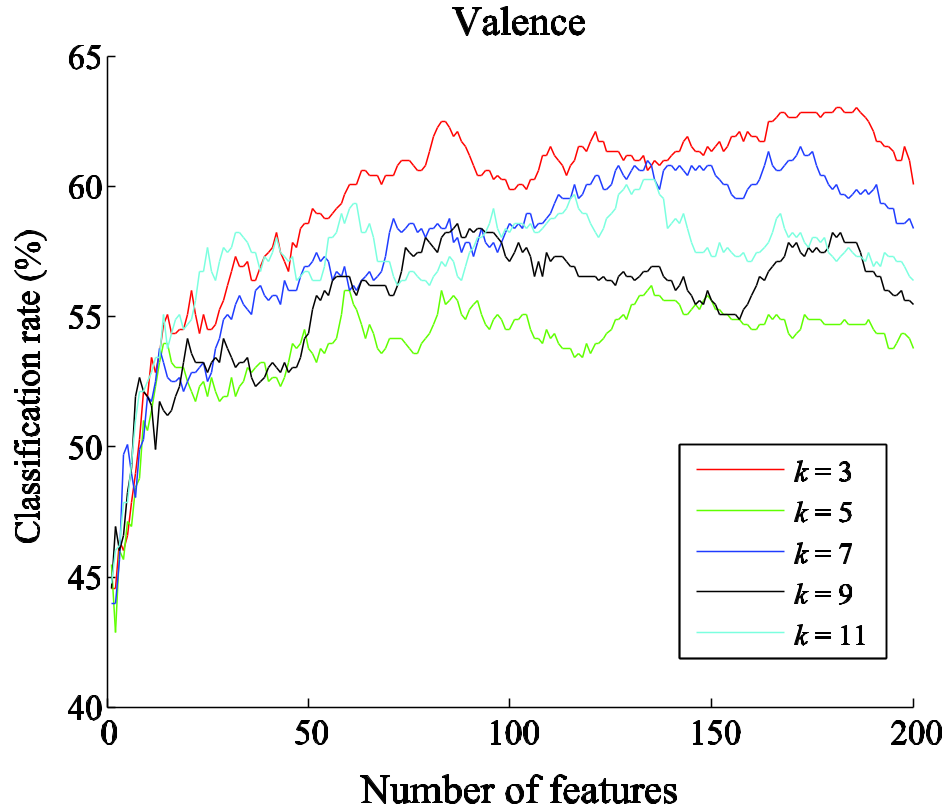 Fig 2: Classification rate as a function of the number of features. Notice how performance peaks and then plateaus/declines, illustrating the "curse of dimensionality" if feature selection isn't used.
Key Insight: For arousal, the model relied heavily on low frequencies (<6 Hz) and the high alpha band (11-12 Hz). For valence, the lower frequencies (<12 Hz) were more dominant, while high-frequency gamma activity was less informative.
Critical Analysis & Future Outlook
Takeaway
The study confirms that subject-independent recognition is viable if we treat EEG spectra as a continuous resource rather than a set of 5 buckets. The SFFS algorithm provides a robust way to navigate this high-dimensional space without the massive computational cost of exhaustive searching.
Limitations
- Computation: Even with SFFS, the initial feature pool was so large that an ANOVA pre-selection was required.
- Spatial Blindness: The current SFFS approach focuses on spectral power but doesn't fully exploit the topographical relationships (how different brain regions communicate during emotion).
Future Work
The next frontier is combining this optimized feature selection with deep manifold learning or Graph Convolutional Networks (GCNs) to account for the physical distance between electrodes, potentially pushing accuracies toward the 70-80% range required for real-world HCI applications.