
Logic Meets Feeling: Formalizing Emotions in Rational Agent Design
Emotions and Personality in Agent Design and Modeling
This paper presents a formal framework for integrating emotions and personality into rational agent design by extending classical decision theory. It defines emotional states as distinct decision-making modes that transform an agent's utility functions, action spaces, and probability distributions to handle environmental pressures.
TL;DR
For decades, "rationality" in AI was synonymous with cold, exhaustive calculation. This paper challenges that by proving that emotions and personality are actually principled mechanisms for efficient decision-making. By redefining emotions as "modes" of a decision-theoretic model, the authors provide a mathematical framework where traits like fear or anger become heuristics for managing limited cognitive resources under time pressure.
Background Positioning: This is a foundational theoretical work that bridges the gap between Cognitive Science (psychological models of emotion) and Symbolic AI (decision theory), moving agents from static calculators to dynamic, "personality-driven" entities.
The "Complexity" Trap in Rationality
Standard rational agents aim to maximize expected utility: However, in a real-world multi-agent environment, the number of states () and actions () is often infinite or computationally prohibitive. Humans don't solve this by calculating faster; we solve it through emotional predispositions. For example, "fear" narrows our action space to "flee" or "fight" instantly, bypassing the need for an exhaustive search of all possible behaviors.
Methodology: The Decision-Making Quadruple
The core insight of the paper is representing an agent's situation as a quadruple: .
The authors then define Personality as a Finite State Machine (FSM) where the "states" are actually different versions of this quadruple.
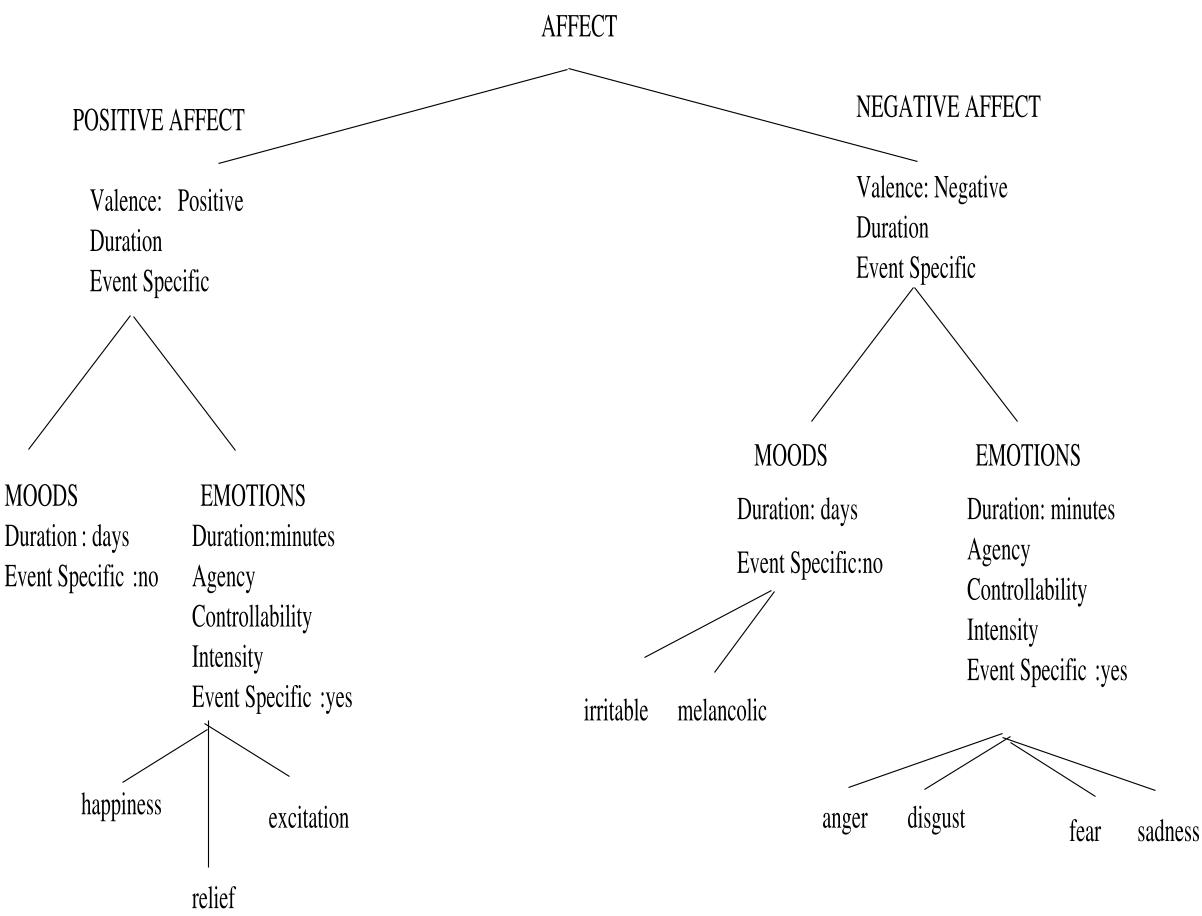 Figure 1: Taxonomy of emotional states used to differentiate decision-making modes.
The Three Core Transformations
How does an emotion actually change the "rationality" of an agent?
- Action Space () Transformation: Emotions like "Anger" might restrict the set to aggressive actions only. "Panic" might force the agent to consider only short-term time horizons (), ignoring long-term consequences to save computation time.
- Utility Function () Transformation: "Sadness" might be modeled as a global decrease in the utility of all states, leading to inaction. "Happiness" (Elation) might increase weights on specific positive attributes.
- Probability () Transformation: Under extreme pressure, an agent might simplify its world view by only considering the single most likely outcome of an action, effectively turning a stochastic problem into a deterministic one.
Learning and Social Intelligence
A major contribution of this work is the Personality Model of Others. By representing a human user's personality as a probabilistic FSM, an agent can learn through interaction (using unsupervised learning) how the user transitions between states like "Neutral," "Annoyed," and "Angry."
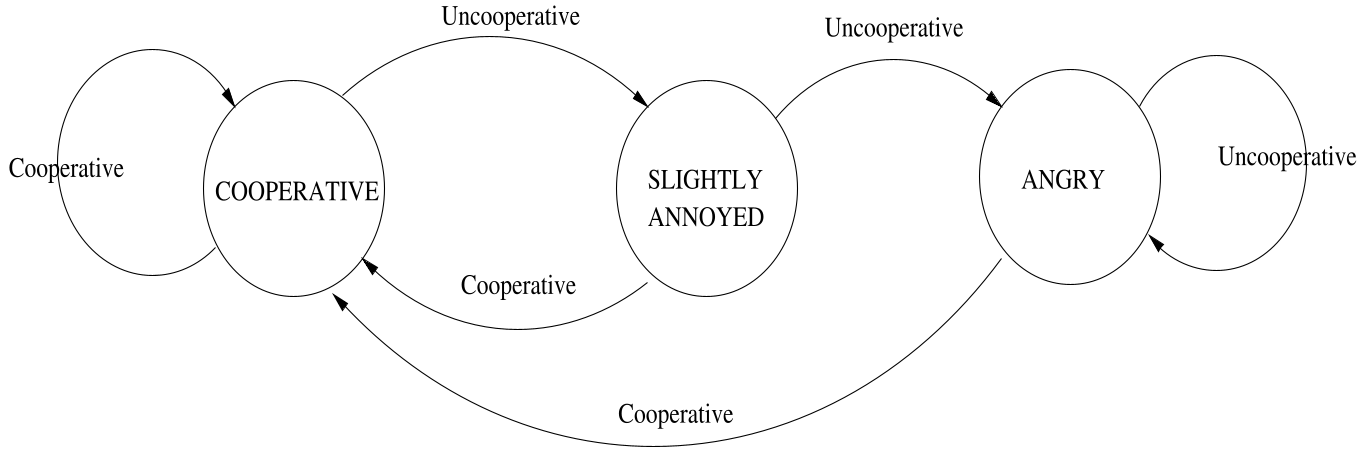 Figure 2: A simple personality model representing a 'Tit-for-Two-Tats' strategy as transitions between emotional states.
This allows the machine to predict that if a user is already "Slightly Annoyed," an uncooperative response will push them into "Angry," whereas a neutral calculation might have missed this social context.
Critical Analysis & Conclusion
Takeaway
The paper successfully demystifies emotions. Instead of seeing them as "irrational," it frames them as meta-level control parameters that allow an agent to operate efficiently in complex, uncertain, and social environments.
Limitations
- Simplicity of States: The FSM approach assumes discrete emotional states. In reality, human emotions are often continuous and overlapping (affective space).
- Input Mapping: While the paper defines how states change based on "environmental inputs," the mapping from raw sensory data (like facial expressions) to these specific inputs remains a significant engineering hurdle.
Future Outlook
This work lays the groundwork for Affective Computing. In the era of LLMs, these formalisms could be used to build "Emotional Wrappers" that prevent agents from hallucinating or over-thinking when context-specific "emotional" heuristics are more appropriate.