
EmotiW 2020: Decoding Human Behavior from Group Dynamics to Driver Vigilance
EmotiW 2020: Driver Gaze, Group Emotion, Student Engagement and Physiological Signal based Challenges
This paper details the 8th Emotion Recognition in the Wild (EmotiW 2020) grand challenge, introducing four multimodal benchmarking tasks: driver gaze prediction, audio-visual group emotion recognition, student engagement prediction, and physiological-based affect analysis. The challenge sets a standardized evaluation protocol using SOTA deep learning baselines, achieving significant performance leaps through participant contributions in transfer learning and multimodal fusion.
TL;DR
The 8th Emotion Recognition in the Wild (EmotiW) 2020 challenge represents a pivotal shift in affective computing. Moving beyond simple facial expression classification, this grand challenge benchmarks AI's ability to interpret human states in chaotic, real-world environments. It covers four critical domains: Driver Gaze, Group Emotions, Student Engagement, and Physiological Signals, providing the community with standardized datasets and baselines to push the boundaries of multimodal interaction.
Problem & Motivation: The "In the Wild" Frontier
Why is affective computing so difficult when we leave the lab? In real-world scenarios, AI faces "The Wild" — a cocktail of variable lighting, camera occlusions, and diverse subject demographics.
Current SOTA models often fail because they lack:
- Contextual Intelligence: Understanding that a group's emotion is more than the sum of individual faces.
- Temporal Dynamics: Missing the subtle shifts in engagement during a 5-minute lecture.
- Multimodal Synergy: The inability to reconcile what we see (video) with what we hear (audio) or feel (physiological signals).
Methodology: The Core Framework
The EmotiW organizers proposed a modular approach to these challenges, providing robust baselines for each:
1. Audio-Visual Group-Level Emotion
Instead of just looking at faces, the baseline uses an Inception V3 network to extract visual features and the OpenSMILE toolkit for audio descriptors (GeMAPS). These are fused and processed through a 4-layered LSTM to capture the temporal "vibe" of a social event.
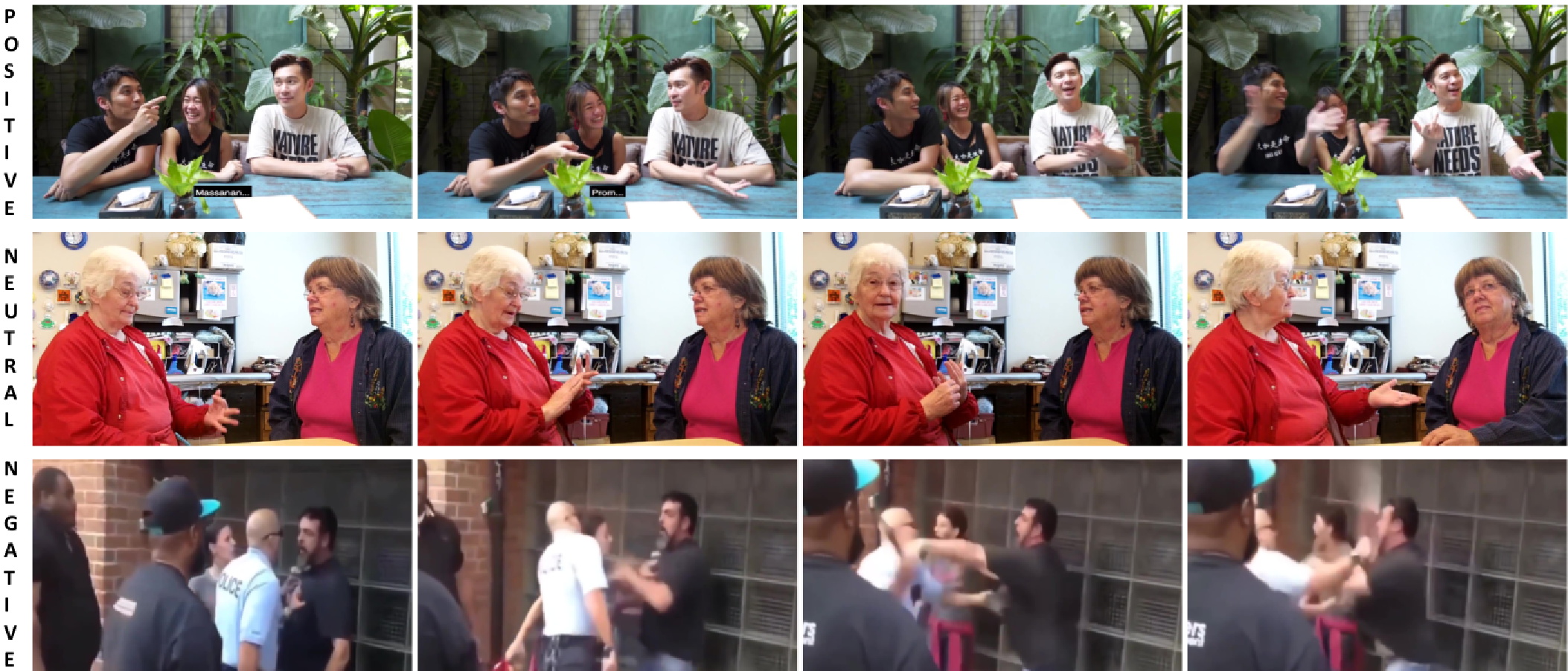 Above: Different social contexts like weddings and protests require the model to understand group dynamics.
2. Driver Gaze Zone Estimation
Safety-critical AI must know where a driver is looking. By dividing a car cabin into 9 zones (mirrors, radio, windshield), the challenge frames gaze estimation as a classification problem using Inception-based architectures.
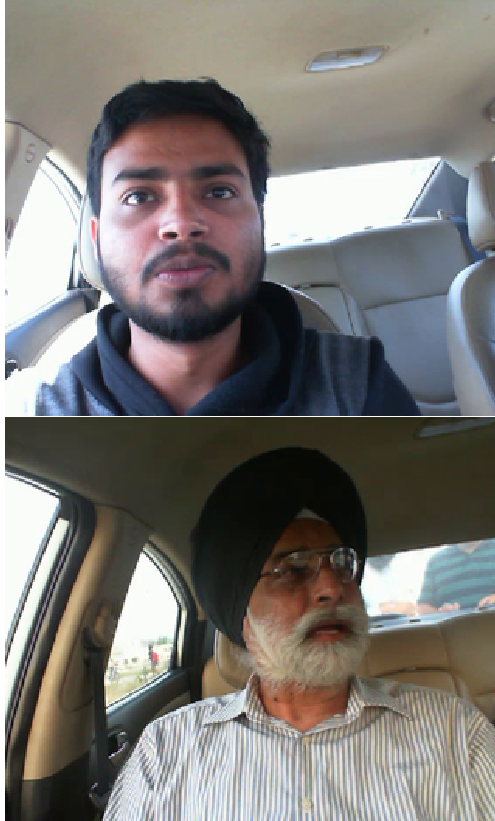 Above: The 9-zone layout used to map driver attention in the DGW database.
3. Engagement and Physiology
- Engagement: Utilizes OpenFace to track head pose and eye gaze, feeding the standard deviation of movements into an LSTM.
- Physiology (PAFEW): Analyzes ElectroDermal Activity (EDA) to predict emotions based on the observer's internal biological response.
Experiments & Results: Crushing the Baselines
The results from EmotiW 2020 show that the research community is rapidly mastering these complex tasks.
| Task | Baseline Accuracy/MSE | Top Team Performance | Improvement |
|---|---|---|---|
| Group Emotion | 47.88% (Acc) | 76.85% (SituTech) | +28.97% |
| Driver Gaze | 60.98% (Acc) | 82.52% (Didi) | +21.54% |
| Engagement | 0.150 (MSE) | 0.054 (UDECE) | -64% Error |
In the Group Emotion task, the top-performing teams (SituTech, DD_VISION) leveraged massive pre-training and sophisticated fusion strategies to nearly double the baseline's efficacy.
Critical Insight & Conclusion
The main takeaway from EmotiW 2020 is the dominance of Multimodal Transfer Learning. The winning solutions didn't just train from scratch; they borrowed knowledge from face identification and scene context tasks.
Limitations: While visual and audio methods are thriving, the Physiological Signal sub-challenge saw lower participation and lower accuracy (only 17.44% by the leading team), indicating that "internal" emotion recognition remains a significant bottleneck compared to "external" visual cues.
Future Outlook: The success of engagement and gaze prediction has immediate applications in Autonomous Driving (Level 3 handover) and EdTech (AI tutors). As we move forward, the integration of sparse physiological data with dense video streams will likely be the next major hurdle for the affective computing community.