
EmoTrend: Deciphering the Global Heartbeat through Social Event Analytics
EmoTrend: Emotion Trends for Events
EmoTrend is a web-based temporal analytics system designed to track global emotional responses to events on Twitter. It leverages peak frequency detection and social graph sequences to identify significant events, followed by a dual-classifier sentiment analysis (Bag-of-Words and Neural Networks) to visualize trends across six core emotions.
TL;DR
EmoTrend is an end-to-end system that monitors the "global mood" on Twitter, transforming chaotic microblog streams into coherent emotional narratives. By identifying "bursty" keywords and analyzing them through dynamic social graphs and emotion-bearing patterns, it visualizes how events like the Boston Marathon bombing evoke shifting waves of anger, fear, hope, and sadness.
Problem & Motivation: Beyond Factual Reporting
While microblogging platforms like Twitter have become the fastest news outlets globally, they are inherently noisy. A single event triggers millions of disjointed voices. Traditional analytics often focus on what happened (event detection) or how much was said (volume analysis), but they rarely capture the nuance of the societal impact.
The authors argue that understanding the evolution of emotion—the transition from initial shock (surprise) to collective grief (sadness) and eventually resilience (hope)—is critical for sociologists, corporations, and policymakers. The challenge lies in filtering meaningful "bursty" events from profanity and noise, and then accurately classifying emotions without losing the temporal context.
Methodology: The Mechanics of Event and Emotion
EmoTrend operates through two sophisticated pipelines:
1. Robust Event Detection
The system doesn't just look for frequent words; it looks for meaningful burstiness.
- Preprocessing: Uses m-function adaptations (Porter Stemmer) to filter low-meaning words and z-scores to statistically identify words that are significantly more frequent in the current window than in the past.
- Graph Dynamics: An event graph connects co-occurring keywords. Using PageRank, the system identifies "hub" keywords that define an event.
- Social Propagation: It employs Concept-Based Evolving Graph Sequences (cEGS)—sequences of directed graphs where nodes are users and edges are "following" relationships—to monitor how information propagates through the social fabric.
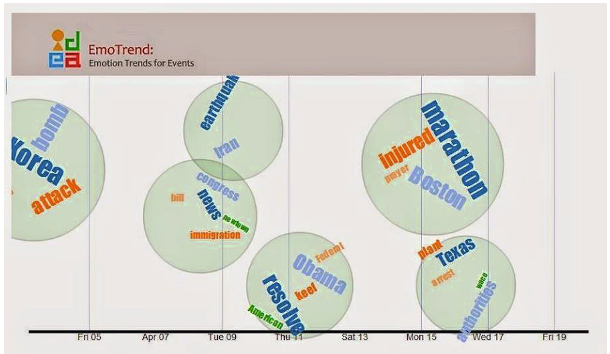 Fig 1: The Timeline interface showing detected events as circles, where size and content represent keyword frequency and duration.
2. Mood Summarization via Pattern Matching
Unlike simple bag-of-words models, EmoTrend uses emotion-bearing patterns.
- HW/PW Hybridization: High-frequency words (HW - e.g., "this") and Psychological-Words (PW - e.g., "love", "hate" from the LIWC dictionary) are combined into templates like
.+ this .+. - Adapted tf-idf: The system ranks these patterns using a modified tf-idf that accounts for how well a pattern captures various psychological categories across six emotions: anger, fear, hope, joy, sadness, and surprise.
Experiments & Results: Visualizing Impact
The system was demonstrated using real-world data, most notably the Boston Marathon bombing.
- The Emotion Pizza: A pie chart showing the distribution of the six emotions at any given time.
- The Emotion Trend: An area chart visualizing how these emotions fluctuate. In the case of the Boston bombing, the system captured high levels of fear and sadness immediately, followed by a visible rise in hope as users shared support for survivors.
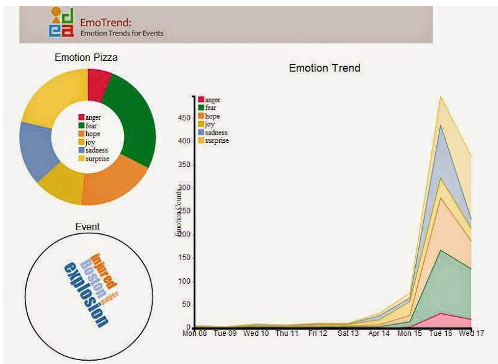 Fig 2: The detailed view for the Boston Marathon bombing, showcasing the Emotion Trend and proportions.
Critical Insight & Conclusion
EmoTrend's strength lies in its Inductive Bias: it assumes that significant events are characterized by both a spike in word frequency and a specific structure of social propagation (the cEGS).
Takeaway: This work moves beyond "Sentiment Analysis" (Positive/Negative) toward "Emotion Analytics." For businesses, this means understanding not just if a product launch was discussed, but if those discussions were driven by "Surprise" (excitement) or "Anger" (frustration).
Limitations: While the hybrid pattern-matching and neural network approach was advanced for its time, it lacks the deep contextual understanding of modern Transformers (like BERT or GPT). Future iterations would likely benefit from LLM-based zero-shot emotion classification to handle sarcasm and complex linguistic nuances that pattern-matching might miss.