
Empathy as Social Capital: Why the "Affective Brain" Determines Your Inner Circle
Empathic people have more friends: Empathic abilities predict social network size and position in social network predicts empathic efforts
This study investigates the link between dispositional empathy and social network structures, demonstrating that empathic abilities (specifically Empathic Concern) significantly predict the size of a person's "support group." Using the Interpersonal Reactivity Index (IRI) and social network mapping, the authors provide empirical evidence for the Social Brain Hypothesis from an affective rather than purely cognitive perspective.
TL;DR
While we often think of social success as a matter of "social intelligence" or memory, new research suggests that your heart might be as important as your head. This study reveals that Empathic Concern—the affective drive to care for others—is a primary predictor of how many close friends you can maintain. Furthermore, we don't empathize with everyone equally; we strategically "budget" our empathy, concentrating it on our innermost support group.
The Problem: The Cognitive Bias of the "Social Brain"
The Social Brain Hypothesis traditionally argues that humans evolved large neocortices to manage the complexities of social living. Until now, the "proof" for this has been largely cognitive: if you can remember more people and track their complex intentions (Mentalizing), you have a larger network.
However, the authors of this paper argue that cognitive capacity isn't enough. Maintaining a friendship—especially a close one—requires more than just knowing what someone is thinking; it requires a reaction to how they feel. The authors point out that psychopaths can often mentalize perfectly well, yet they fail to maintain healthy social networks because they lack the "social glue" of empathy.
Methodology: Mapping the Layers of Friendship
The researchers recruited 80 participants to map their personal social networks, dividing them into two critical layers:
- Support Group: The "core" individuals contacted at least weekly with high emotional closeness.
- Sympathy Group: Important but less central relationships, typically contacted once a month.
They utilized the Interpersonal Reactivity Index (IRI) to measure three facets of dispositional empathy:
- Perspective Taking (PT): The cognitive ability to see the world from another’s view.
- Empathic Concern (EC): The affective tendency to feel for others in need.
- Empathic Distress (ED): The personal anxiety felt when witnessing others' suffering.
 Table 1: Correlations between empathy facets and network layer sizes. Note the strong correlation between Empathic Concern and the Support Clique.
The Core Finding: Empathy is a Finite, Strategic Resource
The study yielded two major insights that change how we view human relationships:
1. Affective Ability (EC) Trumps Cognitive Ability (PT)
While Perspective Taking was correlated with network size, multiple regression showed that Empathic Concern was the only independent predictor of a person's support group size. This suggests that the emotional drive to care is the actual bottleneck for deep human connection. If you aren't naturally inclined to feel concern for others, your inner circle remains small, regardless of how "smart" you are socially.
2. We are "Empathy Economists"
The most striking result was the strategic allocation of empathy. Participants were asked to rate their empathy toward specific individuals (contextualized empathy). The results showed a massive drop-off in empathy when moving from the support group to the sympathy group.
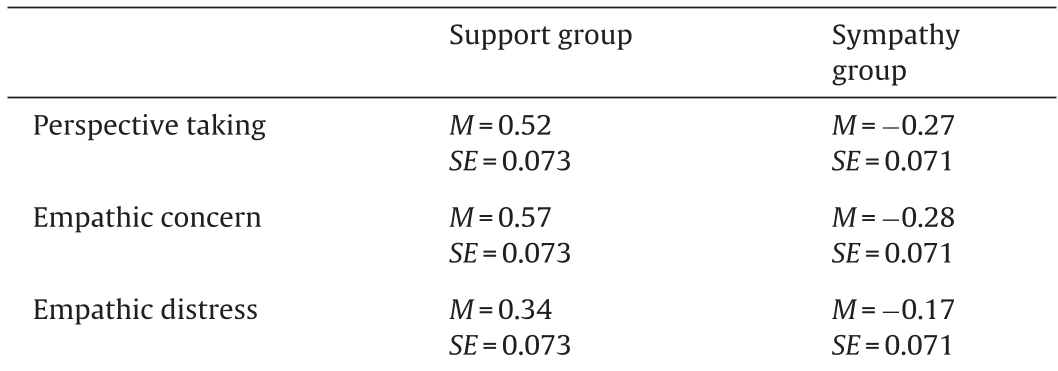 Table 2: Mean empathy levels across Support and Sympathy groups. The disparity suggests we purposefully withhold empathy from those outside our inner circle to avoid emotional burnout.
Critical Analysis & Conclusion
The study confirms that empathy is not an "always-on" trait. Instead, it functions as a limited resource. We have a "budget" for how much emotional distress and concern we can handle. To keep our "support group" stable, we selectively invest our empathic energy there, while maintaining a more "empathy-lite" relationship with the rest of our network.
Takeaway: If you want to expand your inner circle, it’s not just about meeting more people; it’s about your capacity for Empathic Concern.
Limitations: The study relies on a relatively small sample (80 Americans) and cross-sectional data. Future research should investigate if "empathy fatigue" in high-stress professions (like medicine) leads to a shrinking of personal support groups, as the "empathy budget" is exhausted at work.
Perspective: This work pushes the Social Brain Hypothesis into a more "human" territory, acknowledging that our social world is built on a foundation of shared feelings, not just shared data.