
From Beacon to Browser: The Empire State Building as a Supermodern Interface
The empire state building and the roles of low-resolution media façades in a data society
This paper explores the evolution of the Empire State Building’s low-resolution media façade from a 1930s beacon to a modern, data-reactive LED system. It frames these programmable surfaces as "supermodern" architectural tools that transform physical monuments into communicative interfaces via social media and public data visualization.
TL;DR
In a society saturated with data, the Empire State Building has evolved from a silent 1930s monolith into a "supermodern" communicative interface. By leveraging low-resolution LED façades and social media, iconic architecture now functions as a "public data visualization" tool—mapping digital sentiment onto the urban skyline to create temporary, intense public experiences.
The Problem: Static Stone in a Dynamic Data Society
Historically, architecture was built for permanence. However, in our "supermodern" era—defined by French anthropologist Marc Augé as a state of excessive information and rapid dissemination—static monuments can feel disconnected from the fluid pulse of the city. The challenge identified by Dave Colangelo is how to ground the "infoscape" (our digital reality) into the "cityscape" (our physical reality) without succumbing to historical amnesia or purely commercial spectacle.
Methodology: Decoding the "Associated Media"
Colangelo argues that a media façade is never just about the lights; it is a composite dispositif. This means the physical light must be decoded through "associated media"—radio, TV, and increasingly, Twitter and Instagram.
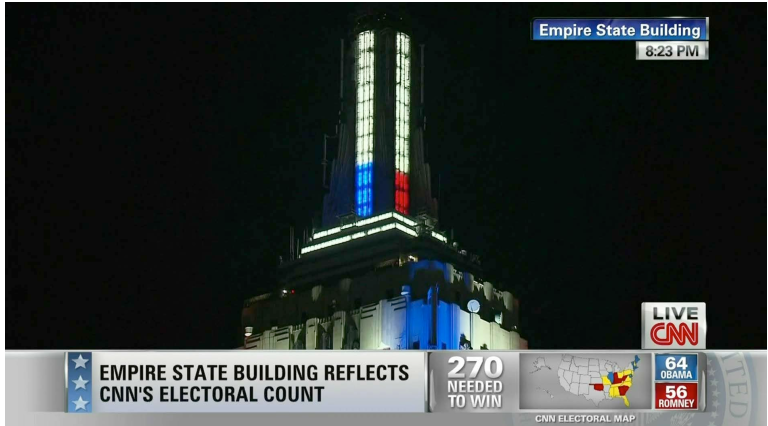 Figure: The 2012 Election night visualization, where the mast acted as a real-time tally for electoral votes.
The researcher analyzed the @EmpireLights feed, discovering that the building’s "semiotic resources" are now spent on a frenetic cycle of causes, commercial promotions, and sports, creating what Scott McQuire calls Relational Space—a space where meaning is contingent and ambivalent.
The "Supermodern" Shift: Why Low-Res Works
Why use low-resolution LEDs instead of high-def screens? The paper suggests that low-res architecture creates a "personal subjective experience" of living in a data society.
- Scale vs. Detail: By compressing vast data into simple color pulses, the building becomes an "affective beacon" that a whole city can feel at once.
- Mapping: Visualizing data on an iconic tower (Mapping) borrows the building’s historical authority to heighten the importance of the data (e.g., election results or social messages).
- Participation: Modern façades allow for "prosumption." During the 2014 Super Bowl, fans could vote on the tower's color via #WhosGonnaWin, turning the monument into a two-way street.
Research-Creation: Architecture as Activism
The author puts theory into practice with two critical projects:
- E-TOWER (2010): Transformed Toronto’s CN Tower into an "energy" visualization driven by SMS participation.
- In The Air Tonight (2014): Used the Ryerson Image Centre to visualize #homelessness. Every time the hashtag was used on Twitter, the building pulsed red, bringing a marginalized issue to the center of the urban gaze.
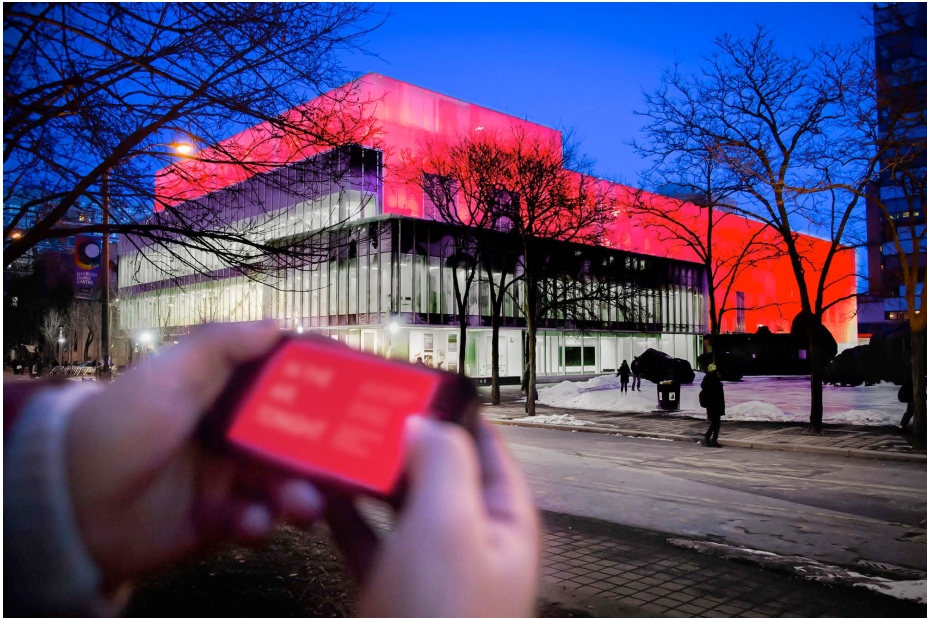 Figure: The Ryerson Image Arts Building reflecting social data in real-time.
Critical Insight & Conclusion
While these façades offer exciting potential for "democratized urbanism," Colangelo warns of the "inescapable corporatization" of these tools. Because these buildings are often private or tightly guarded tourist hubs, true "socially engaged" practice requires navigating strict gatekeeping and editorial control.
The Takeaway: The Empire State Building is no longer just a skyscraper; it is a shared resource and a critical site for public debate. As we move forward, the city itself will increasingly "talk and listen," requiring us to become "avant-garde readers and writers" of the contingent, ambivalent city.