
Navigating the Four Pillars: An Empirical Blueprint for Modern Financial IT Strategy
An Empirical Analysis of Cloud, Mobile, Social and Green Computing
This paper provides an empirical analysis of the adoption of Cloud, Mobile, Social, and Green computing within the financial services sector. Based on qualitative interviews with 15 CIOs and senior technology executives, it proposes an integrated framework for aligning these emerging technologies with IT strategy and enterprise architecture.
TL;DR
This research decodes how financial industry leaders (CIOs and CTOs) perceive and integrate Cloud, Mobile, Social, and Green computing. It moves beyond the hype to provide a structured, risk-aware framework for enterprise architecture that balances the agility of emerging tech with the rigorous security demands of global banking.
The Tension: Innovation vs. Regulation
In most industries, "moving fast and breaking things" is a mantra for growth. In financial services, breaking things leads to regulatory fines and loss of public trust. The authors identify a critical gap: while technologies like Cloud Computing offer undeniable scalability, the industry faces severe "De-motivators" such as local banking act hurdles and the risks of data co-mingling in public clouds. This paper explores how executives reconcile these tensions to build a future-proof IT strategy.
Methodology: Insights from the Top
The study isn't just theoretical; it’s an empirical deep dive into the minds of 15 senior technology executives from major institutions like UBS, Deutsche Bank, and Barclays Capital. Using a qualitative content analysis, the researchers distilled hundreds of pages of interview transcripts into a coherent map of technology adoption.
The Integrated Architectural View
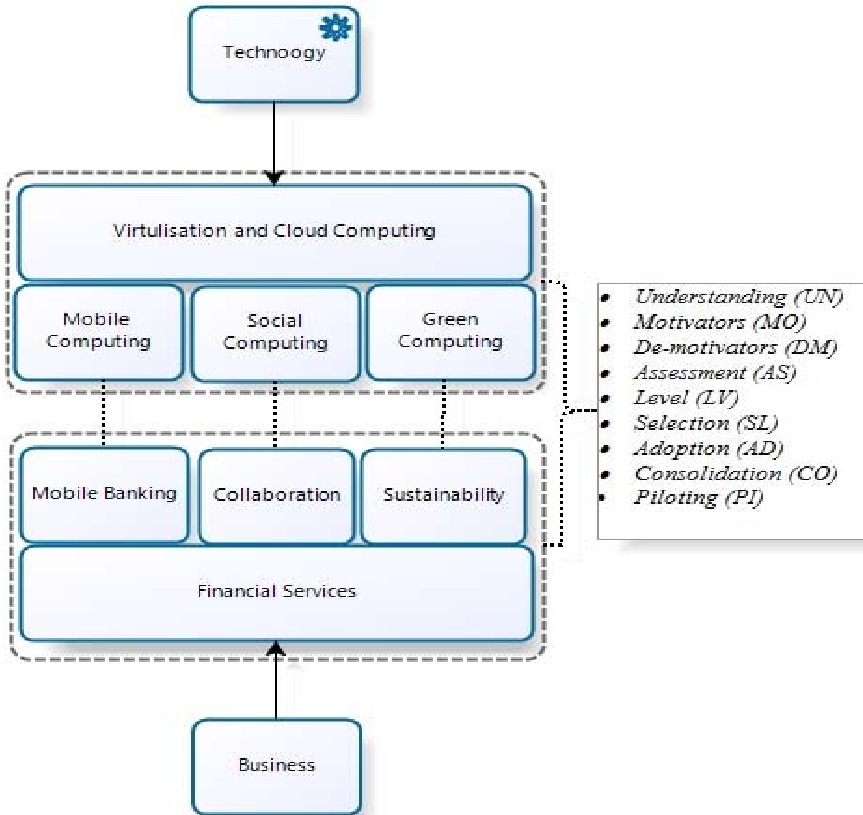
One of the paper's most profound contributions is the Integrated View of these four disparate technologies. Instead of viewing them as silos, the study positions them as an ecosystem:
- Cloud & Virtualization: The foundational layer providing Platform-as-a-Service (PaaS).
- Mobile & Social Computing: The delivery and interaction layer (SaaS) that enhances customer experience and co-creation.
- Green IT: The sustainability layer, optimizing the physical infrastructure to reduce costs and environmental impact.
Key Findings across the Four Pillars
1. Cloud: The Prudent Transition
Executives view Cloud as a "logical child of virtualization." However, adoption is cautious and phased. The consensus is to start with private clouds behind firewalls for development and testing environments before even considering public cloud migration for sensitive customer data.
2. Mobile & Social: The Engagement Drivers
Unlike Cloud, Mobile and Social technologies are met with massive optimism. Mobile Banking is seen as a way to make traditional credit cards redundant and reduce fraud. Social Computing is perceived as a "mass collaboration" tool for better understanding customer sentiment and "co-creating" financial products.
3. Green IT: Beyond Symbolism
Green computing is no longer a PR stunt. CIOs now recognize it for real material advantages, specifically lowering electricity costs and streamlining data center efficiencies. However, there is a noted need for better technology to "meter" and track these benefits.
The Four-Stage Adoption Framework
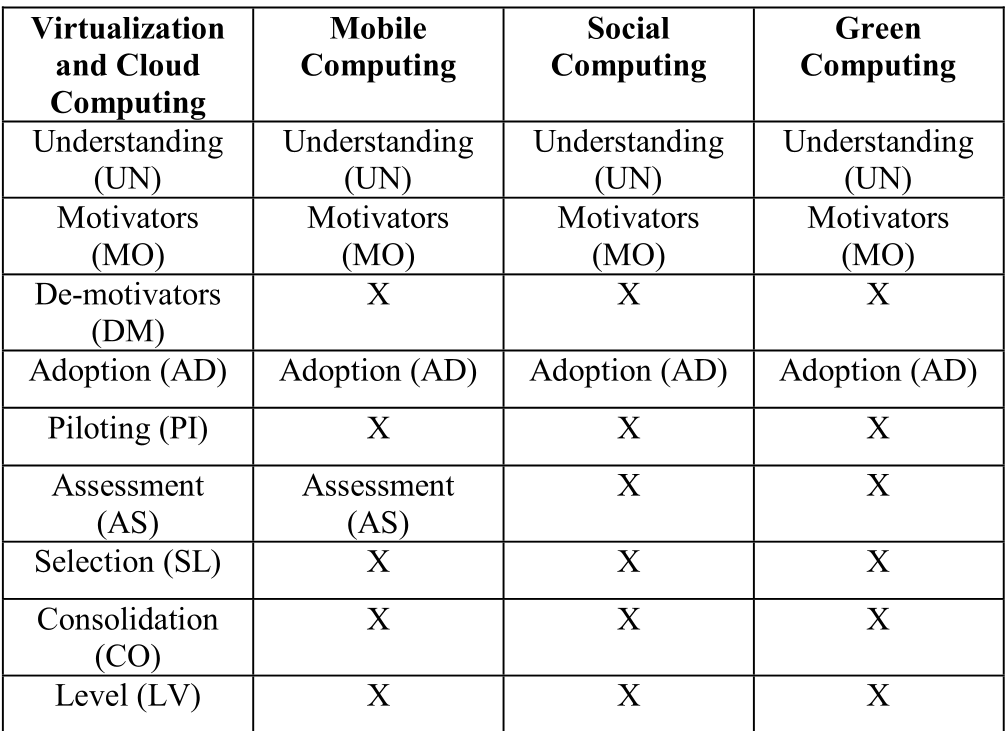
The paper concludes by proposing a systematic rhythm for technology integration:
- Context-awareness: Understanding the local organizational environment.
- Assessment: Evaluating readiness and target virtualization levels.
- Selection: Picking specific services (e.g., non-sensitive back-office) for migration.
- Adoption & Improvement: Iterative piloting to manage risk.
Critical Insight & Conclusion
The true takeaway of this study is that technology is only as good as the people behind it. Financial institutions are not just looking for "faster servers"; they are looking for "low risk, people-oriented" transitions. While Mobile and Social lead the charge in customer-facing innovation, the backbone of the industry remains tethered to a very cautious, virtualization-first Cloud strategy.
Limitations & Future Work
The study was conducted in a specific 2011 timeframe; while the core principles of Enterprise Architecture remain valid, the "Level of Adoption" was noted as "Unknown" at the time. Future research must look at how AI and Blockchain have further complicated this four-pillar model, potentially adding a fifth pillar to the financial services IT stack.