
Designing for "Birds of a Feather": How Crowdsourcing and Homophily Drive Knowledge Generation
Empirically Analysing Knowledge Generation Framework in Student Homophily Through Crowdsourcing
This paper introduces a knowledge generation framework specifically designed for "student homophily"—the tendency of learners to associate with similar peers. Utilizing a crowdsourcing-based visual platform called WiseMapping, the study demonstrates how groups of homogeneous students can achieve higher academic performance and more meaningful knowledge co-construction compared to traditional methods.
TL;DR
In the world of collaborative learning, students naturally gravitate toward peers who share similar characteristics—a phenomenon known as homophily. This paper presents a novel framework that turns this social instinct into an academic advantage. By using a crowdsourcing platform called WiseMapping and structured Knowledge Graphs, the researchers successfully channeled peer similarity into a rigorous process of knowledge negotiation, significantly boosting academic performance, especially for mid-tier students.
Background: The Power of Similarity
Why do some study groups fail while others thrive? According to Similarity Attraction Theory, individuals are more attracted to those who mirror their own traits, leading to higher trust and smoother communication. When combined with Social Identity Theory, this creates a sense of belonging that should facilitate knowledge sharing. However, without a structured framework, these "homogeneous" groups often fall into "off-topic" traps or superficial agreements.
The authors argue that the missing link is a Knowledge Generation Framework that utilizes the scalability of crowdsourcing and the visual clarity of Knowledge Graphs.
The Proposed Knowledge Generation Framework
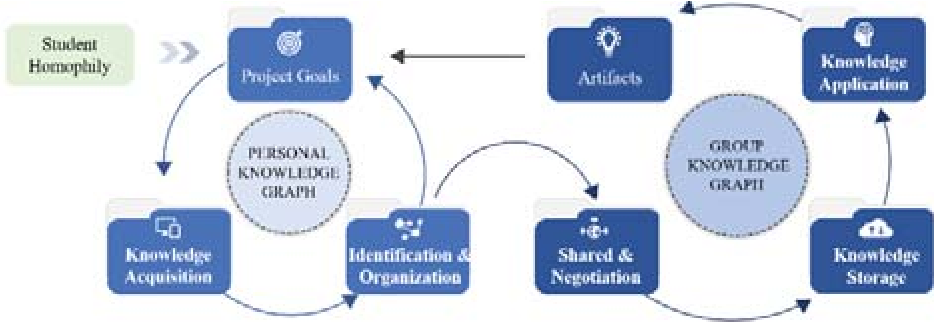
The framework (shown in Fig. 1) transforms raw information into collective intelligence through five cyclical stages:
- Knowledge Acquisition: Activating prior knowledge and identifying gaps.
- Identification & Organization: Externalizing concepts into Personal Knowledge Graphs.
- Shared & Negotiation: The "clash of ideas" where personal graphs are merged into a group graph.
- Storage: Cloud-based maintenance of the evolved knowledge system.
- Application: Using the co-constructed artifacts to solve real-world problems (e.g., the paper bridge-building task).
Cracking the Code of Interaction
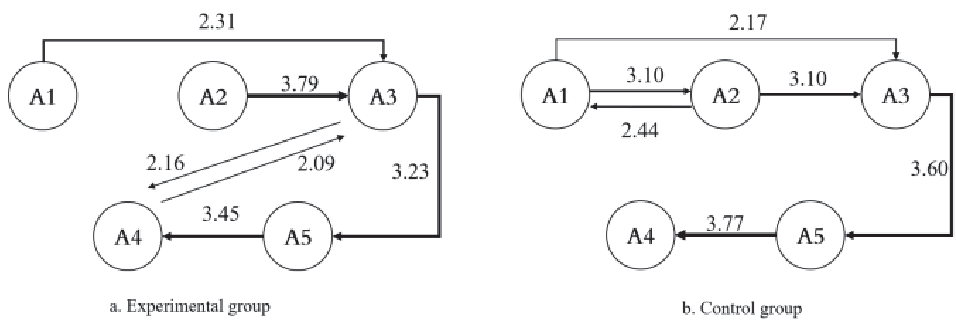
The researchers conducted a quasi-experimental study using 24 undergraduates. By applying Lag Sequential Analysis (LSA), they visualized the "behavioral DNA" of student interactions.
The "Negotiation Loop" vs. The "Irrelevant Circle"
- The Crowdsourcing Group (Success): Exhibited frequent transitions between "Meaning Negotiation" (A3) and "Testing/Modification" (A4). They didn't just agree; they argued, tested, and refined.
- The Traditional Group (Stagnation): Trapped in a loop between "Knowledge Sharing" (A1) and "Inconsistency" (A2). They noticed differences but lacked the mechanism to resolve them, often leading to off-topic discussions.
Key Results: Lifting the "Middle"
The experiment yielded three major insights:
- Homophily is Real: Pre-test results confirmed that students naturally choose partners with similar academic performance levels.
- Performance Boost: The experimental group achieved a post-test score of 9.04 vs 8.44 in the control group.
- The "Middle" Breakthrough: Intermediate-score students benefited most, jumping from 8.66 to 9.44. The structured framework provided the "scaffolding" these students needed to engage in high-level cognitive negotiation.
| Group Category | Pre-test Mean | Post-test Mean (Exp) | p-value |
|---|---|---|---|
| High-score | 9.21 | 9.50 | 0.096 |
| Intermediate | 8.66 | 9.44 | 0.009 |
| Low-score | 7.56 | 8.78 | 0.049 |
Critical Insight & Conclusion
The true value of this work lies in its rejection of the "diversity for diversity's sake" dogma. Instead of forcing students into heterogeneous groups that might suffer from friction and low trust, the researchers leveraged homophily as a psychological safety net. By providing a technical framework (WiseMapping) to guide that social energy, they turned "similar peers" into "collaborative experts."
Future Outlook: While effective, the study is limited by its small sample size and focus on behavioral data. Future iterations should incorporate cognitive data (such as eye-tracking or EEG) to see if these frameworks truly reduce the cognitive load of knowledge generation.