
The Social Capital Lens: How Enterprise 2.0 Reshapes Organizational Ties
An Empirical Analysis on Social Capital and Enterprise 2.0 Participation in a Research Institute
This empirical study explores the relationship between Social Capital and Enterprise 2.0 participation within a research institute (FBK). By deploying the open-source "Taolin" platform and analyzing survey data from 362 employees, the research establishes that platform users possess significantly higher bridging and bonding social capital compared to non-users.
TL;DR
Does internal social networking actually make employees better connected, or is it just another digital distraction? This empirical study from Fondazione Bruno Kessler (FBK) confirms that employees who use internal "Enterprise 2.0" platforms exhibit significantly higher Social Capital. However, it unearths a fascinating paradox: the more someone uses the system, the more they realize how little they actually know about the vast expanse of their organization.
Context: Beyond the Water Cooler
In the academic and corporate world, Social Capital—the value derived from your network of relationships—is as critical as financial or human capital. While we've long understood how Facebook affects personal lives, the impact of internal social networks (Enterprise 2.0) on professional collaboration has remained under-researched.
The authors implemented an open-source SNS called Taolin at a research institute and set out to validate the theories of Steinfield et al. by comparing active users against a control group of non-users.
The Methodology: Deconstructing Connection
The researchers didn't just ask "do you like the app?" They used Factor Analysis to break Social Capital into five distinct technical dimensions:
- Bonding: Strong ties (e.g., "Who can I borrow 300 Euros from in an emergency?").
- Access to New People: Bridging weak ties across research groups.
- Citizenship: The willingness to mentor or assist others.
- Desire for Networking: The cognitive drive to find new collaborators.
- Knowledge of Colleagues: The self-perceived awareness of what others do.
The Data Sources
The study is rigorous because it triangulates three data points:
- Subjective Surveys: (54% response rate from 670 employees).
- Objective Logs: Real-world data on logins, chat messages, and profile views.
- Demographics: Age, seniority, and contract type.
Key Insights: Success and Surprises
1. The User Advantage
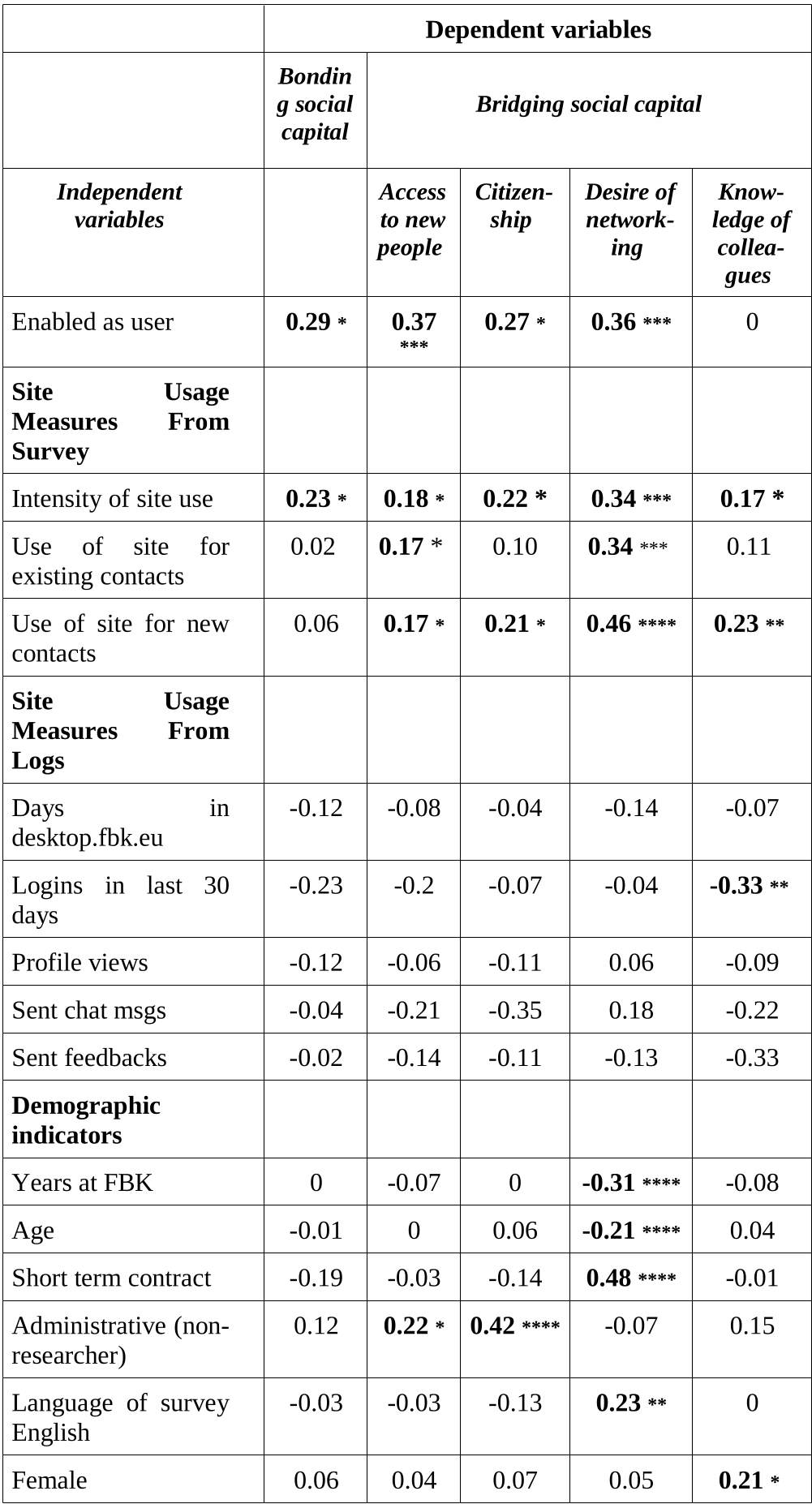
Being "enabled" as a user was a massive predictor of social capital. It showed a high correlation (p<.001) with Access to New People. In a research environment where silos are common, the platform acted as a bridge, allowing researchers to "give a face" to names they saw on publications but never met.
2. The Heavy User Paradox
The most striking finding was the negative correlation between Logins and Knowledge of Colleagues.
- Intuition: You’d expect heavy users to say "I know everyone!"
- Reality: Frequent users saw the constant flow of new profiles and diverse research areas. This "unveiling" effect gave them a more realistic—and therefore lower—assessment of their total knowledge. They became aware of the "known unknowns."
3. Demographics and the "Newcomer Incentive"
The data showed that younger employees and those on short-term contracts had a significantly higher Desire for Networking (p<.0001). For these individuals, the Enterprise 2.0 platform isn't just a social tool; it's a critical career survival mechanism to find potential long-term collaborators before their contract expires.
Critical Analysis & Conclusion
This paper provides empirical evidence that internal social platforms are not merely "Facebook for work" but are infrastructure for Organizational Citizenship.
Limitations: The study is cross-sectional, meaning we can't definitively say if the platform creates social capital or if people with high social capital are simply more likely to use the platform (selection bias). However, the positive correlation across almost all bridging metrics suggests a reinforcing loop.
Future Outlook: For modern organizations, the takeaway is clear: enterprise social tools are most effective when they focus on Identity ("Giving a face to a colleague") and Discoverability. As the authors released their platform as open-source, the door is open for other institutions to replicate these findings in the era of hybrid and remote work.
Dataset and Software: The Taolin platform and the collected dataset have been released as open-source to promote institutional transparency and further research.