
Empowering Pharmacovigilance: Empirical Bayesian Data Mining in Drug Safety
Empirical Bayesian data mining for discovering patterns in post-marketing drug safety
This paper presents WebVDME, a web-based visual data mining environment designed for pharmacovigilance. It leverages the Multi-Item Gamma Poisson Shrinker (MGPS) algorithm—an empirical Bayesian approach—to detect disproportionately frequent drug-adverse event associations in massive post-marketing databases like the FDA's AERS.
Executive Summary
TL;DR: This paper details the development of WebVDME, a professional-grade visual data mining platform that utilizes the Multi-Item Gamma Poisson Shrinker (MGPS) algorithm. By applying empirical Bayesian statistics to massive adverse event databases, it enables medical experts to distinguish genuine safety "signals" from statistical noise, even in complex polytherapy and drug-interaction scenarios.
Context: Published during a pivotal shift in drug safety, this work moves pharmacovigilance from reactive case-by-case monitoring to proactive, statistically-driven surveillance. It sits as a cornerstone in the transition of KDD (Knowledge Discovery in Databases) from academic theory to regulatory and industrial practice.
The "Denominator Problem" and the Noise in Safety Data
In the world of drug safety, the gold standard is the clinical trial. However, trials are often too small or too short to detect rare side effects. Once a drug hits the market, millions use it—often alongside other medications. This leads to spontaneous reporting databases (like the FDA's AERS).
The challenge? These databases are "dirty." They contain duplicates, inconsistent naming (trade vs. generic), and no information on how many people took the drug without having a reaction (the missing denominator). Traditional statistical tests often fail because:
- Small Cell Counts: A single report of a rare event can create a massive, but misleading, "Relative Risk."
- Simpson’s Paradox: Interactions can be masked by age, gender, or year of report.
- Complexity: How do you tell if an event is caused by Drug A, Drug B, or the specific combination of A and B?
Methodology: The Logic of "Shrinkage"
The core of the system is the MGPS algorithm. Instead of relying on a simple ratio of Observed (N) to Expected (E) counts, MGPS assumes that all drug-event combinations belong to a "super-population."
1. Bayesian Shrinkage
If the count (N) is very small, the algorithm "shrinks" the reporting ratio toward the average. As N increases, the estimate becomes more confident and moves closer to the raw N/E value. This drastically reduces false alarms caused by rare, coincidental reports.
2. Multi-Item Associations
One of the paper's major contributions is the ability to handle n-way associations. By using an "all-2-factor" model, the system can ask: "Is the risk of this triple (Drug A + Drug B + Event) higher than what we would expect just by knowing the risks of A+Event and B+Event?"
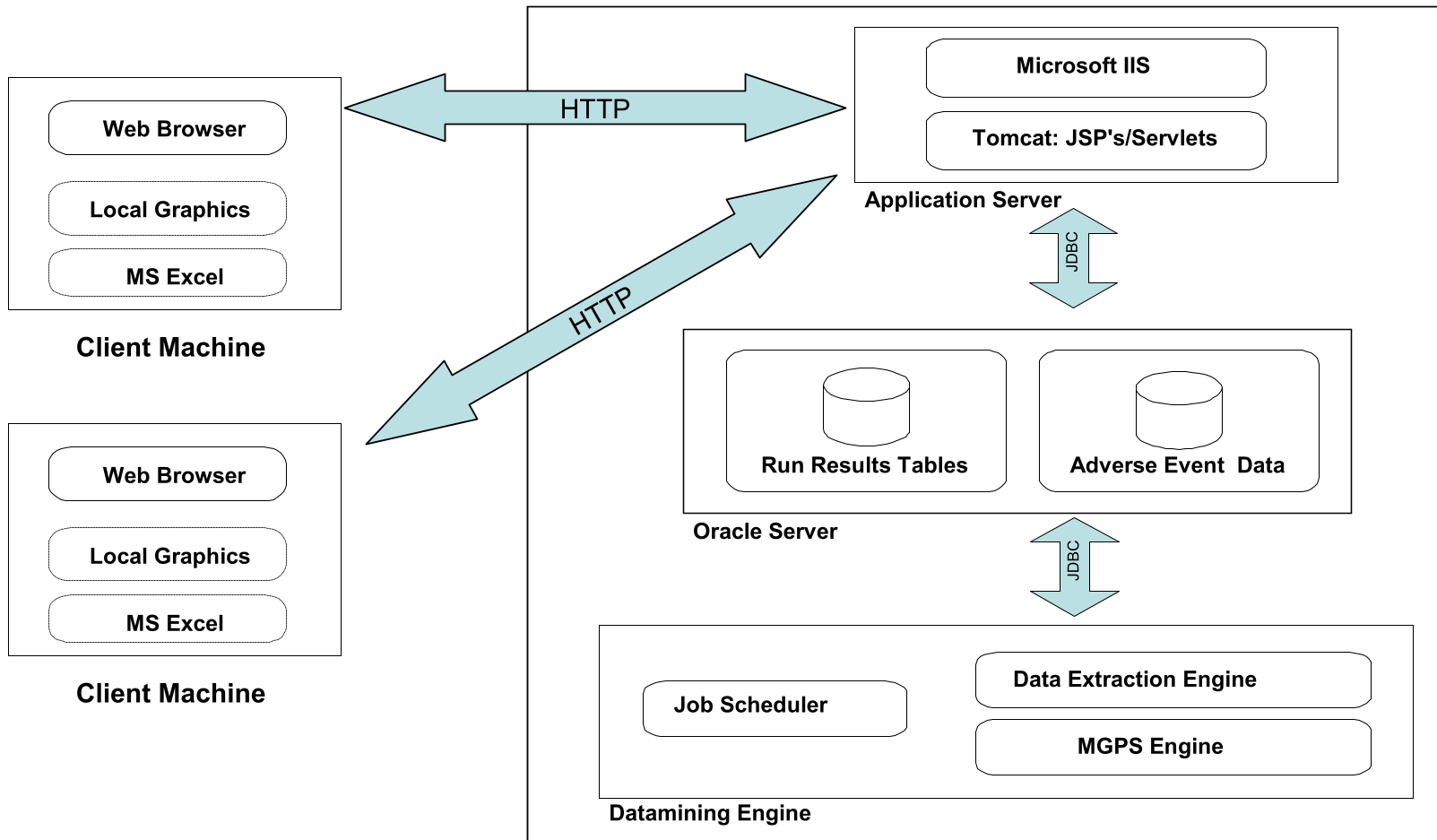
Transforming Data into Insight
The paper emphasizes that a "black box" algorithm is useless to a doctor. WebVDME was developed to wrap this math in a web-based GUI that allows for:
- Filtering by EB05: Only looking at signals where the lower bound of the 95% confidence interval (EB05) is greater than a threshold (e.g., 2.0).
- Temporal Tracking: Seeing how a signal grows over time as new reports come in.
- Case Drilldown: Moving from a statistical graph directly to the individual patient narratives that generated the signal.
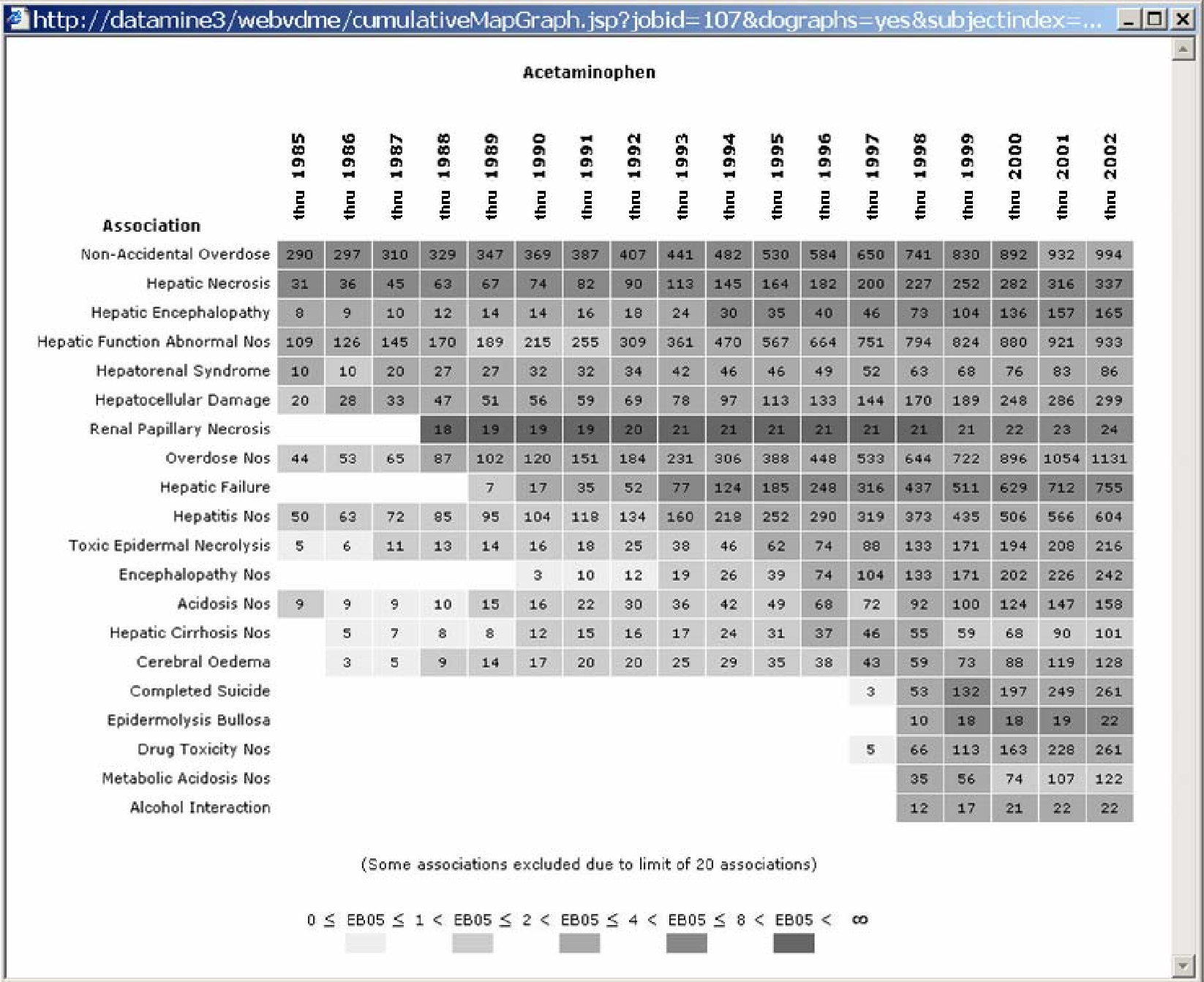 The figure above illustrates how safety signals for Acetaminophen evolved over years, highlighting the system's ability to provide a chronological "heatmap" of emerging risks.
Experimental Deployment at GSK
The system was tested on GlaxoSmithKline’s internal "OCEANS" database. It proved effective in:
- "Innocent Bystander" Problems: Identifying which drug in a cocktail was the likely culprit for a side effect.
- Special Populations: Comparing signal strengths between pediatric and adult populations to determine if clinical trials in specific groups were warranted.
Critical Insight & Future Outlook
The genius of this work isn't just the Bayesian math—it's the engineering of the data pipeline. The authors spent significant effort on "data squashing" (to speed up likelihood estimation) and "fuzzy-equality" matching (to remove report duplicates).
Takeaway for Today: While modern AI (LLMs, Neural Nets) is now entering this space, the Empirical Bayes approach remains a regulatory standard because of its interpretability. You can mathematically explain why a signal was flagged, a feature often missing in "black-box" deep learning models.
Limitations: The system still relies on spontaneous reports. If a doctor doesn't report it, the system can't see it. The next frontier, hinted at by the authors, involves integrating these tools with real-world healthcare records to solve the "denominator problem" once and for all.