
Hybrid Recommenders: Balancing Precision and Coverage via Social Graph Dynamics
An empirical comparison of social, collaborative filtering, and hybrid recommenders
This paper presents a comprehensive empirical comparison between social-based, collaborative filtering (CF), and hybrid recommendation systems using the Filmtipset dataset. It specifically introduces a user coverage metric to address the limitations of precision-only evaluations and proposes a novel dynamic weighting strategy for hybrid models based on graph-theory measures.
TL;DR
While social-based recommenders often boast high accuracy, they suffer from a "sparsity trap" where they cannot serve users without explicit friends. This research identifies a critical trade-off between Precision and User Coverage. By implementing dynamic hybrid models that use graph-theory indicators (like PageRank) to adjust weights per-user, the authors achieve a "best-of-both-worlds" scenario: the broad reach of Collaborative Filtering with the surgical accuracy of Social Recommendations.
The "Hidden" Problem: The Coverage Gap
In the academic evaluation of Recommender Systems (RS), we often focus on Precision or RMSE. However, the authors argue that this is deceptive. If a model is 90% accurate but can only provide recommendations for 5% of users (because they lack social links), is it truly a "better" model?
The authors highlight that Social Recommenders have high accuracy but low coverage, whereas Collaborative Filtering (CF) has high coverage but relatively lower accuracy. The goal of this work is to navigate this Pareto frontier.
Methodology: The Hybrid Spectrum
The paper explores three primary architectures to merge these distinct signals:
- Combined Neighborhoods: Merging a user's explicit friends with their "nearest neighbors" (based on rating similarity) into a unified calculation.
- Random Walk with Restarts (RWR): Utilizing the social-item graph as a Markov chain. The model simulates a "walker" moving through users and items, with a restart probability that anchors the walker to the target user's known preferences.
- Dynamic Hybridization (The Core Innovation): Instead of a static linear combination (s = (1-\lambda)s_{CF} + \lambda s_{Social}), the authors propose (\lambda(u_m) = f(u_m)).
Architecture of the Data Model
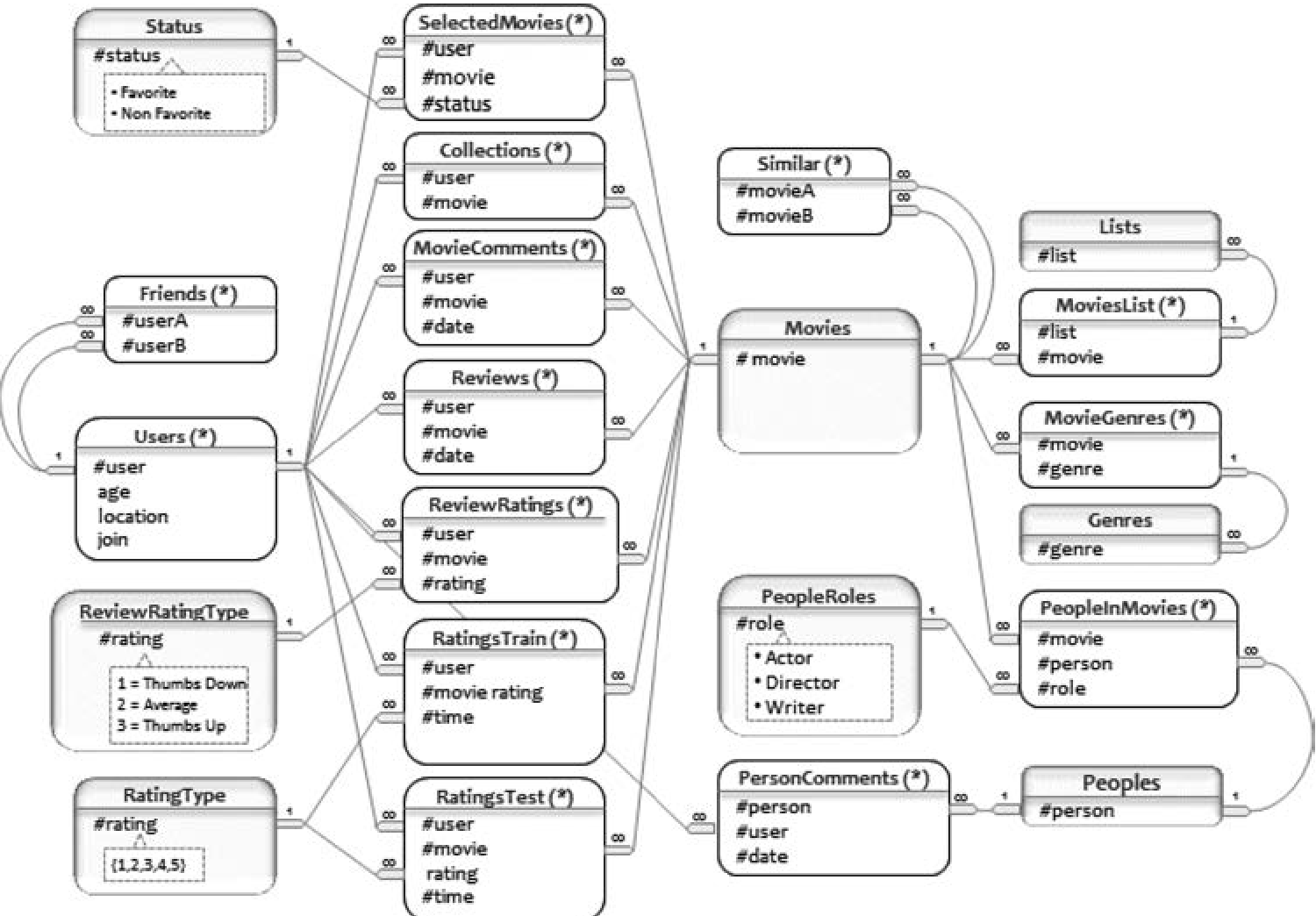
The following diagram illustrates the complex entity relationships within the Filmtipset dataset, showcasing how social links, ratings, and item attributes are intertwined.
Insights from the Social Graph
The authors discovered that "Socially Important" users—those with high PageRank or Centrality—derive much more value from social-based recommenders. Conversely, "isolated" users are better served by CF.
By using Graph Measures as indicators, the system automatically dials up the social signal for "influencers" and dials it down for "lurkers," as shown in the performance comparison below:
| Indicator | NDCG@50 (H1) | P@5 (H1) |
|---|---|---|
| PageRank (Dynamic) | 0.303 | 0.227 |
| Static (\lambda=0.5) | 0.266 | 0.186 |
| Best Static (Post-hoc) | 0.303 | 0.218 |
Note: The dynamic approach often exceeds even the best "manually tuned" static weight, because it optimizes at the individual level rather than the population average.
Experimental Validation: The Sparsity Test
The authors conducted a "Collaborative-Social Evaluation" by introducing users with zero social ties into the test set.
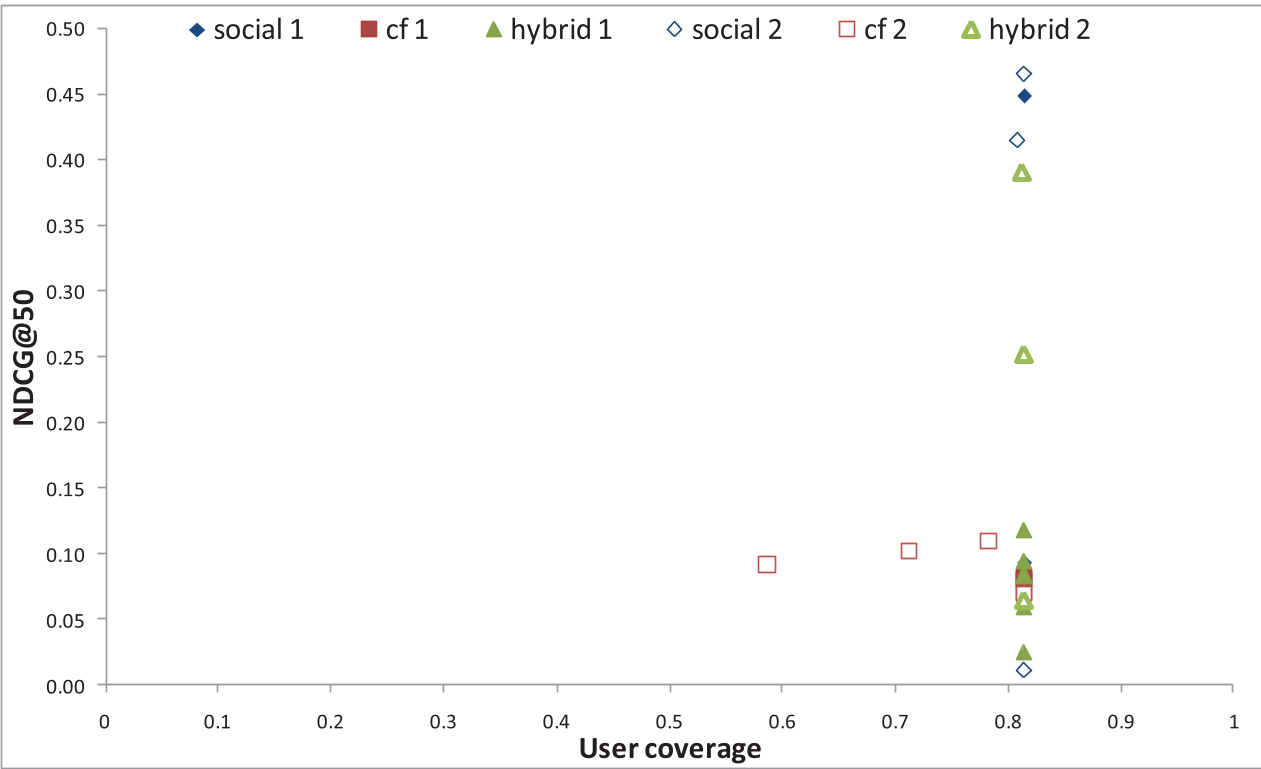
As seen in the results, Pure Social methods collapse in coverage as the network gets sparser. The Hybrid Combined models (the filled markers) maintain a much more stable position, proving their robustness in realistic, "cold-start" prone environments.
Critical Analysis & Conclusion
The true value of this paper lies in its movement away from "Precision-at-all-costs." By introducing User Coverage as a first-class citizen in evaluation, the authors provide a framework that is much more aligned with industrial needs.
Key Takeaways:
- The Overlap Threshold: Increasing the minimum number of neighbors required for a recommendation improves precision significantly but executes a "coverage tax."
- PageRank as a Weight: Among all graph measures, PageRank was the most consistent indicator for weighting social vs. CF signals.
- Hybridity is Essential: For any platform where social interaction is optional, a hybrid model is not just an optimization—it is a requirement for service availability.
Future Outlook: The methodology could be extended by replacing graph distance with "latent distance" from Matrix Factorization or Deep Learning embeddings, potentially allowing the social logic to function even in the absence of an explicit social graph.