
Beyond the CAL Myth: Optimizing Active Learning in Legal Document Review
Empirical evaluations of active learning strategies in legal document review
2017-12-01
Summary
Problem
Method
Results
Takeaways
Abstract
This paper evaluates three training selection strategies—Top-Ranked (Continuous Active Learning), Uncertain, and Random—within legal document review (Technology Assisted Review). Using five real-world legal datasets, it challenges the consensus that Top-Ranked selection is always superior, establishing a new "Optimum Performance" metric.
## TL;DR
In the high-stakes world of legal discovery, "Continuous Active Learning" (CAL) using top-ranked documents is often viewed as the ultimate efficiency tool. However, this empirical study of five real-world legal datasets reveals a surprising truth: **Top-Ranked selection is often the least efficient strategy.** By shifting to "Uncertainty" or even "Random" sampling, legal teams can reach target recall levels (75%-90%) significantly faster, potentially saving thousands of hours in manual document review.
## The Legal Industry's Multi-Million Dollar Bottleneck
Electronic discovery (e-discovery) is a logistical nightmare. In modern litigation, attorneys must wade through millions of emails and documents to find "responsive" evidence. Manual review accounts for a staggering **73% of total production costs**.
To combat this, the industry adopted **Technology Assisted Review (TAR)**. The current state-of-the-art is **Continuous Active Learning (CAL)**, which focuses on reviewing the highest-scoring (top-ranked) documents. The logic seems sound: review the most likely "wins" first. But the authors of this paper ask a critical question: *Does selecting only top-ranked documents actually build the best model, or does it just create an echo chamber of similar content?*
## The Experiment: Real Data vs. Industry Dogma
Unlike many studies that use the aging Enron dataset, this research utilized five confidential, real-world datasets from matters involving intellectual property and regulatory investigations.
The researchers compared three primary selection strategies:
1. **Top-Ranked**: Selecting documents the model is most confident are responsive.
2. **Uncertain**: Selecting documents where the model is least confident (scores near 0.5).
3. **Random**: Pure stochastic selection.
### Methodology: Defining "Optimum Performance"
The authors introduced a vital new metric: **Optimum Performance**. This is the "sweet spot" in the review process where the total number of documents an attorney has to look at (Training Set + Predicted Responsive Set) is at its absolute minimum for a specific recall goal.
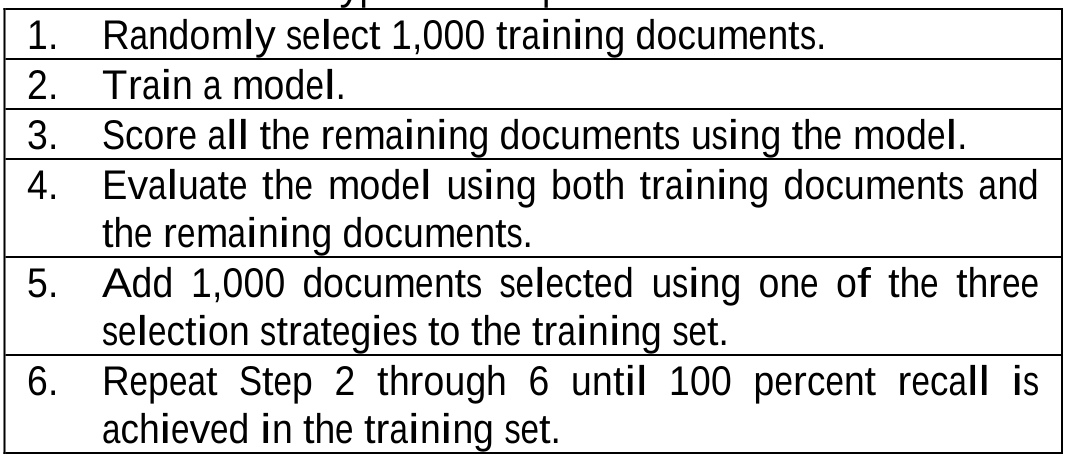
*Table 3: The Type Two experimental workflow used to simulate real-world review scenarios.*
## Key Insights: Why Top-Ranked Fails Early
The findings were a wake-up call for the legal community:
* **Convergence Speed**: The **Uncertainty** strategy reached optimum performance far earlier than Top-Ranked. In one dataset (Data Set B), Uncertainty hit the 90% recall target in just **63 rounds**, while the "popular" Top-Ranked strategy took **248 rounds**.
* **Content Redundancy**: Top-Ranked selection tends to pick documents that look exactly like what the model already knows. It fails to "explore" the document space, leaving the model blind to different types of responsive documents.
* **The Power of Randomness**: In low-richness datasets (where responsive documents are rare, e.g., 4%), **Random sampling** was surprisingly effective at identifying a broad range of informative documents early on, outperforming sophisticated AI selection.
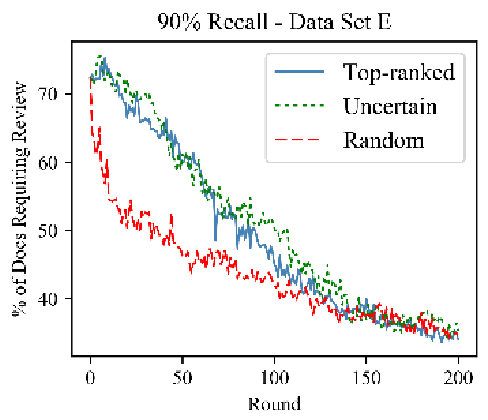
*Figure 2: Performance curves showing that while Top-Ranked (CAL) excels at finding responsive documents during training, it lags in overall model improvement compared to Uncertainty sampling.*
## Results: Quantifying the Efficiency Gap
The study proves that at high recall rates (90%), the Uncertainty strategy consistently requires fewer documents to be reviewed.
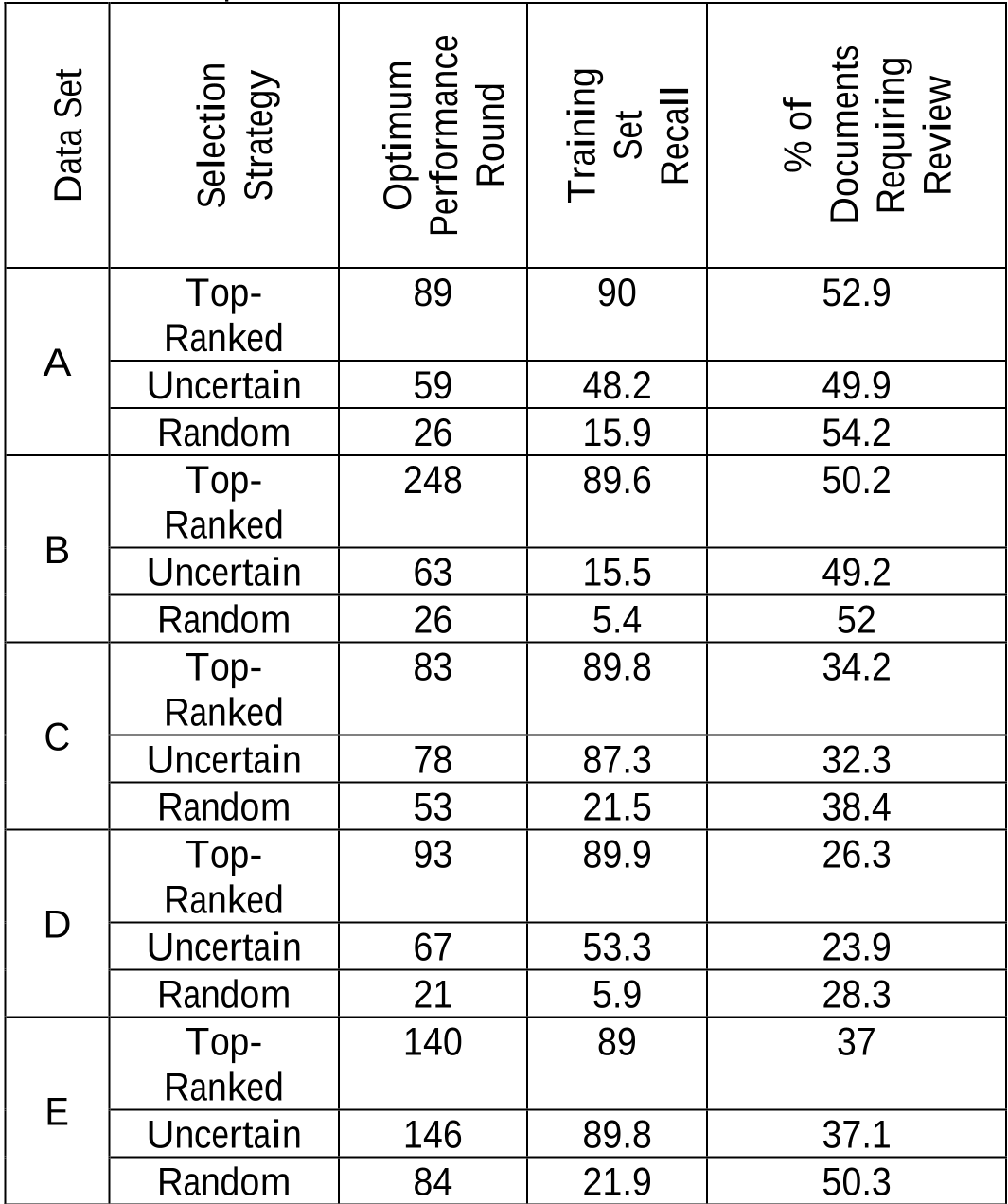
*Table 5: Statistics at 90% Recall. Note how "Uncertain" often reaches the target in nearly half the rounds required by "Top-Ranked."*
## Tactical Recommendations for Legal Professionals
The paper concludes with a call for a **Hybrid Methodology**:
1. **Initiate with Uncertainty or Random Sampling**: Use these strategies to build a robust, diverse understanding of the "responsive" landscape quickly.
2. **Monitor for Optimum Performance**: Don't just keep training until the end. Identify the point where model improvement plateaus.
3. **Transition to Batch Review**: Once the model is mature, stop active learning and use the model's predictions to identify the remaining responsive documents in bulk.
## Final Thoughts
This research debunks the myth that more "AI features" (like continuous Top-Ranked selection) always lead to more efficiency. By understanding the **Inductive Bias**—the tendency of CAL to ignore diverse evidence—legal teams can move from "guessing" which documents to train on to a mathematically optimized workflow. The future of e-discovery isn't just about "Active" learning; it's about *Smarter* Active Learning.