
The Resilience of Trust: How Similarity Drives Social Network Dynamics
An Empirical Investigation of Similarity-Driven Trust Dynamics in a Social Network
This study investigates the empirical relationship between user preference similarity and trust dynamics within social networks using a controlled experiment with computer agents. It evaluates how human trust fluctuates when faced with "shocks" (unexpected dissimilarity) and compares this human behavior against a normative Naïve Bayes model.
TL;DR
In modern social networks, we are constantly bombarded with recommendations based on "similarity." This paper investigates the cognitive mechanics behind this: How does our trust in someone change when they suddenly disagree with us? Through a controlled experiment with hidden AI agents, researchers found that while our trust takes a massive hit during a "shock" of dissimilarity, it recovers with surprising speed—far faster than traditional Bayesian models would predict.
Problem & Motivation: Beyond Static Similarity
Recommender systems (like those on Amazon or Netflix) often assume that if you liked what I liked in the past, you will like what I like in the future. This is the core of Collaborative Filtering. However, human relationships are not static. Trust fluctuates.
The researchers identified a critical gap: Dynamic Trust Resilience. Most current algorithms do not understand "The Shock Event"—the moment a trusted peer provides a recommendation that completely contradicts your worldview. Does trust break forever, or is it elastic? Understanding this is vital for building "human-centered" AI that mirrors actual social cognition.
Methodology: The "Shock" Experiment
To study this, the team created a web-based environment where participants watched "Tom and Jerry" cartoons and rated them on a 10-point scale. They were told they were interacting with four other real users, but in reality, they were interacting with hidden computer agents.
- User A (The Similar Peer): Always matched the participant's ratings closely, except for trials 3 and 5, where they provided a "Large Variation" (the shock).
- Users B, C, and D (The Controls): Consistently provided medium to large variations to represent dissimilar peers.
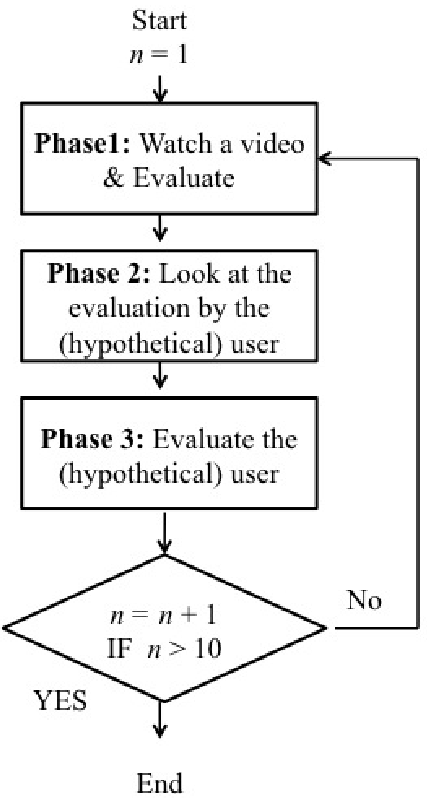 Figure 1: The experimental workflow from watching stimuli to trust evaluation.
By controlling every "opinion" the participant saw, the researchers could isolate exactly how much the "shock" of disagreement damaged trust and how quickly the participant "forgave" the agent.
Results: The Psychology of Fast Forgiveness
The data revealed a striking pattern. User A (the similar agent) consistently held higher trust scores than the others. When the shock occurred in Trial 3, trust plummeted. However, by Trial 4, trust had already begun a rapid climb back to original levels.
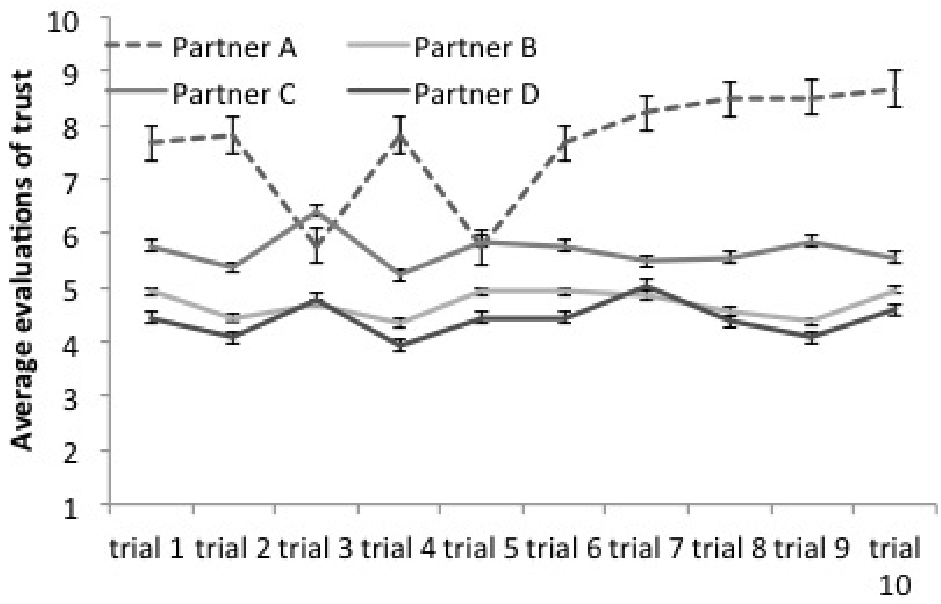 Figure 2: Trust dynamics across 10 trials, showing the dip and recovery for User A.
The Bayesian Gap
The researchers compared this human behavior to a Naïve Bayes Model. Theoretically, a Bayesian agent updates its trust probability based on evidence. While the model correctly predicted the direction of trust changes, it failed to capture the velocity. Humans were much more "forgiving" and recovered trust faster than the mathematical model suggested.
This points to a powerful Confirmation Bias: once we identify someone as "like us," we are psychologically predisposed to ignore or minimize occasional conflicts to maintain that social bond.
Critical Analysis & Conclusion
Takeaway: Trust in social networks is highly elastic. We don't just calculate trust based on a rolling average of similarity; we actively seek to restore trust with those who have shared our preferences in the past.
Limitations: The study used simple cartoon stimuli and smart-phone interactions. In higher-stakes environments (politics, finance), the recovery from a "shock" might be significantly slower or lead to permanent "unfollowing."
Future Outlook: For the next generation of recommender systems, the lesson is clear: Algorithms shouldn't just look for similarity; they should look for long-term preference alignment. A single disagreement shouldn't result in a peer being "de-ranked" in a user's feed, as the human brain is naturally designed to look past these anomalies.
Senior Editor's Note: This work is a crucial bridge between social psychology and HCI. It reminds AI developers that "Trust" is not just a variable in a matrix, but a resilient cognitive state shaped by evolutionary biases.