
Decoding the Digital Tribe: How Social Networks, Profiles, and Slang Intersect
Empirical Study of Conversational Community Using Linguistic Expression and Profile Information
This paper presents a multi-dimensional framework for conversational community analysis on Twitter using the Louvain method and Neural Probabilistic Language Models (NPLM). By analyzing a massive dataset of 7.4M Japanese users, the authors successfully correlate topological network structures with linguistic expressions and user profile attributes, achieving 84% label accuracy in social communities.
TL;DR
Researchers from the University of Tokyo and Kyoto University have developed a framework to map the complex relationship between who we are (profiles), who we talk to (social networks), and how we speak (linguistics). By training separate AI language models for different Twitter communities, they discovered that school-based groups share a "common tongue" even if they don't talk to each other directly, whereas interest-based groups are linguistically distinct silos.
The Missing Dimension in Social Graph Analysis
Most community detection algorithms treat social networks like a skeletal structure—they see the bones (nodes and edges) but miss the soul (the actual conversation). Previous research often failed to scale to millions of users or relied on simple "bag-of-words" counts. This study argues that to truly understand a community, we must look at contextual linguistics: the same word might mean "meat" to a gamer but "meeting" to a Disney fan.
Methodology: The Two-Pronged Approach
The authors harnessed a massive dataset of 7.4M users and 404M links. Their pipeline consists of two primary engines:
- The Structural Engine: Using the Louvain Method, they extracted communities based on mutual "mentions." They identified 38 massive communities with over 10k members each.
- The Semantic Engine: This is the "secret sauce." They trained a Skip-gram (word2vec) model for each community. Since the vector for a word depends on its neighbors, the model captures how the same word shifts in meaning across different digital neighborhoods.
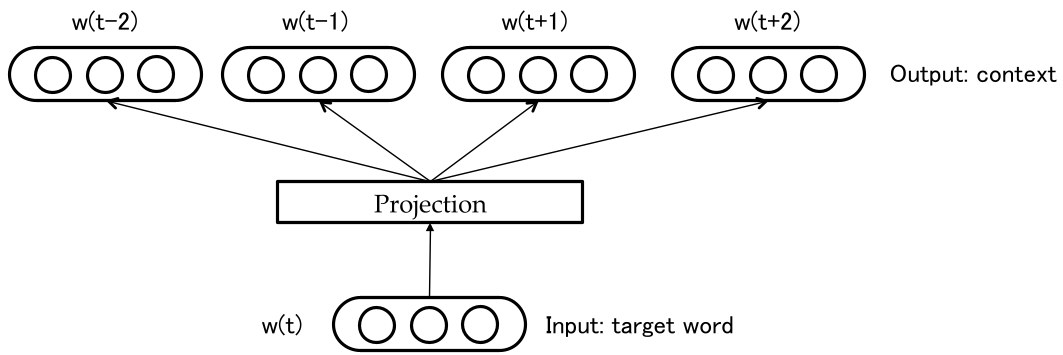 Figure 1: The Skip-gram model used to learn distributed word representations by predicting context words.
The "Miito" Mystery: Detecting Ambiguous Slang
One of the paper's most fascinating contributions is identifying "Ambiguous Words." By calculating the cosine similarity of the same word's vector across different communities, they found words like "miito" (ミート).
- In Online Gaming Communities: "Miito" correlates with words like "rice," "lard," and "crunchy," clearly referring to the English word "Meat."
- In Disneyland Fan Communities: "Miito" correlates with "timing," "in," and "please," referring to "Meeting" (specifically meeting characters or friends at the park).
This proves that community detection isn't just about graph bridges; it’s about linguistic manifolds.
Results: Proximity vs. Language
The study plotted communities on a 2D plane: Social Similarity (how much they talk) vs. Linguistic Similarity (how similarly they speak).
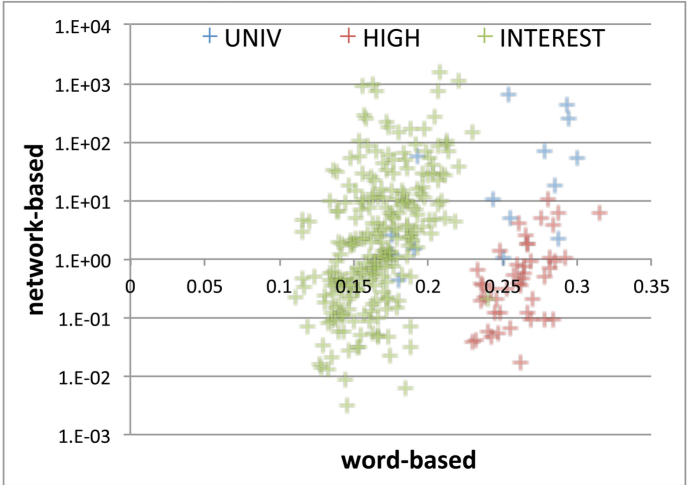 Figure 2: Correlation between Social-network similarity and Word-usage similarity across high schools (red), universities (blue), and interest groups (green).
Key Findings:
- University Groups (Blue): High interaction AND high linguistic similarity. These are cohesive, active "tribes."
- High School Groups (Red): Low interaction but HIGH linguistic similarity. Even students in different regions use the same slang/patterns, identifying as a "generation" rather than a specific clique.
- Interest Groups (Green): Usually low linguistic similarity to others. These are distinct silos with their own specialized vocabularies (e.g., Anime fans vs. Political reformers).
Critical Insight & Future Outlook
This work represents a shift from "Topological Analysis" to "Sociolinguistic Mining." For marketers, it suggests that targeting "High Schoolers" as a category is effective because they share a linguistic identity despite being geographically fragmented.
Limitations: The study primarily focuses on Japanese Twitter data from 2012. Given the evolution of AI (LLMs) and social shifts (TikTok/Discord), the linguistic drift today is likely even more fragmented.
Future Work: Integrating these "community-aware" embeddings into modern Transformers could significantly improve personalized recommendation engines and sentiment analysis by understanding the slang-of-the-day in specific subcultures.