
Athletes and Echo Chambers: How Popularity Dilutes Diversity on Twitter
An Empirical Study of the Diversity of Athletes’ Followers on Twitter
This empirical study explores user interest diversity on Twitter by analyzing 8,000 athletes across 13 sports categories and their 197 million followers. The authors propose a weighted diversity metric that penalizes mass-market popularity (e.g., Soccer) and rewards niche interests (e.g., Winter Olympics) to quantify follower variety and athlete heterogeneity.
TL;DR
By analyzing nearly 200 million Twitter followers, researchers have discovered a counter-intuitive truth: the more followers an athlete has, the less diverse their audience is. Using a novel category-weighted metric, this study reveals that niche sports (like the Winter Olympics) foster the most diverse fanbases, while global giants like Soccer are supported by users who rarely engage with other disciplines.
Background: The Popularity Bias Problem
In the landscape of social media, "Diversity" is a loaded term. Does following five different soccer players make you a "diverse" sports fan? Likely not. Does following one soccer player and one professional curler? Probably so.
The problem with standard metrics is Popularity Bias. If a researcher simply counts the number of categories a user follows, the results will be skewed by the sheer gravity of sports like Soccer or the NBA. This paper aims to solve that by introducing a weight-based system that rewards "expensive" (less popular) interests.
Methodology: Quantifying the Interest Spectrum
The core of the paper lies in two mathematical definitions designed to neutralize the raw numbers of followers.
- Follower Diversity (): Instead of counting categories, the authors assign weights. If a category is extremely popular, its weight is low. If it represents a niche interest (like Tennis or Golf relative to Soccer), its weight is higher.
- Athlete Heterogeneity (): This measures the "quality" of an athlete's reach. It is the average diversity score of all people following that specific athlete.
Architecture of the Data
The researchers built a custom crawler combining data from tweeting-athletes.com and the Twitter API.
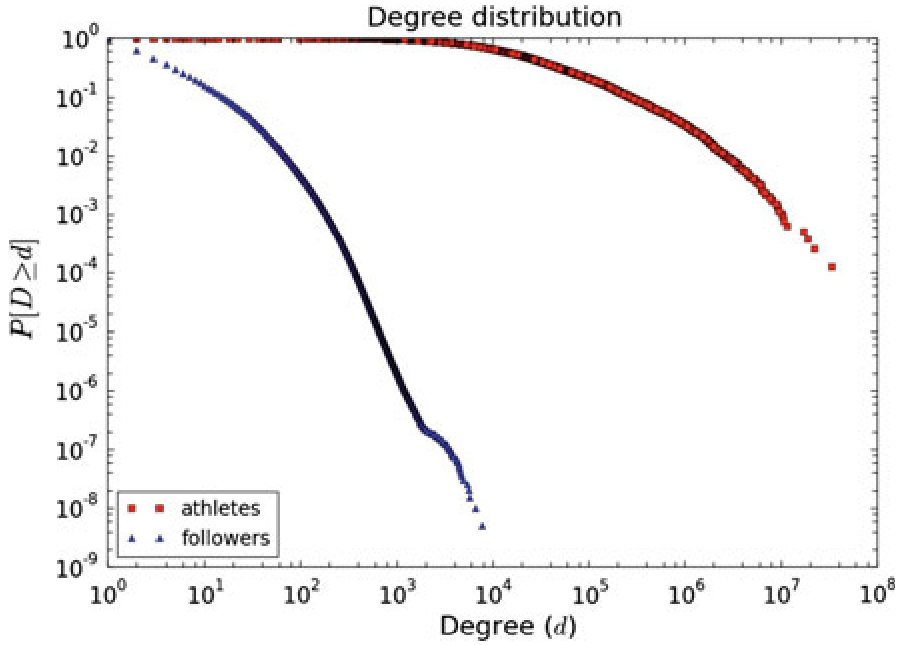 Figure 1: The CCDF shows that while athletes have a long-tail distribution (some with millions of followers), the majority of followers (80%+) follow fewer than 10 athletes.
Key Insights: The Inverse Popularity Law
The most striking finding is the relationship between an athlete's fame and the diversity of their audience.
1. The Soccer Monopoly
The study found that 66% of Soccer fans follow ONLY soccer athletes. Because soccer is so massive, it acts as a self-contained ecosystem. These users have the lowest diversity scores in the entire dataset.
2. The Niche Connector
Conversely, followers of the Winter Olympics have the highest average diversity. This suggests that people interested in niche sports are "Collectors" of interests—they don't just follow one thing; they follow many.
3. The Heterogeneity Trap
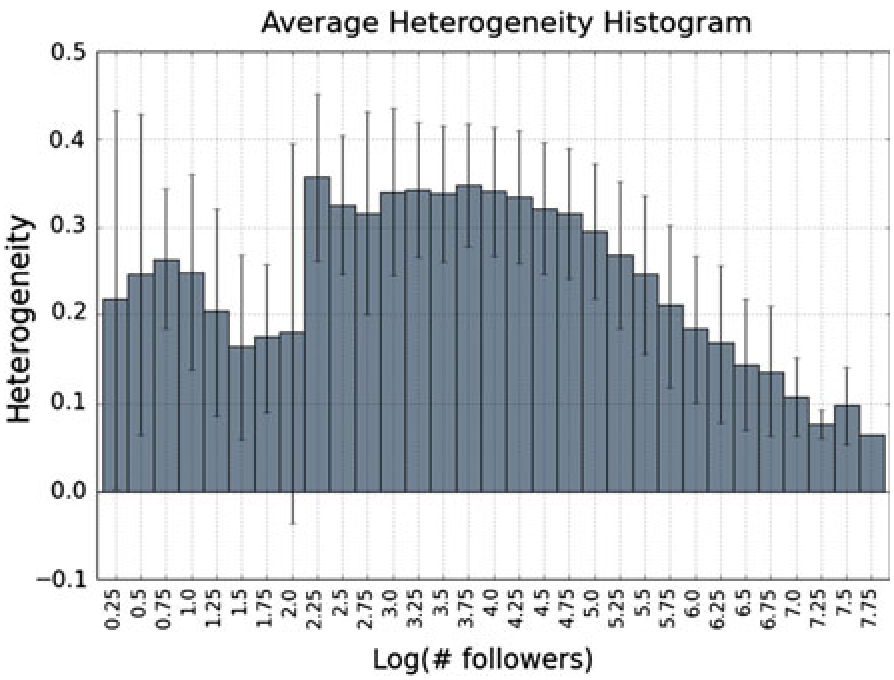 Figure 2: The clear downward trend shows that as an athlete moves from 1,000 to 10M followers, the average diversity of their follower base collapses.
As shown in the histogram above, there is a clear Inverse Proportionality. Superstars like Cristiano Ronaldo or LeBron James are followed by the "masses"—people who may only use Twitter to follow that specific star or sport. Small-scale athletes in volleyball or cycling are followed by "die-hard" sports fans who track many different categories.
Conclusion & Intellectual Takeaway
This research challenges the idea that "viral" growth leads to broader cultural impact. Instead, it suggests that Extreme Popularity = Extreme Narrowness.
For researchers and marketers, the takeaway is clear: If you want to reach a "diverse" audience, you shouldn't look at the athletes with the most followers. You should look at the "Heterogeneous Athletes"—those with moderate followings in niche categories whose audiences are active across the entire sports spectrum.
Limitations
The study is limited by its 2015 dataset and the "one category per athlete" rule, which doesn't account for dual-sport athletes or influencers. However, the underlying mathematical framework for penalizing popularity to find true diversity remains a powerful tool for social network analysis today.