
Legal Intelligence in Traffic Disputes: Predicting Law Articles with Semantic Depth
9597_An Empirical Study of Law Articles Prediction on Transportation Legal Cases.
This paper explores Legal Judgment Prediction (LJP) specifically for traffic accident liability disputes using a custom Chinese dataset of 130,000 cases. It benchmarks traditional machine learning (LR, SVM, Bayes) against deep learning architectures (TextCNN, ResNet, TextRNN, Transformer) to predict relevant law articles.
TL;DR
Legal Judgment Prediction (LJP) is transitioning from simple retrieval to sophisticated semantic classification. This paper presents a specialized study on traffic accident liability in China, leveraging a dataset of 130k cases. By comparing nine different models—ranging from Logistic Regression to Transformers—the research demonstrates that treating legal articles as semantic entities rather than just "tags" significantly aids in predicting judicial outcomes.
Problem & Motivation: Beyond Keyword Matching
The legal field is saturated with data, yet extracting actionable intelligence remains difficult. Existing LJP systems often fall into two traps:
- Semantic Ignorance: They treat law articles as atomic ID labels, ignoring the text of the law itself.
- Domain Generality: Most models are trained on general criminal law, failing to capture the nuances of specific civil sectors like motor vehicle traffic accidents.
The authors argue that a legal document is not just a bag of words; it contains a rigid structure where the facts of a case must "map" onto the semantic requirements of a law article.
Methodology: A Multi-Model Benchmark
The core of the methodology lies in reframing the task as a Multi-label Classification problem. Since a single traffic accident might involve multiple legal violations (e.g., speeding, intoxication, and vehicle maintenance), the model must predict a set of articles.
Architecture Overview
The authors implemented and compared three categories of models:
- Traditional Machine Learning: Logistic Regression (with Binary Relevance), SVM, and Naive Bayes.
- Proximity-based: ML-KNN (Multi-Label K-Nearest Neighbors).
- Deep Learning: TextCNN (capturing local n-grams), ResNet (deep residual feature extraction), TextRNN (capturing long-term sequential dependencies), and Transformers (utilizing self-attention).
The Semantic Insight
Unlike previous works that only look at the distance between "Case A" and "Case B," this methodology emphasizes the Semantic Meaning of Law Articles. By embedding the text of the legal articles, the models can better align case facts with the specific language used in the legislation.
Experiments & Results
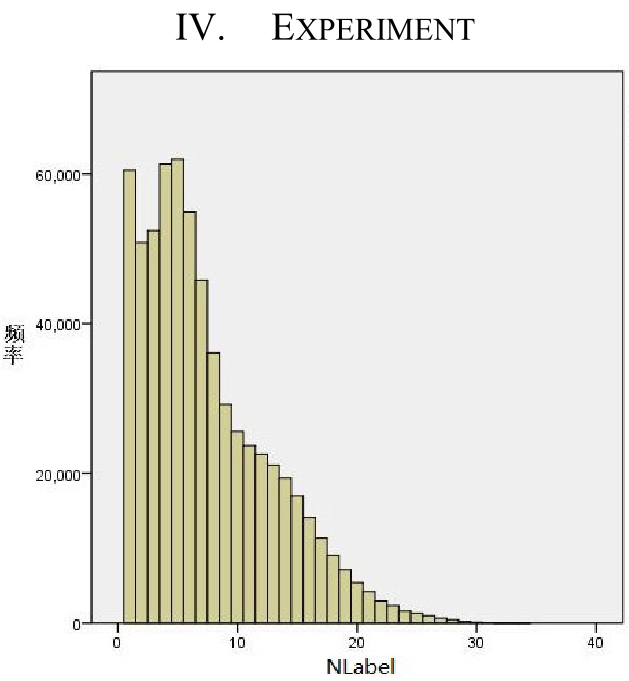
The researchers crawled over 7.5 million documents from "China Judgments Online," narrowing it down to ~130,000 traffic-related cases citing 120 primary articles.
Key Findings:
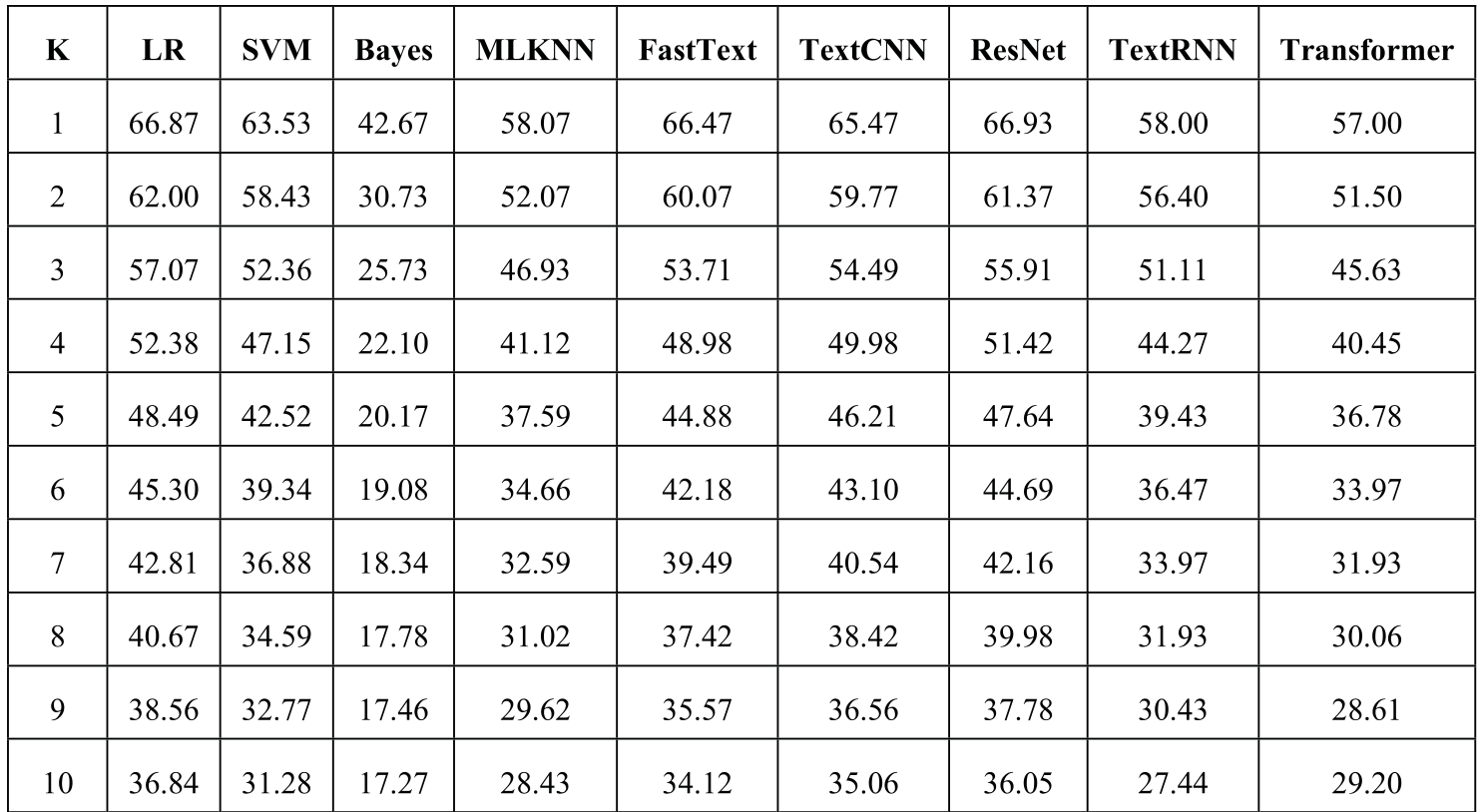
- ResNet dominated the deep learning category with a Top-1 accuracy of 66.93%.
- Logistic Regression (LR) proved remarkably resilient in the legal domain, matching ResNet with 66.87%. This suggests that legal language is often highly structured and linear features are quite powerful.
- The "K-Drop" Effect: As the number of labels to predict () increases, accuracy naturally drops across all models (see table below).
Critical Analysis & Conclusion
The "Weighted Accuracy" Innovation
A significant takeaway from this paper is the introduction of a new metric for legal tasks: Where is the intersection of predicted and actual labels, and is the predicted set. This effectively penalizes "hallucinated" legal citations, which is critical in a field where precision is a matter of justice.
Limitations
While the study is comprehensive, it relies on "Frequency-based Labeling" (selecting the top 120 articles). This creates a long-tail problem where rare but critical legal articles might be ignored by the model.
Future Outlook
The path forward for Legal AI lies in Explainable AI (XAI). Future iterations of this work should not just predict which article applies, but highlight which sentence in the case facts triggered that specific legal citation, bridging the gap between machine learning and judicial reasoning.
Takeaway: In specialized domains like traffic law, classical models like LR and SVM remain strong baselines, but the future of Legal Intelligence depends on deep semantic alignment between fact and law.