
Beyond Product Reviews: Why Off-the-Shelf Sentiment Tools Fail Societal Topics
Empirical study of sentiment analysis tools and techniques on societal topics
2020-10-15
Summary
Problem
Method
Results
Takeaways
Abstract
This paper presents an empirical benchmarking of 10 off-the-shelf sentiment analysis (SA) tools and 17 machine learning techniques (feature-based and neural-based) across societal and non-societal domains. The study demonstrates that while commercial tools excel in product reviews, they are significantly less effective for complex societal topics like social unrest and government policy.
## TL;DR
While AI sentiment analysis tools are ubiquitous, most are "customer-service" bots in disguise. This empirical study reveals that popular APIs like **MeaningCloud** and **IndicoIO** suffer from a massive performance cliff when moved from product reviews to societal issues. The solution? Specialized **CNN-based** models that understand the nuance of social unrest and public policy.
## The Domain Trap: Why Context is Everything
In the world of Natural Language Processing (NLP), we often assume that "sentiment is sentiment." However, the vocabulary used to describe a bad movie is fundamentally different from the language used during a terror attack or a major policy shift like the *Paris Agreement*.
The authors argue that existing tools are heavily biased toward the "Customer Review" domain. When a tool expects to hear about "battery life" or "plot twists," it fails to parse the sarcasm and regional "code-mixed" (multilingual) nuances found in the heated digital public square.
## Methodology: Benchmarking Tools vs. Techniques
The researchers pitted two groups against each other:
1. **The Tools**: 10 popular off-the-shelf solutions (Vader, AFINN, TextBlob/Pattern, etc.).
2. **The Techniques**: 17 locally trained methods, spanning traditional ML (SVM, Random Forest) and Deep Learning (CNN, LSTM, Bi-LSTM).
They tested these across 8 datasets, including a custom-built **Societal-I** dataset capturing real-world reactions to events like the *Surgical Strike* and *GST* implementation in India.
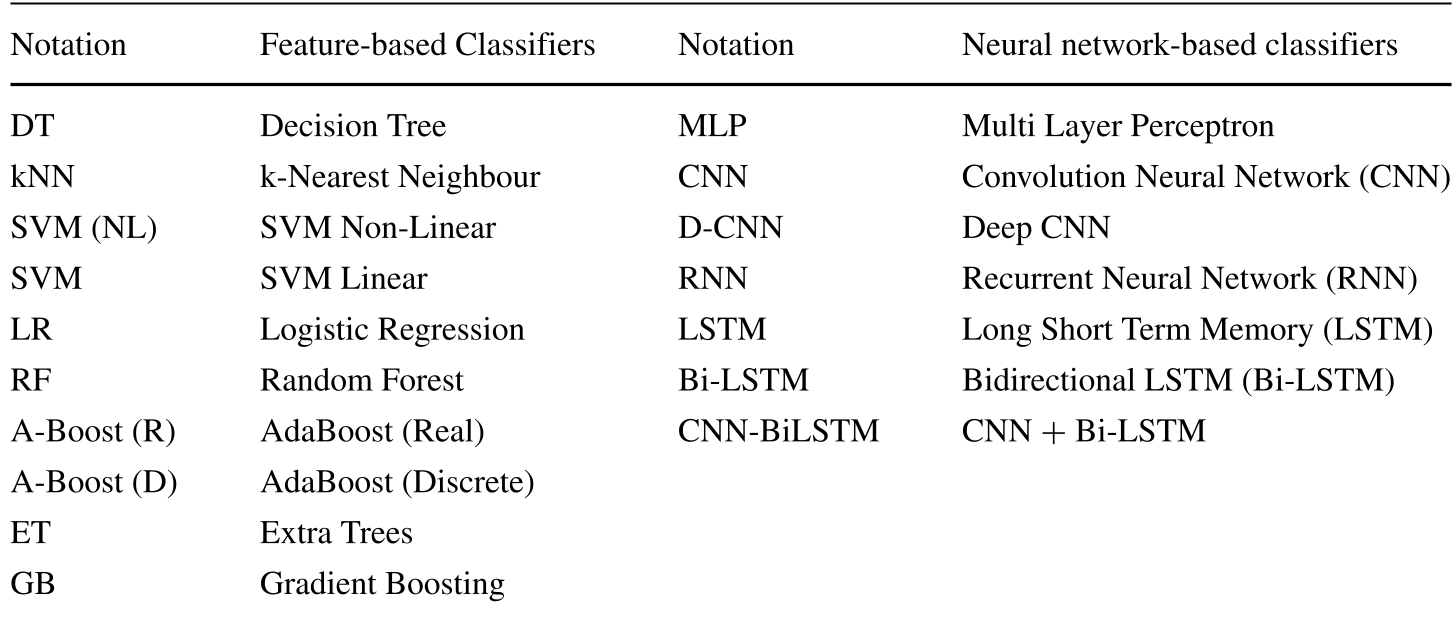
*Table: The 17 ML Techniques evaluated in the study, categorized by feature-based vs. neural approaches.*
## The Performance Cliff
The results were startling. While **IndicoIO** achieved a near-perfect **95% accuracy** on Amazon reviews, its performance plummeted to below **40%** on societal topics.
### Key Findings:
- **Neural Networks Dominate**: CNNs consistently outperformed traditional feature-engineered models (like SVM or Naive Bayes) because they could capture latent textual patterns without manual feature selection.
- **Regional Generalization**: Interestingly, a model trained on Indian social issues performed reasonably well on the *Syria Crisis*. This suggests that public sentiment during "terror attacks" or "policy shifts" shares a universal linguistic signature across different geographies.
- **Vader and AFINN**: Among the lexicon tools, these were the most "robust" for societal topics, likely due to their better handling of social media-specific slang.
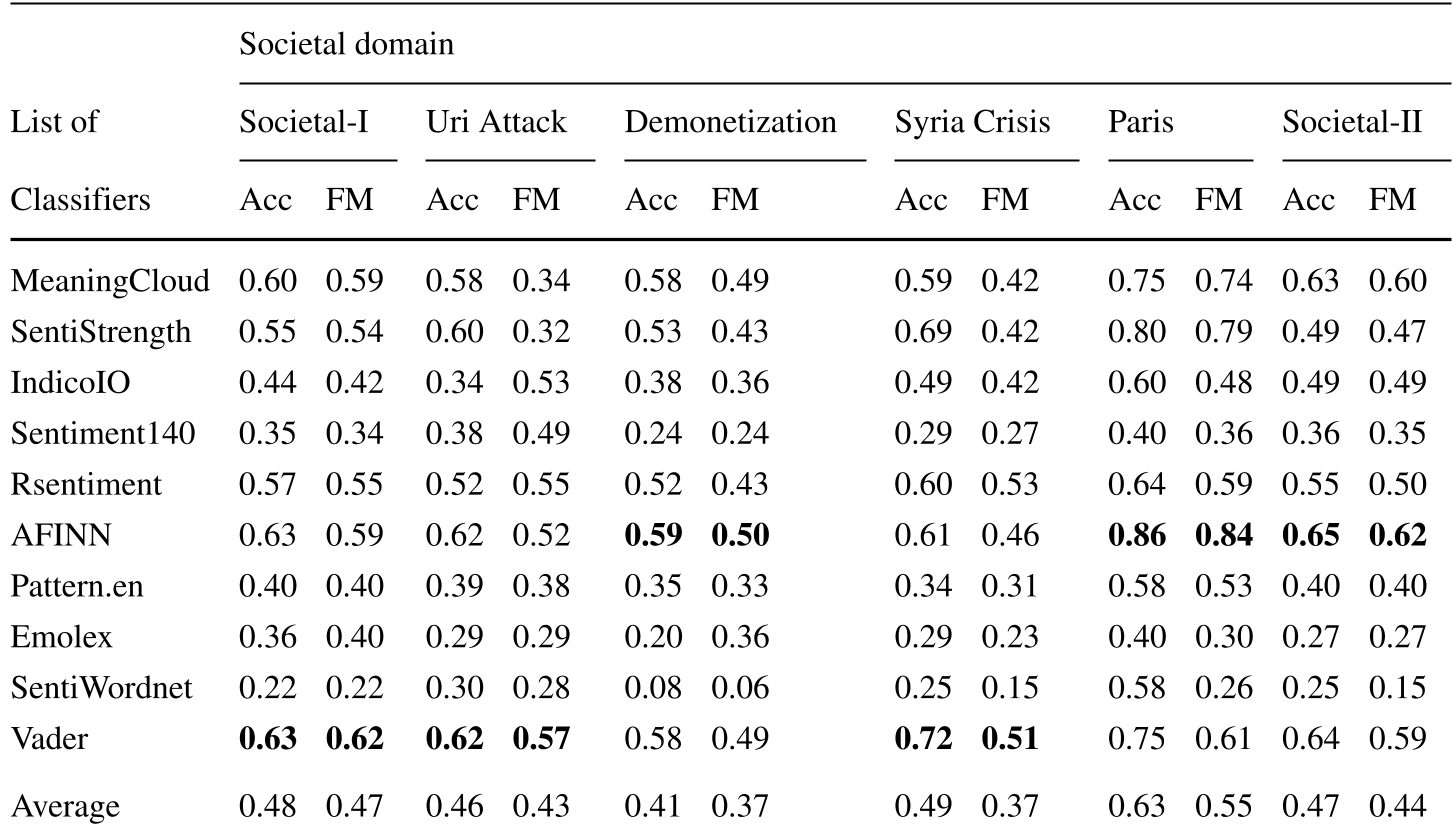
*Table: Evaluation of Tools across Societal Domains. Note the discrepancy between accuracy (Acc) and F-Macro (FM) scores.*
## Deep Dive: The Sarcasm and Stance Barrier
Why do tools fail so badly on social issues? The authors performed an error analysis and identified five sub-tasks where Tools struggle:
1. **Sarcasm**: Sarcastic tweets often use "positive" words to convey "negative" meanings. Tools lack the contextual reasoning to flip the sentiment.
2. **Stance**: A tweet might be negative toward a *person* but positive toward an *event*. Tools struggle to distinguish the target.
3. **Code-Mixing**: In regional contexts (like India), users mix Hindi and English. Most off-the-shelf tools are monolingual.
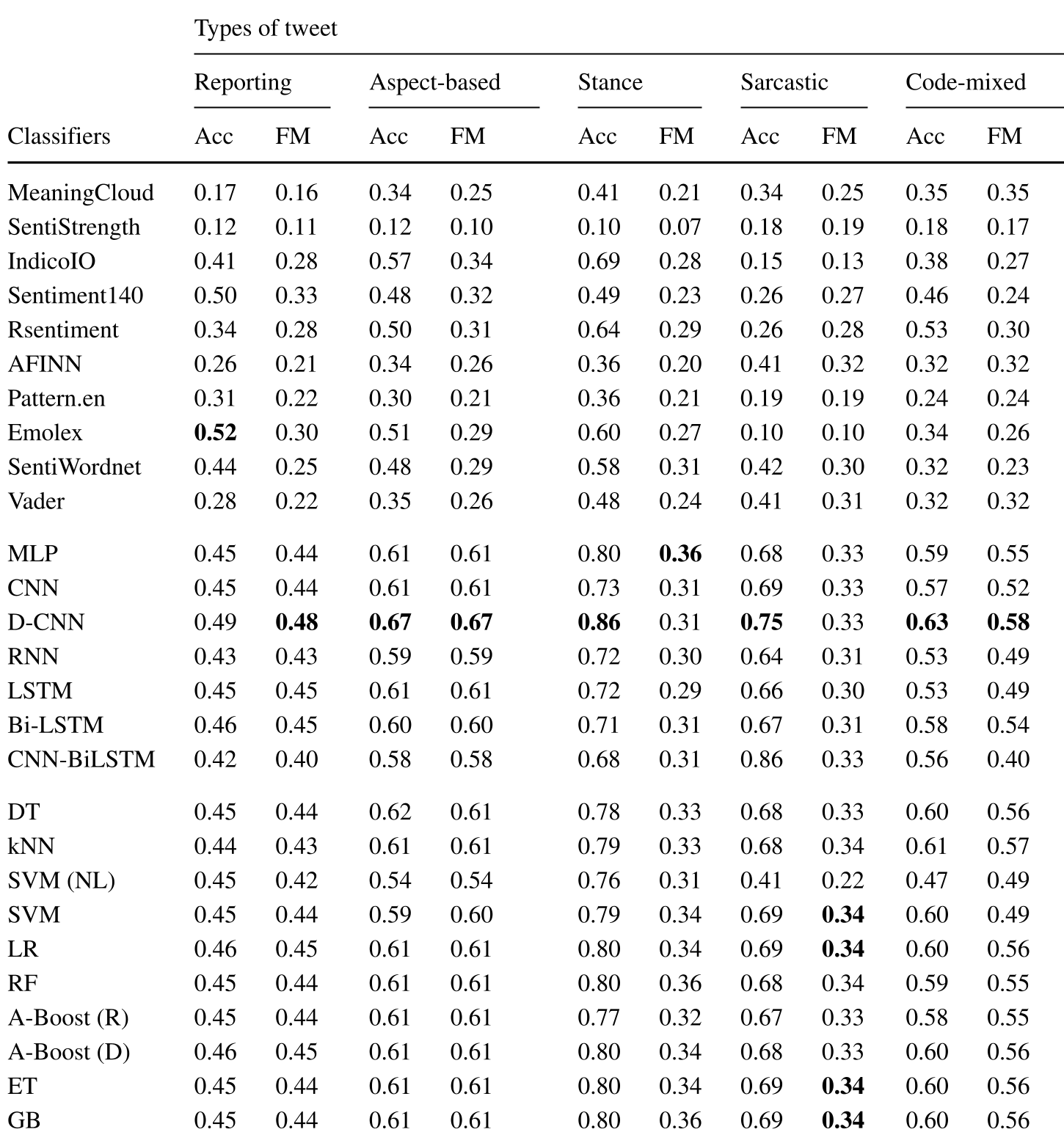
*Table: Performance of classifiers across sub-tasks like Sarcasm, Stance, and Code-mixing.*
## The Senior Editor's Verdict
This paper serves as a vital warning for data scientists: **Stop blindly using Sentiment APIs for social science research.** If your data involves politics, human rights, or societal shifts, a generic API is effectively a coin toss.
The "universal sentiment tool" is a myth. The future of sentiment analysis lies in **domain-specific fine-tuning** and architectures like **CNN-BiLSTM**, which can simultaneously capture local features (words) and long-range dependencies (context).
### Takeaways for Research and Industry:
- **For Policymakers**: Don't rely on simple dashboard tools to gauge public reaction to a new law. Use custom models.
- **For NLP Engineers**: Focus on **Normalizing Code-Mixed text** and **Sarcasm Detection**—these are the real frontiers of sentiment accuracy.