
Pinterest Probed: Deciphering the "Social Collecting" Paradigm
An Empirical Study of User Behaviors on Pinterest Social Network
This paper presents a large-scale empirical study of user behaviors on Pinterest using a dataset of 1.13 million users and 933 million pins. It identifies Pinterest as a unique "social collecting" platform where interests revolve around everyday life (food, decor, fashion) rather than news or social updates, establishing it as a distinct entity in the social media landscape.
TL;DR
Unlike the real-time news cycle of Twitter or the personal social graph of Facebook, Pinterest represents a unique ecosystem of image curation and lifestyle aspiration. This study analyzes nearly a billion "Pins" to prove that Pinterest users aren't there to talk; they are there to collect, categorize, and plan their everyday lives—creating a goldmine for retail marketing and interest-based recommendation.
Contextualizing Pinterest: More than just a Social Network
In the academic coordinate system, Pinterest sits at the intersection of Flickr (image sharing) and Twitter (unidirectional following). However, the authors argue that its essence is "Social Collecting." People don't just post content; they "Pin" and "Repin," moving objects from the external web into themed "Boards." This mechanism creates a unique topological structure characterized by low verbal interaction but high topical alignment.
Pain Points: Why Traditional Social Metrics Fail
Most social network analysis assumes that "Following" implies a social tie or a desire for news. On Pinterest, this intuition breaks down:
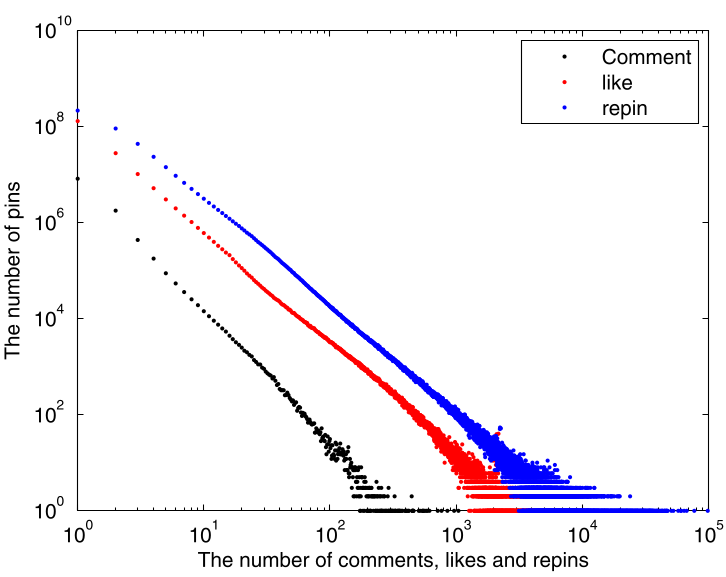
- Low Engagement Intensity: 98.8% of pins have no comments.
- Utility over Celebrity: Unlike Twitter, where news flows from celebrities, Pinterest's most popular pins often come from ordinary users (mothers, designers, chefs) who provide utility rather than status.
- External Dependency: 93.4% of content is sourced from outside the platform (Blogspot, Tumblr, Etsy), making it a portal rather than a silo.
Methodology: Mapping a Billion Pins
The researchers built a comprehensive dataset to dissect the network from four angles: topology, interest, source, and influence.
1. The Two-fold Power-Law
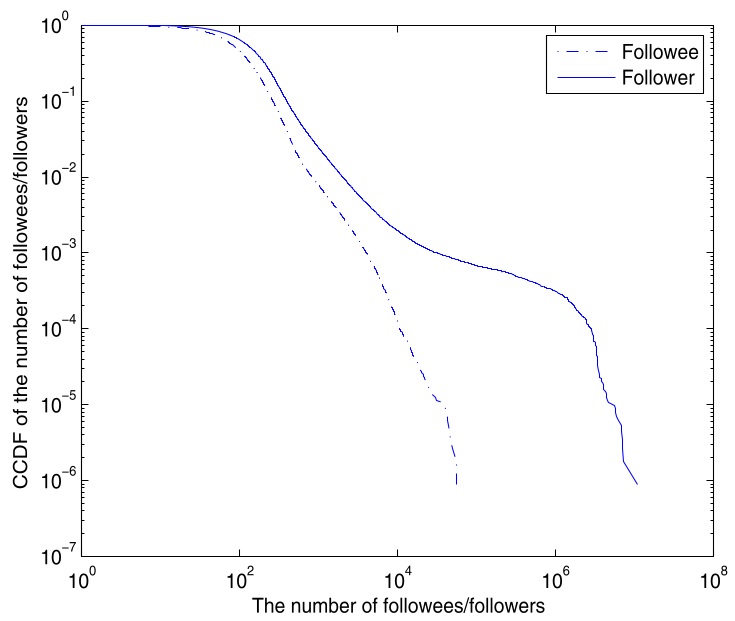
The study discovered that follower distribution isn't a simple power law. Instead, it follows a two-fold power law, a phenomenon where a small elite of "super-users" (influencers) resides in a distinct mathematical space from the general population due to the cumulative advantage of the Matthew Effect.
2. Homophily and Friendship
By applying Cosine Similarity to board titles and descriptions, the authors found that "Friendships" (reciprocal follows) are much stronger indicators of shared interests than simple follows. 62.3% of users are more similar to their reciprocal friends than their general followees.
Key Results and Visual Insights
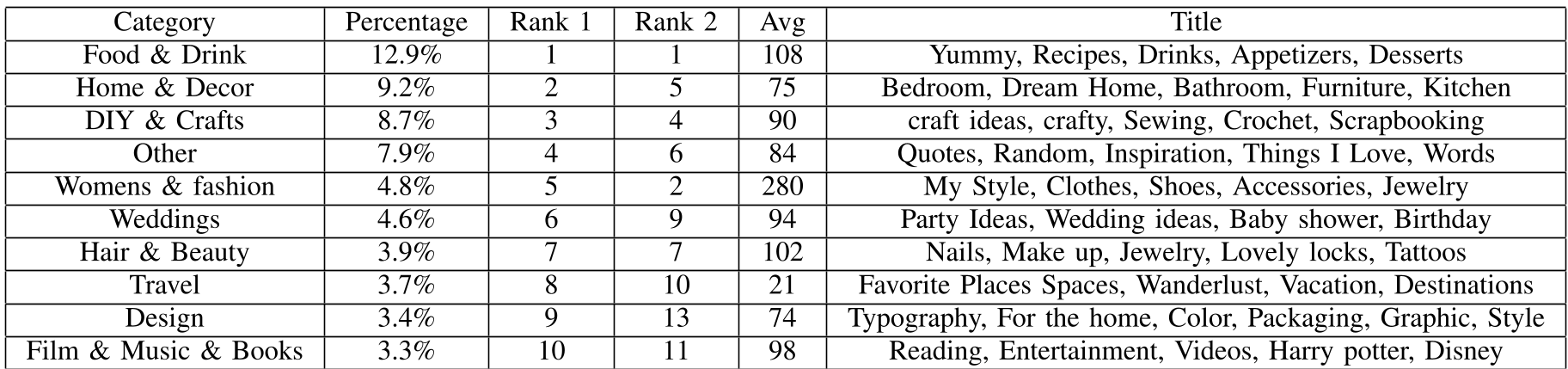
The data confirms Pinterest's role as a "lifestyle manual." The top categories—Food & Drink, Home Decor, and DIY—dominate the landscape.
- Interaction Disparity: Figure 2 shows that while "Repinning" (collecting) is rampant, "Commenting" (socializing) is nearly non-existent.
- Influencer Profile: The top 10 influencers are not pop stars but "lifestyle gurus"—designers and parents who curate high-quality aesthetics.
Critical Insight: The "Everyday Life" Commercial Value
The study's most profound takeaway is that Pinterest's "boring" nature—its focus on recipes and living room layouts—is its greatest commercial strength. Because users are in a "planning" or "collecting" mindset, the platform acts as a high-intent marketing funnel.
Limitations: The study is primarily focused on the US population (as evidenced by location data). Furthermore, since the data is a snapshot, it doesn't fully capture the temporal evolution of interests or the "long-tail" of niche communities.
Future Outlook
The authors suggest that future work should focus on Information Propagation—how does a pin go viral if no one is talking? Understanding the "Repin" cascade as a mechanism of algorithmic recommendation rather than social conversation will be the next frontier for researchers.