
Beyond Sensors: Decoding the Human Element in Home Healthcare Design
Empirically derived user attributes for the design of home healthcare technologies
The paper introduces a framework of 15 empirically derived user attributes and 5 data-driven personas to guide the design of Home Healthcare Technologies (HHT). Using an ethnographic approach involving 15 households, it shifts the focus from purely technical monitoring to a sensitive, user-centered understanding of diverse domestic health experiences.
TL;DR
Building a smart home for healthcare is not just a hardware challenge—it's a sociological one. This paper moves past the "monitor and report" mindset to introduce 15 user attributes and 5 data-driven personas derived from real-world ethnography. These tools allow engineers to design for "real people"—from the privacy-conscious retiree to the data-hungry fitness enthusiast—ensuring that health tech actually fits into the complex logic of a domestic environment.
The "Implementation Gap" in Smart Homes
For twenty years, we have been promised smart homes that track our health. Yet, clinical success remains rare. Why? The authors argue we suffer from an implementation gap: a failure to understand that a home is not a clinic. It is a space of personal meaning, shared by diverse residents with varying levels of "computer anxiety," different attitudes toward privacy, and unique ways of managing illness.
Methodology: High-Touch Ethnography
To bridge this gap, the researchers didn't just look at data logs; they walked through people's lives. Using the SPHERE (Sensor Platform for HEalthcare in a Residential Environment) project as a backdrop, they employed:
- Technology Tours: Walking through homes to see where gadgets are hidden or displayed.
- Cultural Probes: The "Map of Me" (body maps) allowed participants to visualize their conditions and the tech they wear.
- Inductive Coding: Turning raw conversations into a structured framework of 15 attributes.
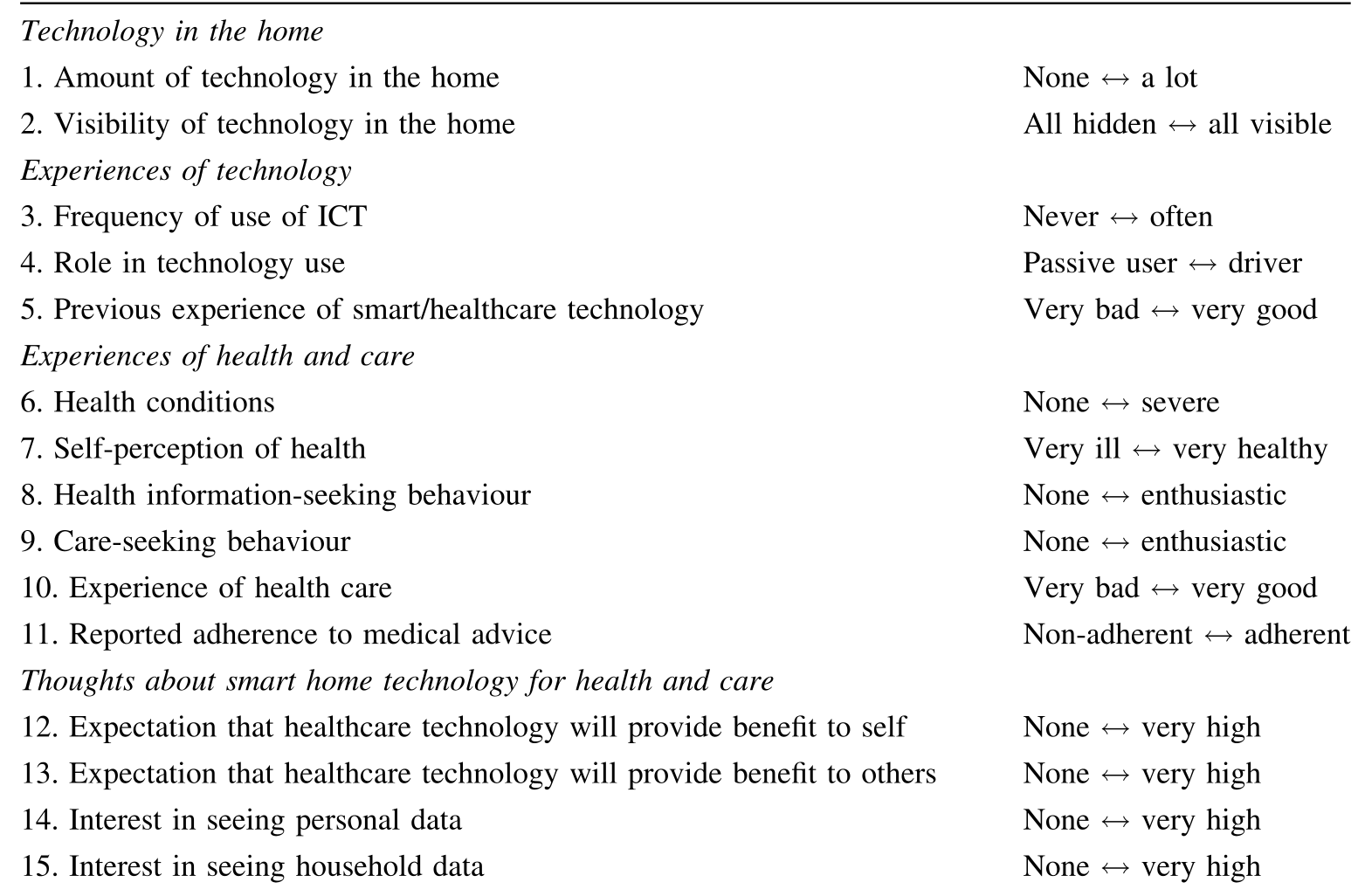
The 15 Attributes of the Home User
The core contribution is a checklist for designers. These attributes are not binary (Yes/No) but exist on a continuum. Key highlights include:
- Visibility of Tech: Does the user want a "caravan-style" tiny screen hidden in a cupboard, or are they comfortable with visible cameras?
- Care-Seeking Behavior: Is the user an enthusiastic seeker of medical advice, or do they adhere to a stoic "get on with it" mentality?
- Data Interest: Some users (like "Rose") have a love-hate relationship with data—feeling "chuffed" by good results but "stressed" by bad ones.
From Data to Personas: The Design Bridge
To make these 15 attributes actionable for a team of 40+ engineers, the authors developed data-driven personas. By mapping participants onto the attribute continua, they identified clusters of behaviors.
These aren't just fictional characters; they are evidence-based archetypes. For example:
- Rick (53): Dyslexic, fears the system might find a condition that stops him from working.
- Wendy (64): Focuses on safety but hates the idea of "being watched" by cameras.
- Oliver (31): An informal carer who wants "control" over tech and data integration.
Critical Insight: The "Older-Older" Fallacy
One of the study's most striking findings is the "not for me" attitude. Even 70-year-old participants felt the technology was for "older-older people" or those with "severe conditions." This highlights a massive hurdle for HHT: stigmatization. If a device looks and feels like "medical equipment," users will reject it because it conflicts with their self-perception as "healthy" and "active."
Conclusion & Future Impact
This research provides a much-needed "human-centered" vocabulary for the Internet of Things (IoT). By moving from patient monitoring to user empowerment, we change the design goal from "efficiency" to "meaningful engagement."
The 15-attribute framework is a gift to the ubiquitous computing community—a template to ensure that the next generation of smart homes feels less like a hospital ward and more like a home.
Image Credits: All charts and tables sourced from "Empirically derived user attributes for the design of home healthcare technologies" (Burrows et al., 2015).