
The Privacy Paradox in the Office: Why Employees Avoid Internal Social Networks
Analyzing the Problem of Employee Internal Social Network Site Avoidance: Are Users Resistant due to Their Privacy Concerns?
This empirical study investigates why employees avoid Internal Social Networking Sites (ISNS) despite high corporate investment. By extending the Technology Acceptance Model (TAM) with a Privacy Concerns (PC) construct, the researcher demonstrates that privacy is a critical determinant of user resistance, achieving a high predictive power for usage intention.
TL;DR
Despite the billion-dollar promise of "Enterprise 2.0," many employees treat internal social networking sites (ISNS) with a cold shoulder. This research proves that the missing link in our understanding isn't a lack of features or a clunky interface—it is Privacy Concerns. By integrating privacy into the standard Technology Acceptance Model (TAM), this study explains a staggering 73% of why users choose to engage or avoid these platforms.
Context: The Multi-Million Dollar Void
Companies like IBM and Deloitte have poured vast resources into ISNS to foster "organic" collaboration. However, there is a persistent gap between the "Usability Potential" (what the tech can do) and "Actual Usage" (what employees actually do). While previous research blamed lack of management support or cultural barriers, this paper digs into the psychological friction of disclosing personal/professional information within the reach of one's employer.
The Core Insight: Privacy is Not a Static "No"
The author's primary technical intuition is that privacy in a corporate setting is a Calculus of Behavior. It isn't just a fixed personality trait; it is a weight that shifts based on the perceived benefits of the system. If an employee feels a system is useful, their privacy concerns might decrease, but if concerns are high, the perceived usefulness itself is often psychologically "devalued."
Methodology & Model Architecture
The research utilizes an augmented version of the Technology Acceptance Model (TAM). The researcher adds Privacy Concerns (PC) as an antecedent that not only directly influences the Intention to Use (IU) but also cross-correlates with Perceived Usefulness (PU) and Perceived Ease of Use (PE).
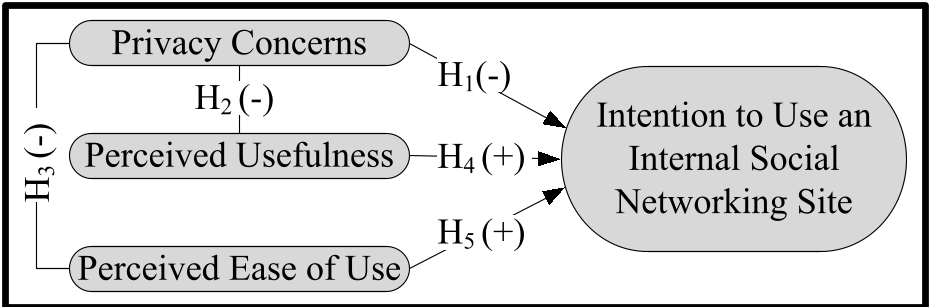 Figure 1: The Research Model extending TAM with Privacy Concerns.
The study surveyed 253 professionals across 33 sectors, ensuring the findings weren't limited to the tech industry. It specifically targetted the "Employer-Employee" dynamic, which is significantly more risk-sensitive than the "User-Facebook" dynamic.
Key Findings: The "Either-Or" Principle
The results from the Structural Equation Modeling (SEM) were profound:
- High Predictive Power: The model achieved an R² of 0.731. In the world of social science and Information Systems research, explaining over 70% of human intent with just three variables is remarkably efficient.
- Privacy vs. Ease of Use: In direct competition, Privacy Concerns explained usage intention more effectively than Perceived Ease of Use.
- The Cognitive Dissonance Trap: The data revealed an "Either-Or" phenomenon. Users typically fall into two camps:
- The Pro-Adopters: High PU, high PE, and notably low PC.
- The Resistors: Low PU, low PE, and significantly high PC.
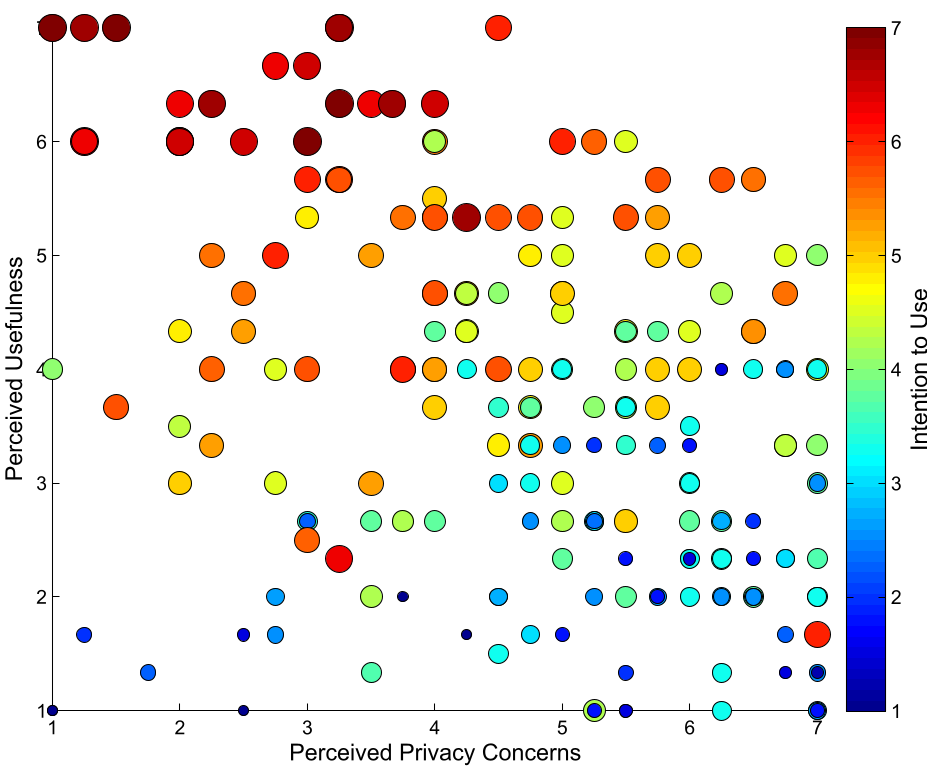 Figure 2: The "Either-Or Principle" showing how intention to use (bubble size) correlates with the tension between Usefulness and Privacy.
Critical Analysis: Why This Matters for the Future of Work
The study highlights a critical Inductive Bias in corporate IT deployment: the assumption that if you build it (and it's useful), they will come.
The author points out that in public networks, the cost of a "leak" might be social embarrassment. In an ISNS, the cost might be career-ending. This "asymmetry of power" makes privacy the primary gatekeeper of adoption.
Limitations and Nuance
The study notes a slight limitation in the reliability of the "Ease of Use" construct (Cronbach’s α = 0.588), suggesting that users might find the concept of "clunky" vs. "easy" tech somewhat subjective or overlapping with usefulness. Furthermore, the "Either-Or" principle suggests that once an employee decides to dislike a platform, they may retroactively inflate their privacy concerns to justify their avoidance (Reducing Cognitive Dissonance).
Conclusion: Beyond Functionality
The takeaway for any CTO or HR Director is clear: Functionality is not adoption. If your employees are avoiding your internal social tools, don't ask your developers for a cleaner UI; ask your legal and management teams for a more transparent privacy policy. Trust is the lubricant that allows the gears of Enterprise 2.0 to turn.
Final Takeaway
- Privacy is a trade-off: It can be mitigated by high perceived value (PU).
- Resistance is logical: Avoiding a platform because of privacy is a rational "calculus," not just stubbornness.
- Design for Trust: Future systems must focus on "Controllability" and "Transparency" to lower the entry barrier for resistant users.