
Breaking the High-Capital Bias: Rethinking Job Search Tech for Economically Distressed Communities
Analyzing employment technologies for economically distressed individuals
This paper presents a competitive analysis and user-centered study of employment technologies (e.g., LinkedIn, TaskRabbit, Amazon Mechanical Turk) aimed at economically distressed individuals. The authors identify systemic barriers in current platforms and propose design implications to foster "bridging" and "bonding" social capital to improve economic mobility.
TL;DR
Current job platforms like LinkedIn and TaskRabbit are built for people who already have jobs, money, and networks. This paper exposes the "hidden barriers"—like the need for credit cards just to sign up or the reliance on pre-existing professional "weak ties"—that keep economically distressed individuals locked out of the digital economy. The authors propose a new design direction that focuses on building social capital from the ground up through community trust and cross-platform skill visibility.
The Motivation: Why LinkedIn Fails the Poor
Social capital theory suggests job seekers need two things: Bonding capital (strong ties like family/friends for support) and Bridging capital (weak ties for new job leads).
Most modern ICTs (Information and Communication Technologies) assume you already have a network to "bridge" into. For a person in a distressed area like Detroit, the digital divide isn't just about hardware; it's about a lack of connections to authority figures ("linking capital") and a lack of the "middle-class markers" required by apps—such as a clean credit history or a professional resume.
User Persona Deep-Dive
To understand these barriers, the authors developed three distinct user profiles representing different facets of economic distress:
- The Career Transitioner: Someone with an advanced degree but no network in their new field.
- The High-Potential Youth: Individuals with skills (e.g., entrepreneurship) but no formal path to monetize them.
- The Disconnected Seeker: Those facing technical and financial barriers like poor credit or lack of transportation.
 Figure 1: Personas used to evaluate current employment technology limitations.
Methodology: Competitive Analysis of Barriers
The team evaluated existing sites across three categories: Online Marketplaces (ODesk, Turk), Informational Sites (CareerBuilder), and Networking Sites (LinkedIn).
Key findings included:
- The "Credit" Wall: Amazon Mechanical Turk and ODesk often require credit cards or bank accounts for verification, effectively banning the "unbanked."
- The Reputation Trap: TaskRabbit rewards those with high ratings. Newcomers without a digital history are invisible.
- Geographic Exclusion: Many "sharing economy" apps simply do not operate in economically distressed zip codes.
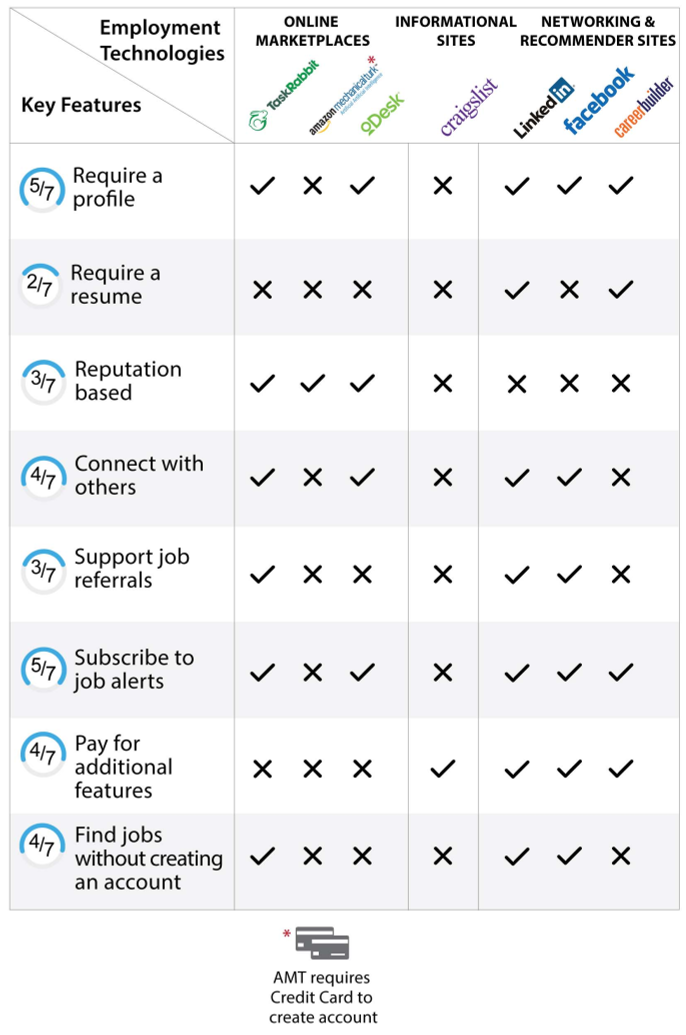 Table 1: Competitive analysis of features and barriers in current employment platforms.
Design Implications: Fostering New Ties
How do we design for those with zero existing social capital? The authors suggest two core shifts:
1. Fostering Strong Ties through Community Action
Platforms should encourage "trust-building tasks" within a local community (e.g., neighborhood repair). By broadcasting these successful offline tasks online, a user can build a "reputation score" that replaces the need for a traditional resume.
2. Building Weak Ties via "Cross-Pollination"
The paper proposes linking job profiles to other social spheres where skills might be visible—such as Massive Open Online Courses (MOOCs) or community forums. Imagine a user seeing that a successful local entrepreneur is taking the same online course; that shared activity serves as an "icebreaker" to create a new weak tie.
Critical Analysis & Future Work
While this work was published in 2014, its insights are more relevant than ever as the "Gig Economy" matures.
Limitations: The study is preliminary, focusing on Detroit and a small sample of Mechanical Turkers. It identifies what is wrong but is still in the early stages of testing how to build the replacement software.
The Takeaway: Technology designers must stop assuming users have a "base layer" of financial and social stability. True innovation in employment tech lies in creating the "on-ramp" for those currently barred from the highway of economic mobility.
Senior Editor's Note: This paper is a foundational call to action for Inclusive Design in the HCI and Labor Economics space.