
Beyond Coding: Empowering the Next Generation of AI Critics
Empowering Children's Critical Reflections on AI, Robotics and Other Intelligent Technologies
This paper outlines a framework and workshop initiative titled "Empowering Children’s Critical Reflections on AI," aimed at bridging the gap between technical STEM education and ethical literacy. It proposes a socio-technical approach to involve children as active stakeholders in the dialogue surrounding the ethical implications of AI, robotics, and automated systems.
TL;DR
As AI and robotics permeate everyday life, technical proficiency alone is no longer enough. This paper argues that children—the ultimate stakeholders of the future—are being left out of the ethical dialogue. Through a series of workshops and participatory design methods, the authors propose a shift from teaching children how to build tech to teaching them how to critique its social and ethical impact.
The "Technical Trap" in Modern Education
The current educational landscape is obsessed with STEM. We teach children to code, to understand algorithms, and to solve problems using computational thinking. However, as the authors point out, this "Technical Trap" creates a dangerous blind spot: we are raising skilled developers who might be blind to the "Weapons of Math Destruction"—the biases and ethical pitfalls inherent in Big Data and AI.
The motivation behind this work is clear: children are already interacting with social robots and automated systems, yet they are rarely given the tools to question issues like privacy, gender hierarchy reproduction in robot morphology, or the social consequences of algorithmic decision-making.
Methodology: From Passive Users to Ethical Architects
The core of this work lies in its Participatory Design methodology. Instead of lecturing children on ethics, the organizers use creative, play-based strategies to evoke critical thought.
1. The Divergent-Convergent Approach
The workshop uses a structured discussion format:
- Divergent Phase: Children use "personas" to explore different values and viewpoints regarding a technology.
- Convergent Phase: The group works to find common ground or specific action points for future design.
2. Creative Storyboarding
One of the most compelling examples provided is the "Robot President" storyboard. By asking children to imagine an AI in a position of extreme social power, they naturally begin to grapple with concepts of fairness, authority, and human-robot boundaries.
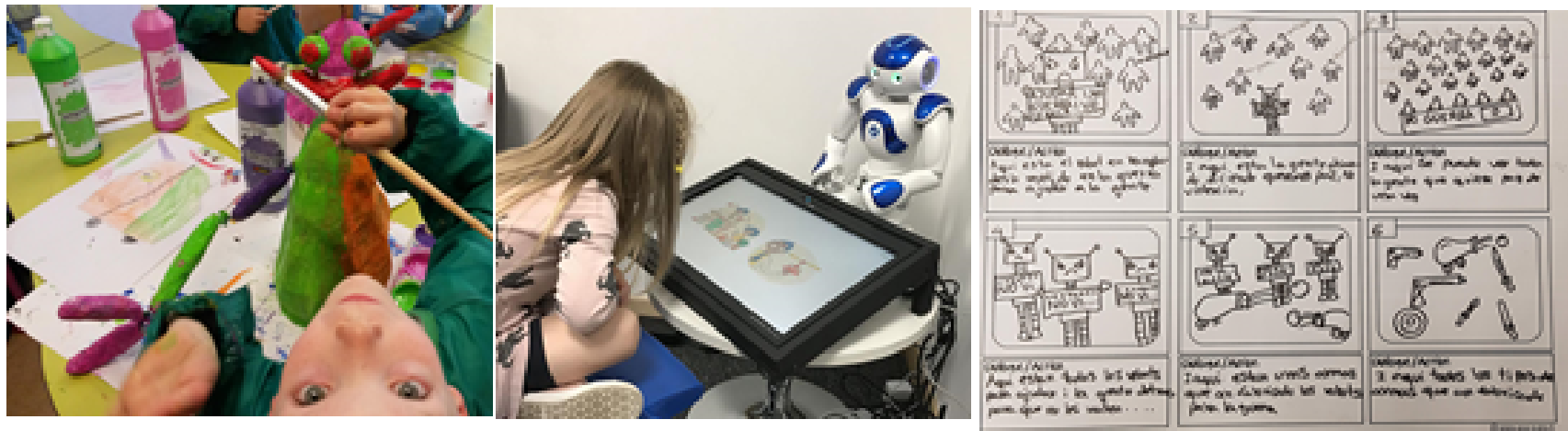 Figure 1: (1) Participatory Robot design session; (2) Interaction with Nao; (3) Storyboard describing the role of a robot president.
Key Insights & Discussion Points
The authors pose several provocative questions that define the current frontier of Child-Computer Interaction (CCI):
- Accessibility: How do we make abstract ethical concepts (like algorithmic bias) "tangible" for a 7-year-old?
- Stakeholder Synergy: How can children’s reflections be effectively communicated to policy-makers at organizations like the European Commission or UNICEF?
- Inherent Bias: Addressing the lack of diversity in robot morphology—why do most social robots look or act a certain way, and what message does that send to a child?
Critical Analysis & Conclusion
This paper serves as a vital call to action for the HCI community. The transition from Computational Thinking to Critical Technical Fluency is essential.
Takeaway: The "innovation" here isn't a new algorithm—it's a new pedagogy. By treating children as competent stakeholders rather than just "test subjects" or "future workers," we can build an AI-driven society that is not only smart but also just.
Limitations: The primary challenge remains scalability. While 20-person workshops provide deep insights, translating these "critical reflection" sessions into standardized global curricula remains an open problem.
Future Outlook: We should expect to see more "Value-Sensitive Design" tools that allow children to "tinker" with the ethical parameters of AI, much like they currently tinker with LEGO or Scratch.