
Empowering Collaborative Intelligence: Distilling Professional Signal from Social Media Noise
Empowering Collaborative Intelligence by the Use of User-Centered Social Network Aggregation
The paper proposes a user-centered Social Network Aggregation (SNA) framework to enhance "Collaborative Intelligence" within organizations. It utilizes a semantic model based on the FOAF vocabulary and DBpedia to merge disjointed streams from platforms like Facebook and Twitter into a unified, group-relevant knowledge base.
TL;DR
Social networks are massive repositories of informal knowledge, yet their "siloed" nature prevents teams from benefiting from members' shared links and interests. This paper presents a semantic, user-centered framework that aggregates streams from Facebook and Twitter, filters them using ontologies (DBpedia), and integrates them into a professional knowledge system. The result? A 20% relevance rate for automatically discovered technical resources.
Background: The Fragmented Social Landscape
In the modern workplace, a developer might tweet a breakthrough in React, post a design trend on Facebook, and share a whitepaper on LinkedIn. However, because their colleagues are not connected to them on every platform, this "ambient knowledge" is lost. The challenge isn't just gathering the data—it’s identifying the user across platforms and filtering out the "what I had for lunch" posts from the "this new API is game-changing" insights.
The Problem: Why Current Aggregators Fail
Most existing social aggregators (like the now-retired FriendFeed) act as simple notification hubs. They lack:
- Semantic Integration: They don't understand that a "Like" on Facebook and a "Tweet" on Twitter might refer to the same DBpedia entity (e.g., #MachineLearning).
- Privacy Control: Users are often reluctant to sync personal accounts with corporate systems without fine-grained control.
- Entity Matching: Without public APIs, identifying that "UserA" on Twitter is "UserB" on Facebook is technically difficult and often inaccurate.
Methodology: The User-Centered Semantic Bridge
The authors propose a "User-Centered" approach. Instead of guessing who a user is, they allow users to authenticate their own accounts, granting the system access to "Real-time Update" APIs.
1. The 6-Dimension Model
The system maps all incoming data into a unified FOAF-based model:
- Personal Characteristics
- Friends/Contacts
- Interests (Weighted concepts)
- Groups
- Studies/Works
- User-created Content (Posts/Photos)
2. Semantic Enrichment
To handle unstructured text, the system uses DBpedia Spotlight. If a user mentions "React," the system maps it to the URI http://dbpedia.org/resource/React_(JavaScript_library). This eliminates ambiguity and allows for "Ontology-based Filtering"—if a group is interested in "Programming Languages," the system knows that "Python" and "Rust" belong to that category even if those specific keywords weren't pre-defined.
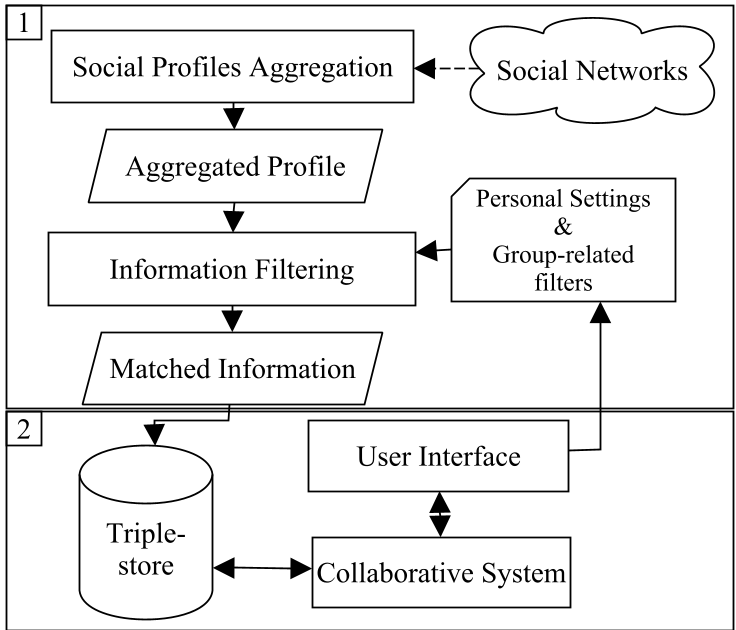 Figure 1: The system architecture illustrating the flow from OSN data collection to Information Filtering and final integration into the Memorae collaboration platform.
Experiments: Real-World Validation
The authors tracked 13 employees at a web development company (50A) over three weeks. The goal was to see if users would share their data and if that data was actually useful.
Key Findings:
- Engagement: 9 out of 13 users linked both Facebook and Twitter, showing a high willingness to contribute if the system is transparent.
- Data Density: On average, users shared 35 links and 50 content items in 21 days.
- The "Signal" Ratio: By manually auditing 100 random shared links, the researchers found that 20% were high-value technical resources (e.g., infographics on social media, new Facebook API logos, Google apps).
 Figure 2: Statistical summary of new content items retrieved per user, showing an average (Avg) of 50 new pieces of digital content over 3 weeks.
Critical Analysis & Conclusion
This work highlights a shift from Individual Intelligence to Collaborative Intelligence. By using FOAF and DBpedia, the authors move beyond simple keyword matching to a "Knowledge Graph" style understanding of user interests.
Limitations: The "Signal-to-Noise" ratio (20%) while significant, still implies that 80% of data needs to be filtered out. The empirical methods (detecting emoticons or "@" mentions) are rudimentary. In a modern context, using Large Language Models (LLMs) for "Zero-shot" relevance classification would likely push this accuracy much higher.
Future Outlook: The integration into the Memorae platform suggests a future where your "Professional Profile" is a living document, automatically updated by your activity across the web, effectively eliminating the need for manual CV updates or internal knowledge sharing reports.