
Socialite: Bridging Social Networks and IoT through End-User Programming
Empowering End Users for Social Internet of Things
The paper introduces Socialite, a novel end-user programming (EUP) tool designed for the Social Internet of Things (SIoT). It combines semantic ontology models with a trigger-action programming interface to allow users to create cross-device automation rules that leverage social relationships, successfully enabling both programmers and non-programmers to manage complex IoT interactions.
TL;DR
Socialite is an innovative framework that transforms the "Internet of Things" into a "Social Internet of Things" (SIoT). By introducing a semantic reasoning engine and a drag-and-drop trigger-action interface, it allows everyday users to create rules that don't just control their own devices, but also interact with those of friends and "kin" devices. The result is a system where a neighbor's smoke detector can trigger an alert on your phone, or a thermostat can learn from the settings of similar models in the community.
Background: Beyond the Siloed Home
For years, the promise of the Smart Home has been limited by manufacturer silos. Your Philips Hue lights rarely talk to your Nest thermostat without a complex third-party bridge. More importantly, the social dimension has been missing. Why can't your home adapt to a guest's preferences automatically? Why can't your appliances learn from the "experiences" (errors and repairs) of other identical appliances?
Socialite addresses this by treating devices as social entities. It leverages Social Capital—the resources embedded in social relationships—to make IoT systems more resilient and collaborative.
The Core Innovation: Social Relationships for Things
The authors define a specific taxonomy of relationships that go beyond human friendship:
- Kinship: Relationships between devices of the same model/manufacturer (e.g., all Bosch dishwashers).
- Thriendship: Friendship between things owned by friends.
- Co-location: Devices or users sharing the same physical space.
- Shared Ownership: All devices belonging to a single user.
Methodology: Semantic Mapping and Production Rules
To handle the mess of different device standards, Socialite uses a Semantic Model. Instead of writing a rule for a "Nest Learning Thermostat Gen 3," a user can write a rule for a "Temperature Sensing Capability." This abstraction is key to scalability.
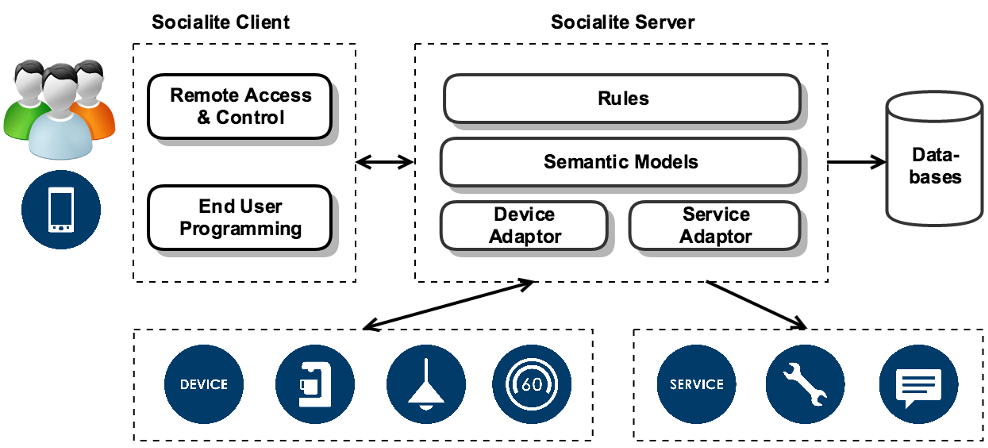
The engine uses Complex Event Processing (CEP) to handle temporal logic (e.g., "If no motion is detected for 30 minutes"). This allows for high-level "Context Generation"—where a user defines a state like "Sleeping" based on a combination of time, light levels, and heart rate.
User Empowerment: The Interface
The research features a web-based client that uses a "Trigger-Action" paradigm. Users drag "Triggers" (IF) and "Actuators" (THEN) into a workspace.
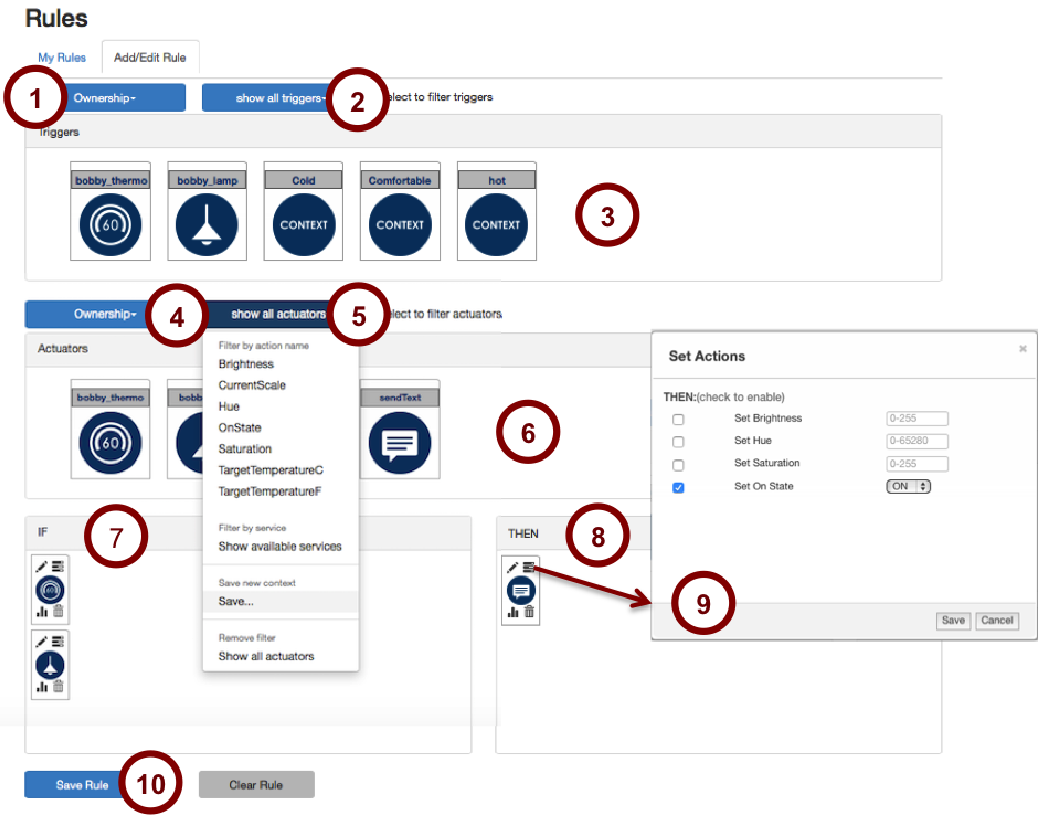
The beauty of this UI is the Filtering by Capability. If you want something to happen when it gets hot, you don't look for a thermometer; you look for the "Temperature" capability, and the system shows you all relevant devices within your social circle (your home, your friend's home, etc.).
Experimental Results: Can Non-Programmers Do It?
The lab study with 24 participants confirmed that the interface is highly intuitive.
- Learning Curve: Both programmers and non-programmers saw a significant decrease in the time required to create rules as they progressed through the tasks.
- Social Rules: Participants found it natural to create rules involving others, such as "If Jenny's smoke detector goes off, text me."
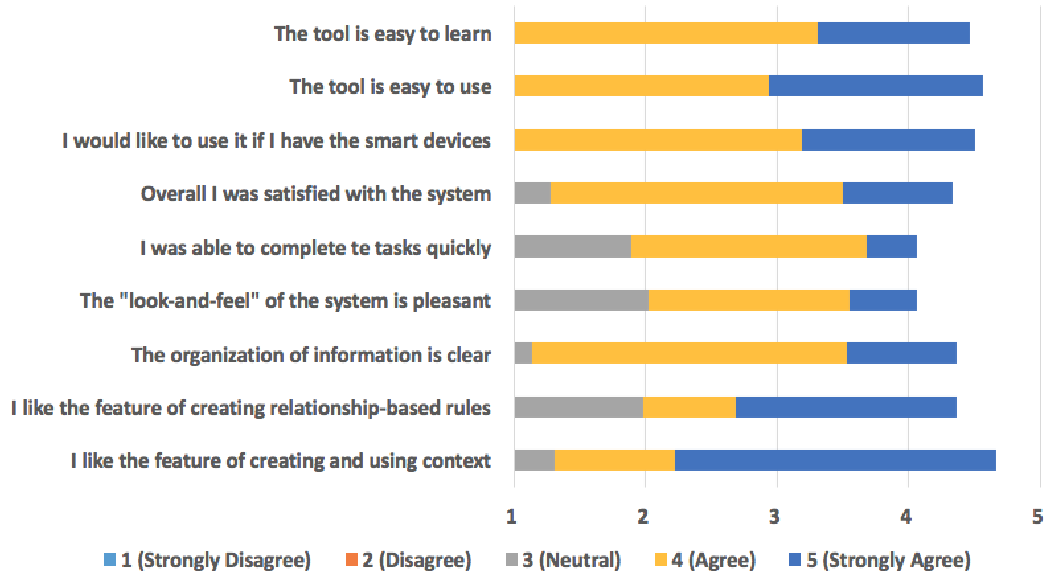
Crucially, while programmers started faster, the gap closed significantly after the first few tasks, proving that the tool "democratizes" IoT programming.
Critical Analysis: The Privacy Elephant in the Room
While the technical framework is sound, the study reveals a major hurdle: Security and Privacy. 52% of survey participants were hesitant about SIoT due to privacy concerns. The idea of a "stranger's device" influencing your home or a "friend" having access to your sensor data requires robust, transparent authentication schemas that are still in the early stages of research.
Conclusion
Socialite is a significant step toward a more collaborative and intelligent IoT ecosystem. By moving from "My Devices" to "Our Devices," it creates a framework for collective intelligence in the smart home, successfully abstracting hardware complexity through semantic reasoning and user-friendly design.