
GTPO: Breaking the Multi-Turn "Stagnation" in Tool-Integrated Reasoning
Empowering Multi-Turn Tool-Integrated Reasoning with Group Turn Policy Optimization
The paper introduces Group Turn Policy Optimization (GTPO), a novel reinforcement learning algorithm specifically designed for multi-turn Tool-Integrated Reasoning (TIR). GTPO enhances Large Language Models by shifting from trajectory-level rewards to fine-grained, turn-level feedback, achieving a 3.0% boost in math benchmarks and a 3.9% improvement in non-math tasks compared to state-of-the-art GRPO.
TL;DR
Training LLMs to use tools iteratively (Tool-Integrated Reasoning, or TIR) has long been hampered by the "sparse reward" problem. Most RL methods only care if the final answer is right, ignoring the quality of intermediate steps. Group Turn Policy Optimization (GTPO) changes the game by treating every interaction "turn" as a discrete decision point, using discounted rewards and code-based similarity to guide the model toward success even when it fails the final test.
Background Positioning: This work represents a significant evolutionary step beyond DeepSeek's GRPO. While GRPO focuses on trajectory-level efficiency, GTPO introduces temporal credit assignment—a classic RL concept—into the modern LLM reasoning paradigm.
The Problem: The "Noisy Credit" Trap
In multi-turn TIR, a model might generate three turns of perfect code but fail on the fourth turn due to a minor syntax error. In a standard GRPO setup, the entire sequence receives a reward of zero.
This creates two major issues:
- Delayed Feedback: The model doesn't know which turn was the culprit.
- Signal Sparsity: "Failure" trajectories, which often contain 90% correct logic, are discarded as useless, wasting valuable training signal.
Methodology: Precision over Coarseness
GTPO addresses these issues by re-engineering the training objective through three core pillars.
1. Turn-level MDP Reformulation
Instead of treating the prompt-to-answer sequence as a single "bandit" arm, GTPO treats every turn as a separate action within a state . This allows for Turn-level Reward Assignment, where the model is penalized for format errors or lack of tool calls immediately at the point of failure.
2. Discounted Return-based Advantage
GTPO introduces the classical RL discount factor . By calculating the "reward-to-go," the model learns that an action taken in Turn 1 has a long-term impact on the final success in Turn 4.
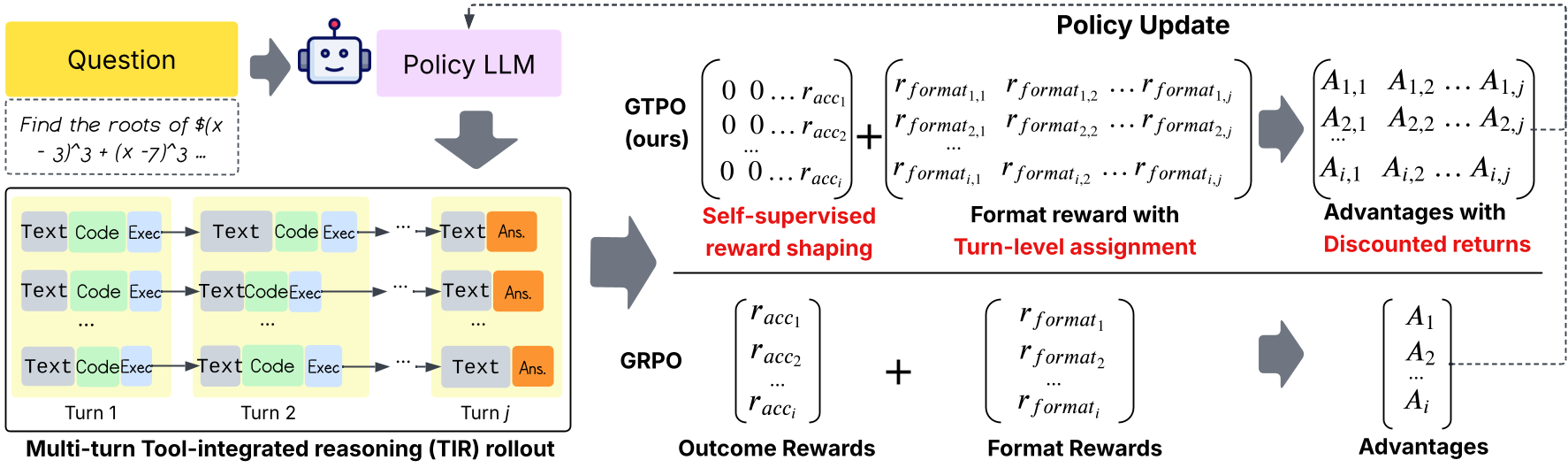
3. Self-supervised Reward Shaping
This is the "secret sauce." If a trajectory is incorrect, GTPO doesn't just give it a 0. It takes the code generated in that failed attempt, embeds it, and compares it to code from successful attempts in the same group. If the code is similar to a successful solution, the model receives a partial "shaping" reward.

Experimental Battleground: Math and Beyond
The researchers tested GTPO primarily on tough mathematical benchmarks (AIME, AMC, MATH 500) using Qwen2.5-7B.
- Peak Performance: GTPO consistently hit higher accuracy peaks than GRPO, surfacing its ability to "explore" more complex reasoning paths.
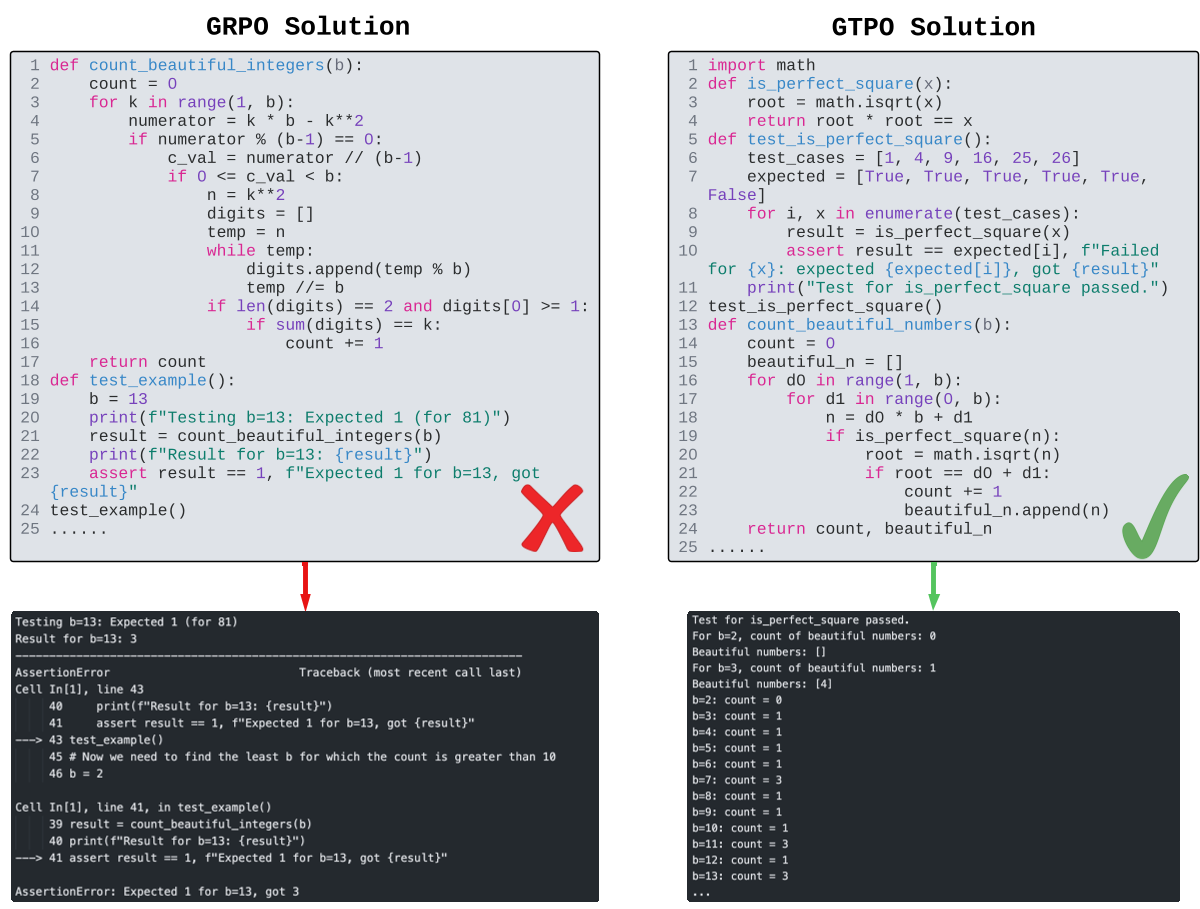
- Code Reliability: It didn't just call tools more often; it called them better. Runtime errors dropped significantly compared to GRPO baselines.
- Generalization: Interestingly, the benefits extended to non-math tasks like HumanEval (Code) and GPQA (Scientific Reasoning), showing that the strategy of "learning from almost-correct code" is a universal booster.
Deep Insight: Why Why Does γ=0.9 Matter?
The ablation study on the discounting factor is a masterclass in RL intuition. At (no discount), the model treats far-future rewards the same as immediate ones, leading to noisy updates. At , it becomes too "short-sighted." The sweet spot at 0.9 provides just enough "temporal decay" to focus the model's attention on the turns most likely to influence the outcome.
Critical Analysis & Conclusion
The Good: GTPO is remarkably efficient. By using off-the-shelf embedding models (like Amazon Titan), it adds almost zero latency to the training pipeline while significantly densifying the reward signal.
The Limitations: The study was limited to 7B models. Whether these fine-grained signals remain as critical for 70B+ models—which may have more inherent "self-correction" capabilities—remains an open question. Furthermore, the reliance on code similarity assumes that "code" is the primary carrier of reasoning logic, which may not hold for purely linguistic reasoning tasks.
Final Takeaway: GTPO signals a shift in LLM training from "sequence-level imitation" to "step-level optimization." For developers building AI agents that use search engines, APIs, or databases, GTPO’s turn-level logic is likely the next standard for fine-tuning.