
Interoperable Social Networks: Selective Data Sharing via Authenticated Dictionaries
Enabling Interoperable and Selective Data Sharing among Social Networking Sites
The paper introduces a privacy-preserving framework for social networking (SN) sites using Authenticated Dictionary (ADT)-based credentials and an extended OpenSocial API. It enables users to selectively share portions of their profile across different platforms without full data disclosure or constant issuer involvement.
TL;DR
This research tackles the "walled garden" problem of Social Networking (SN) sites. By combining Authenticated Dictionaries (ADT) with an extended OpenSocial API, the authors allow users to carry their certified identity attributes from one site to another, sharing only what is necessary (e.g., birthdate but not address) without the original site tracking their activity.
Background: The Privacy-Interoperability Paradox
In the modern social landscape, your digital identity is fragmented across platforms. While initiatives like Facebook Connect tried to bridge this gap, they introduced a major privacy flaw: the "Identity Provider" knows exactly where and when you use your data. Moreover, you are often forced into an "all or nothing" disclosure.
The authors identify two critical gaps:
- Lack of Interoperability: Data is stuck in the silo where it was created.
- Lack of Granularity: You cannot prove a single fact (like being over 21) without handing over your whole profile.
Methodology: The Power of Authenticated Skip Lists
To solve this, the paper moves away from expensive "heavyweight" cryptography like Zero-Knowledge Proofs (ZKP), which were computationally taxing at the time. Instead, they use a data structure called an Authenticated Skip List.
1. How the ADT Credential Works
An Authenticated Dictionary uses commutative hashing. In this structure, user attributes (name, email, age) are hashed and placed into a Skip List. The "root" of this list is signed by the issuing SN site.
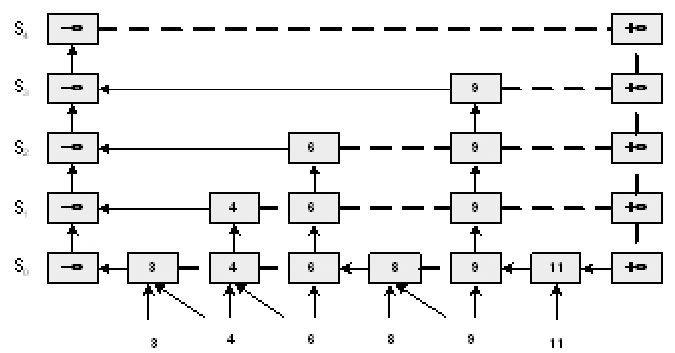 Fig 1: A Skip List structure (left) and how a search path is generated (right).
When a user wants to prove they have a specific attribute, they don't send the whole list. They send:
- The specific attribute value.
- The "path" of hashes in the dictionary needed to re-calculate the signed root.
The verifier hashes the provided attribute and follows the path. If the calculated result matches the signed root from the original SN site, the attribute is verified!
2. Extending OpenSocial
To make this practical, the authors modified the OpenSocial API. They introduced the newDataRequestEx method, which allows a third-party gadget to ask for data not just from the local server, but from a "Remote Site" or a "Credential" stored by the user.
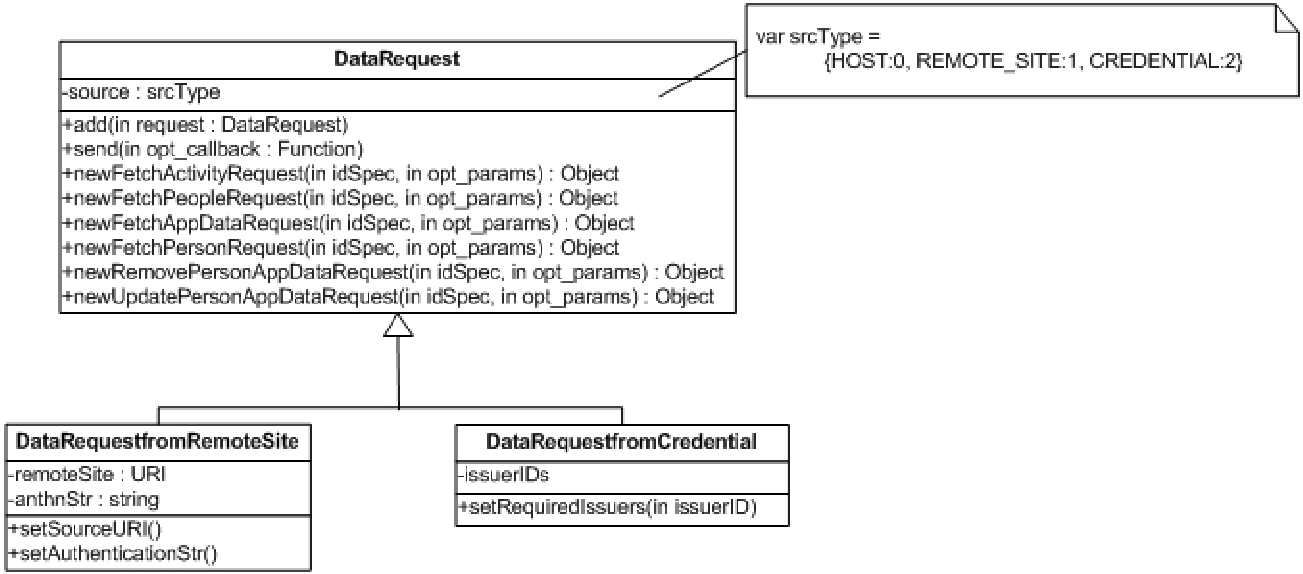 Fig 2: UML diagram showing the extension of DataRequest objects to support external credentials.
Experimental Validation
The team developed a prototype using Apache Shindig to prove that these credentials can be managed in a web environment.
- Efficiency: Proving an attribute is , making it incredibly fast compared to RSA-based anonymous credentials.
- User Control: The user interface allows individuals to "pick and choose" which attributes from their "Social Card" are sent to an application.
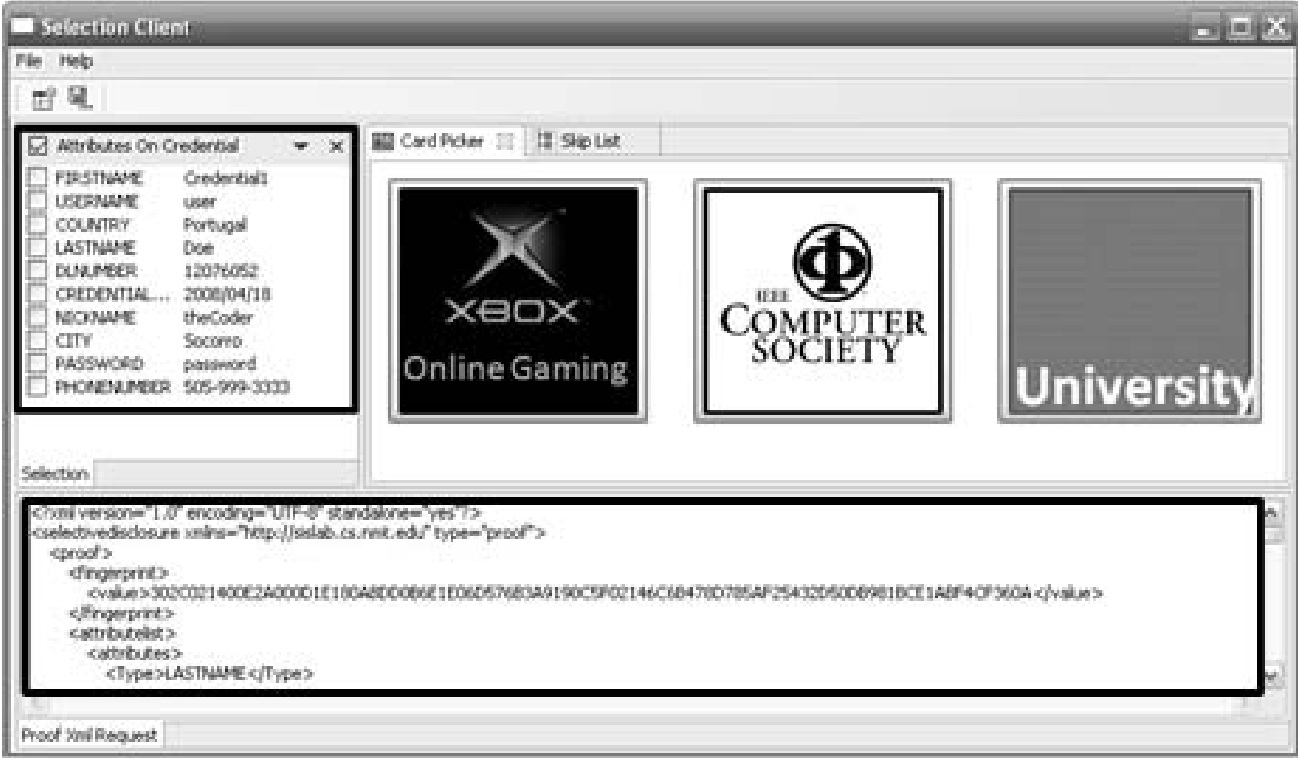 Fig 3: The implemented Credential Management UI where users select specific attributes for disclosure.
Critical Insight & Future Outlook
While this paper was written during the peak of the OpenSocial movement, its core logic is more relevant today than ever. With the rise of the Fediverse (Mastodon) and Decentralized Identifiers (DIDs), the idea of a portable, authenticated, and selective credential is the "holy grail" of digital sovereignty.
Limitations: The primary challenge left unaddressed is revocation. If a user changes their age or name, the old ADT-based credential remains cryptographically valid until it hits an expiration date, creating a window of inconsistency.
Conclusion: By leveraging efficient data structures over complex math, Shin and Lopes demonstrated that we don't need to sacrifice performance for privacy. This work serves as an early blueprint for what we now recognize as the Self-Sovereign Identity (SSI) movement.