
MobiTribe: Solving the Privacy-Cost Dilemma in Mobile Social Networks
Enabling mobile distributed social networking on smartphones
MobiTribe is a distributed mobile social networking architecture that utilizes smartphones to host and share User Generated Content (UGC). It employs a connectivity-aware replication strategy and a novel grouping algorithm (bipartite b-matching combined with greedy heuristics) to achieve high content availability while significantly reducing cellular data costs and battery consumption.
TL;DR
MobiTribe is a decentralized social networking framework designed specifically for the smartphone era. By grouping users into "Tribes" based on their WiFi connectivity patterns, it ensures that your data stays on friend-owned devices rather than corporate servers—without destroying your battery life or data plan. It achieves a 43% reduction in 3G traffic and a 41% reduction in energy use compared to previous distributed models.
Background: The Price of Privacy
In 2012, as social media boomed, the industry faced a fork in the road. Centralized giants offered convenience at the cost of privacy, while distributed efforts like Diaspora struggled with mobile limitations. The core issue was simple: treating a smartphone like an "always-on" server is a recipe for a dead battery and a massive phone bill.
The researchers behind MobiTribe identified a critical "Research Intuition": if we can predict when users will have access to "free" networks (like home/work WiFi), we can intelligently replicate content so that it’s always reachable via at least one "tribe" member who is currently on a low-cost connection.
Methodology: The "Tribe" Selection Algorithm
The paper formalizes the Device Grouping (DG) problem. The goal is to maximize content availability (the probability that at least one replica is online) while adhering to two constraints:
- Limit of Replication: Don't waste storage by making too many copies.
- Limit of Hosting (Fairness): Don't drain the battery of the person with the best WiFi by making them host everyone's data.
The Bipartite b-Matching Insight
While the general problem is NP-Hard, the authors discovered a "tractable sweet spot." When the tribe size is limited to 2-3 members, the problem can be reduced to a Bipartite b-matching computation.
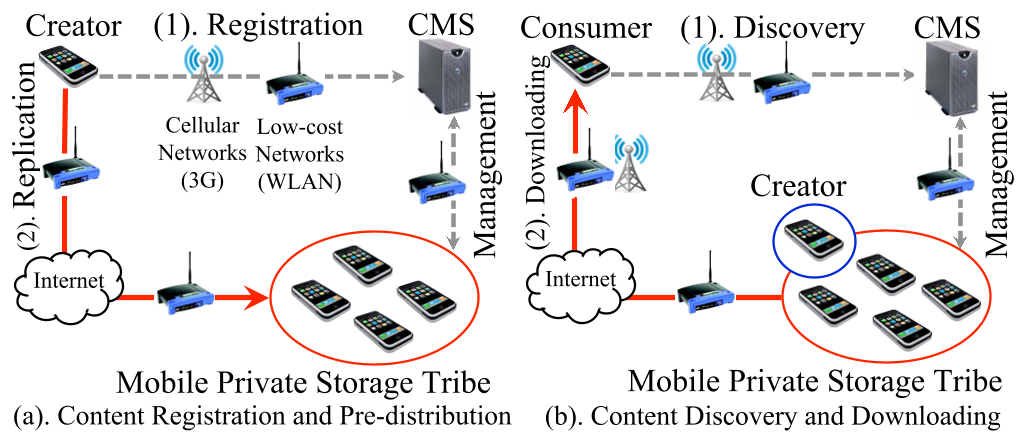 Figure 1: The MobiTribe architecture uses a Content Management Server (CMS) to coordinate peer discovery while keeping the actual data storage distributed.
The system uses a Content Management Server (CMS) as a lightweight coordinator. It doesn't store your sensitive photos; it only knows who has them and when they are likely to be online.
Experimental Results: Efficiency via Intelligence
Using real-world connectivity traces ( Rice Community and CoSphere data sets), the team proved that random replication is highly inefficient.
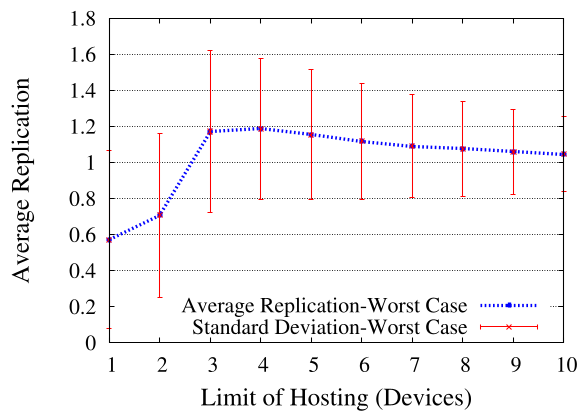 Figure 2: Performance metrics show that targeting specific complementary users achieves ~100% availability with only ~1.2 additional replicas, whereas random selection requires 7+ replicas.
Key Quantifiable Gains:
- 3G Savings: By effectively offloading to WiFi, creators save nearly half their cellular data compared to "naive" distributed servers.
- Energy Efficiency: Because 3G/4G radios consume significantly more power per bit than WiFi, the MobiTribe approach brings the energy footprint of decentralized systems down to the level of centralized ones.
- Availability: A tribe of just 2-3 users, if correctly selected, can provide "carrier-grade" content availability.
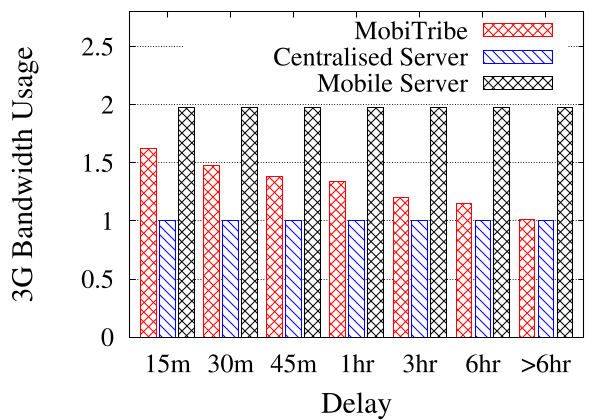 Figure 3: 3G Bandwidth usage comparison showing MobiTribe's advantage over "Mobile Server" (Diaspora-like) architectures.
Critical Insight & Conclusion
The genius of MobiTribe isn't just in the math—it's in the recognition of time elasticity. Most social media updates don't need to be delivered in milliseconds; a 1-6 hour delay for pre-distribution is acceptable if it means total privacy and zero cost.
Takeaway: This work proves that peer-to-peer storage is not just a desktop technology. By accounting for the unique "physics" of mobile networks (battery limitations and connectivity switching), we can build social systems that are both private and sustainable.
Limitations: The reliance on a centralized CMS for tracking presents a single point of failure and a potential (though limited) privacy leak. Future work would likely investigate fully decentralized trackers using Distributed Hash Tables (DHTs) optimized for mobile.