
The Social Enabler: Orchestrating Multimedia Intelligence via Social Context
Enabling Next Generation Multimedia Social Services
The paper introduces a "Social Enabler" (SE) architecture designed to securely extract, standardize, and enrich data from disparate social networks to personalize multimedia services. It leverages an external framework to calculate advanced social metrics like similarity, influence, and distance, achieving real-time social data exposure for third-party providers.
TL;DR
This paper presents the Social Enabler (SE), a middleware architecture designed to break the "walled gardens" of social media platforms. By standardizing social data and applying custom algorithms (Distance, Similarity, Influence), it provides third-party multimedia services with the "social-aware" context needed to boost user Quality of Experience (QoE).
Background: The Fragmented Social Landscape
As of the paper's context, over 130 social platforms existed with billions of users, yet their data remained siloed. For a multimedia service to be truly personalized, it needs to know not just who you are, but how you relate to others. The authors identify a gap: while we have raw data, we lack a secure, standardized way to expose reasoned social knowledge—such as who actually influences your decisions—to external services.
The Insight: From Raw Data to Social Metrics
The core contribution is a brokerage system that transforms raw API data into enriched social intelligence. The authors argue that simple profile matching isn't enough; we must quantify the strength and direction of human relationships.
The Architecture
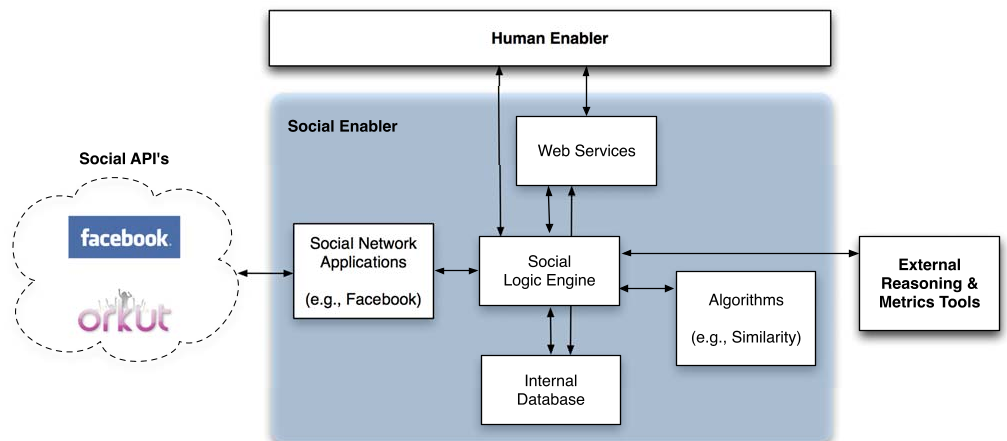
The Social Enabler is divided into four functional blocks:
- Social Network Application: The front-end interface (e.g., a Facebook App) that handles the initial data "leeching."
- Social Logic Engine: The "brain" that processes queries and orchestrates data flow.
- Internal Database: Maps disparate social identities into a unified "Human User" profile.
- Algorithm Module: A pluggable component for calculating Distance, Similarity, and Influence.
Mathematical Intuition: Quantifying Connection
The authors define three pillars of social reasoning:
- Distance (): An iterative set-based approach to determine the "degrees of separation" between peers.
- Similarity (): A weighted keyword-matching algorithm. It prioritizes specific attributes like shared groups or interests over generic data like name or gender.
- Influence (): A directional metric calculating the interaction density (likes, comments, wall posts) from one user to another.
Crucial Logic: To match real-life social behavior—where most people have only a few "close" friends—the authors apply a Normal Distribution adjustment () to these results. This ensures that the system doesn't over-value casual acquaintances.
Experimental Results: Performance and Depth
The authors tested the prototype with real Facebook users to evaluate if such a system could survive real-world latency requirements.
Linear Scalability
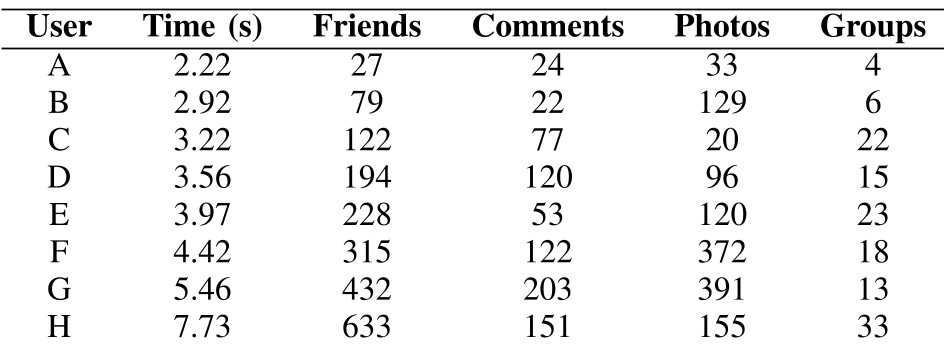
The "leeching" process proved highly efficient. Even for a user with over 600 friends, the system extracted the entire profile and relationship tree in under 8 seconds. This performance confirms that social context can be gathered in real-time without disrupting the user experience.
Advanced Topology Mapping
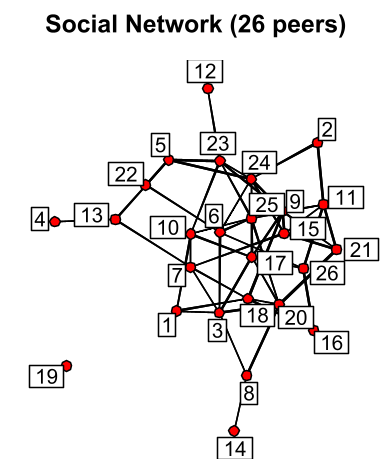
Beyond basic links, the SE integrated with the statnet R-package to visualize degree centrality and betweenness. This allows services to identify "hubs" (users with many connections) and "bridges" (users who connect different social clusters), which is invaluable for targeted advertising and content distribution.
Deep Insight & Future Outlook
The "Social Enabler" represents a pivotal shift from treating social data as static metadata to treating it as a dynamic, relational graph.
Key Takeaways:
- Privacy First: The framework relies on a "Human Enabler" to manage the secure and authorized exposition of sensitive data.
- Business Value: By understanding "Influence," multimedia owners can optimize content delivery (e.g., pre-caching a video for a user whose close friend just watched it).
- Limitations: The keyword-matching approach for similarity is basic. Future iterations should incorporate Ontologies and Semantic Web technologies (like RDF) to better understand the meaning behind shared interests.
Ultimately, this work lays the groundwork for services that don't just "deliver content," but "understand the community" they serve.