
AI at the Edge: Transforming Precision Agriculture with Embedded LSTM Sensing
Enabling Precision Agriculture Through Embedded Sensing With Artificial Intelligence
The paper introduces a low-power embedded AI system for precision agriculture that performs in situ prediction of plant growth dynamics. By deploying a Long Short-Term Memory (LSTM) network on a Raspberry Pi integrated with an Intel Movidius Neural Compute Stick, the system achieves autonomous leaf area analysis and growth forecasting while maintaining extreme energy efficiency.
TL;DR
Researchers have developed an autonomous, low-power embedded system that uses LSTM Recurrent Neural Networks to predict plant growth directly on the device. By combining a Raspberry Pi with an Intel Movidius GPU, the system achieves 180 days of battery life while maintaining a high prediction accuracy (RMSE ~8.6 for a 3-hour horizon), effectively eliminating the need for constant cloud connectivity in remote farming.
Motivation: The Connectivity and Power Bottleneck
In the quest for "Precision Agriculture," we've traditionally relied on two extremes: simple threshold-based sensors (low intelligence) or high-bandwidth cloud-based data processing (high energy/cost).
The authors identified a critical gap: Remote areas lack the infrastructure for high-performance cloud computing. Moreover, "bottom-up" mathematical models for plant growth are notoriously sensitive to hidden environmental variables. The solution? A data-driven, edge-computing approach that treats plant growth as a time-series prediction problem, solved entirely in situ.
Methodology: Squeezing AI into Tiny Hardware
The core contribution lies in the synergy between lightweight neural architectures and specialized hardware.
1. The LSTM Advantage
Traditional models struggle with "long-term dependencies"—essentially forgetting how a plant looked three days ago when predicting tomorrow. The authors utilized a Long Short-Term Memory (LSTM) network. Through an ablation study, they optimized the network to just 4 LSTM units (178 trainable parameters). This tiny footprint is crucial: it prevents overfitting on small datasets (400 samples) and runs efficiently on limited RAM.
2. Hardware Architecture: Raspberry Pi Meets Movidius
The system doesn't rely on the Raspberry Pi's CPU for AI. Instead, it offloads the heavy lifting to an Intel Movidius Neural Compute Stick (NCS).
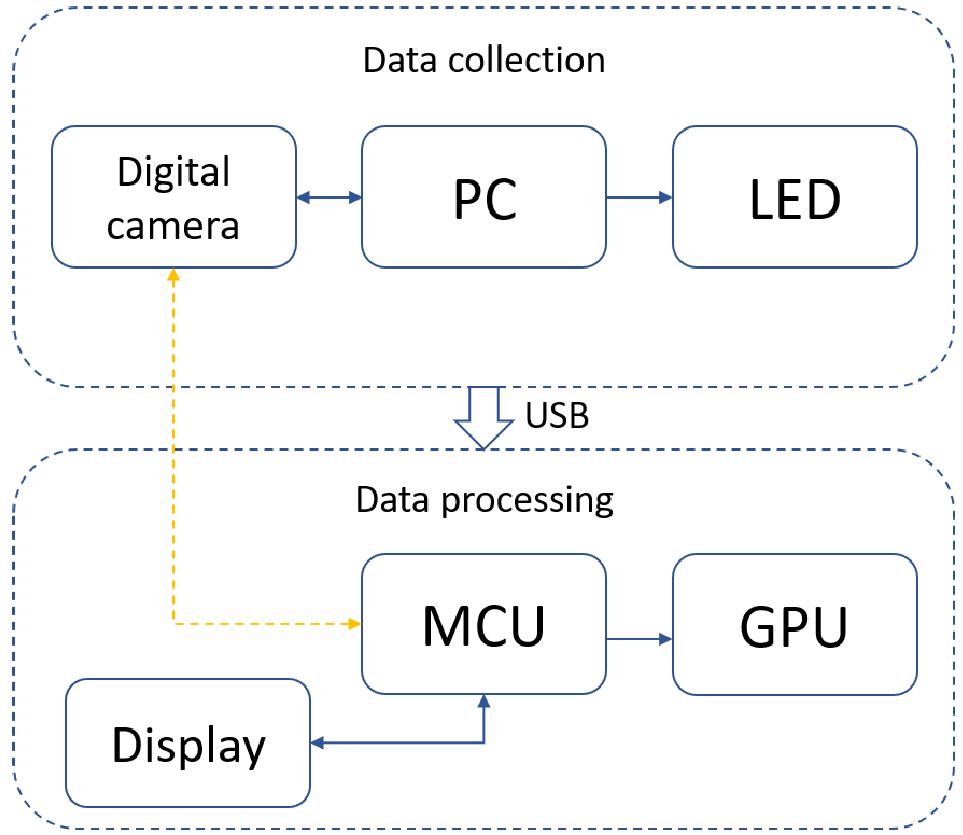 Figure 1: The integration of the GPU (Intel Movidius) with the Raspberry Pi ensures that high-dimensional data processing doesn't drain the battery.
Experimental Results: Precision and Longevity
The researchers tested 48 dwarf tomatoes across six different nutrient solutions (e.g., "Base + P", "Hoagland").
- Accuracy: The model successfully predicted leaf area dynamics, including the subtle diurnal fluctuations (the "circadian rhythm" of the plant). The RMSE (Root Mean Square Error) remained stable around 8.30 for test datasets.
- Efficiency: By utilizing a sleep mode and a 3.4% duty cycle (waking up briefly every 30 minutes to take a photo and predict), the system achieves a massive 180-day autonomous lifespan.
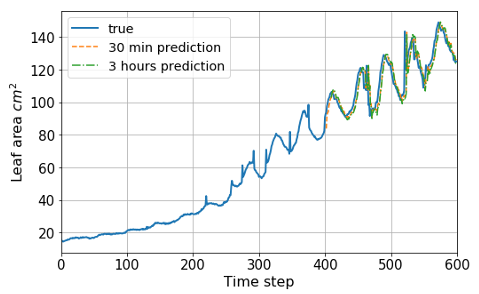 Figure 2: The model's prediction (red) vs. Ground Truth (blue). Note the accuracy in capturing the cyclic growth patterns.
| Metric | Desktop Computer | Embedded Prototype |
|---|---|---|
| Median Prediction Time | 0.55s | 2.98s |
| Power Consumption (Idle) | 4.5W | 2.5W (Total) |
| Autonomous Operation | Hours | 6 Months |
Critical Insight: Why Local AI Matters
The value of this research isn't just in the accuracy—it's in the autonomy. Because the model is pre-trained and executed locally:
- Privacy/Security: Data never leaves the greenhouse.
- Reliability: It works even if the Wi-Fi or cellular network drops.
- Cost: Zero data transmission costs and minimal power bills.
Limitations & Future Work
While the 2-D image processing works well for young plants, leaf overlap remains a challenge for more complex structures. The authors suggest that future iterations could incorporate 3-D imaging or multi-spectral data. Additionally, the current workflow requires pre-training on a desktop; on-device "online learning" remains a distant but desirable goal for edge-AI.
Conclusion
This work marks a shift from "Connected Agriculture" (IoT) to "Intelligent Agriculture" (Edge AI). By proving that an LSTM can run for half a year on a single battery, Shadrin et al. have provided a blueprint for the next generation of autonomous ecological monitoring tools.
Technical Note: The authors have released the Tomato Growth Dataset to the public to encourage further benchmarking of plant segmentation and growth dynamics.