
SQTime: Bridging the Gap Between Social Graphs and Temporal Dynamics
Enabling Social Search in Time through Graphs
The paper proposes a comprehensive framework for social search called SQTime, which integrates graph-structured social data with temporal annotations. It introduces a time-aware data model and a logical algebra designed to handle complex user-centric and system-centric queries across dynamic social networks.
TL;DR
Social networks are not static; they are living, breathing entities. This paper introduces a framework that moves beyond simple "who-knows-who" lookups by injecting a temporal dimension directly into the social graph. By using annotated intervals and a custom logical algebra, the authors enable complex queries that respect time—such as finding friends active during specific periods—and rank results based on the "freshness" of interactions.
Background & Motivation: The Static Graph Trap
Most traditional social search systems treat the social graph as a snapshot. Even systems like Facebook's Unicorn (at the time of this paper's publication) focused heavily on structural connectivity while treating time as a secondary attribute.
The authors identify two fatal flaws in the status quo:
- Structural Evolution: Users join, leave, and rejoin; relationships form and dissolve.
- Contextual Relevance: A friend's interest in a concert from three years ago shouldn't carry the same weight as an event they joined last week.
Instead of expensive and redundant "snapshotting" (storing the whole graph for every point in time), this work proposes an Annotated Graph Model.
Methodology: Logic, Time, and Algebra
The core innovation lies in treating time as a label rather than a separate table. Each node () and edge () is assigned a set of disjoint intervals .
1. The Query Model
The paper categorizes social search into two pillars:
- User-Centric: Queries centered around a reference node (e.g., "Find photos my friends liked").
- System-Centric: Queries from a global perspective for marketing or group discovery (e.g., "Find all users attending CIKM 2014").
2. The Logical Algebra
To implement these, the authors defined a set of operators that can be mapped to a DBMS. The most critical operator developed is the Temporal Select Node (), which filters nodes based on predicates (), entity type (), and time constraints ().

3. Ranking for Freshness
Ranking is where the "Social Winner" logic comes in. Rather than just returning a set, the Temporal Social Rank Operator () recursively identifies the "freshest" nodes based on the latest of the edges connecting them. This ensures that the results reflect current trends rather than historical noise.
Experiments & Visual Evidence
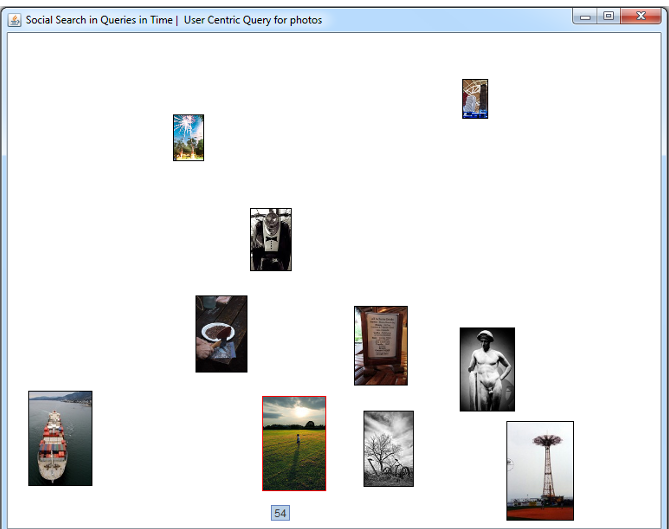
The authors validated their framework using the SQTime Prototype, built using data from Flickr (user links, photos, favorite markings).
Visualizing Freshness
In the SQTime interface, the system uses visual cues to represent temporal relevance:
- For Objects (Photos): Results are displayed in varying sizes. Larger photos indicate "fresher" content.
- For Users: A graph displays connections, with shades of green indicating activity levels—bolder colors represent higher ranked, more recently active users.
Critical Insight: Beyond Snapshots
The strength of this work is its Inductive Bias toward time. By embedding time into the algebra itself:
- Efficiency: It avoids the storage overhead of multi-snapshot systems.
- Flexibility: It supports "Before," "After," "During," and "Point" queries within a single mathematical framework.
Limitations & Future Work
While the logical algebra is rigorous, the paper leaves the Physical Layer optimization (how these operators perform on massive 1B+ node graphs) as a future challenge. Furthermore, as we move into the era of Graph Neural Networks (GNNs), translating these algebraic constraints into learnable embeddings is the next logical step in social search evolution.
Conclusion
"Enabling Social Search in Time through Graphs" serves as a foundational blueprint for dynamic information retrieval. It reminds us that in the social world, when something happened is often just as important as what happened.