
Enacted Virtual Partnerships: Orchestrating Material Agency in Organic Farming
Enacted virtual partnerships: Imbrications of representations of boundary artifacts and cloud services
This paper proposes a socio-material framework for "Enacted Virtual Partnerships" by leveraging the imbrication of digital representations. Using a case study in regional organic farming, it demonstrates how blending boundary artifacts with generic cloud services (Google Calendar, Disqus, Flickr) enables effective cross-organizational collaboration and coordination.
TL;DR
This research explores how virtual partnerships are born not through simple connectivity, but through the imbrication of representations. By layering digital artifacts like shared calendars, argumentation threads, and visual evidence from cloud services, the authors demonstrate a framework that transforms isolated physical routines in organic farming into a highly coordinated, cross-organizational digital ecosystem.
Positioning: Beyond the "Black Box" of Collaboration
In the landscape of Inter-organizational Information Systems (IOIS), most technologies are viewed as static "best-practice" packages that organizations must adapt to. This paper shifts the paradigm. Drawing on Sociomaterial Theory, it argues that the "IT artifact" is not a neutral tool but a "material agent" that, when layered correctly with human intent, creates new spaces for collective action. It occupies a unique space between Computer-Supported Cooperative Work (CSCW) and Management Information Systems (MIS), focusing on the evolutionary transition from physical to virtual practice.
Problem & Motivation: The Boundary Trap
Traditional collaboration tools often fail because they treat boundaries (geographical, organizational, or knowledge-based) as problems to be solved or static walls. In complex sectors like organic farming—characterized by high risk, strict regulation, and fragmented actors—standardized ERPs or CRMs create "lock-in" effects. They lack the flexibility to capture the informal, situated knowledge (the "human mind" data) that actually drives trust and coordination at the boundary.
The authors' insight is profound: Virtuality is not just digitization. It occurs when digital representations substitute for physical objects and processes, requiring a new "linguistic vocabulary" for connectivity.
Methodology: The Power of Imbrication
The core of the paper is the Theoretical Scaffold for Imbrications (Figure 1). Imbrication refers to the arrangement of distinct elements in overlapping patterns so they function interdependently.
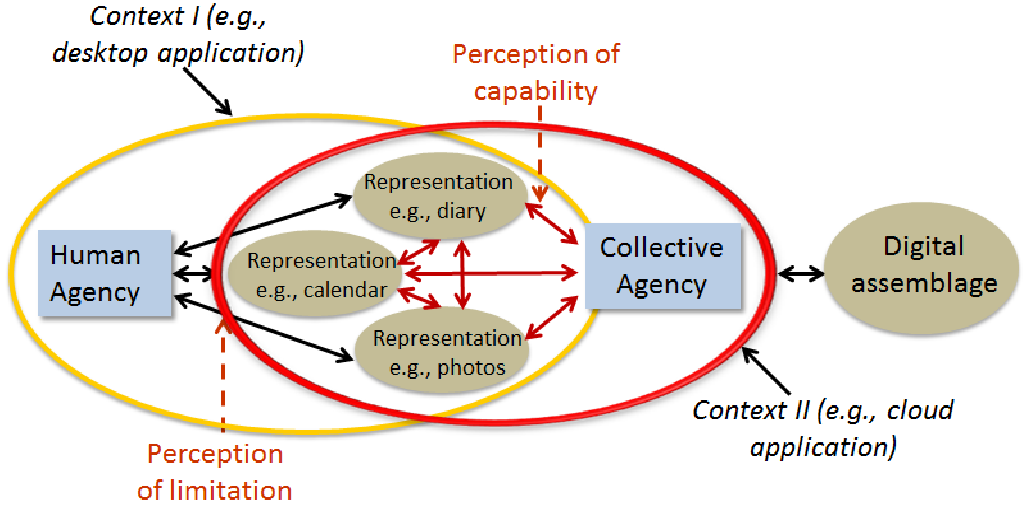
The authors broke down the transition into three stages:
- Work on/with representations: Individual farmers using digital tools to record their own activities.
- Work through representations: Using these tools to communicate and span knowledge boundaries.
- Work within representations: Creating a shared workspace where the partnership itself is "enacted."
The Multi-Cloud Architecture
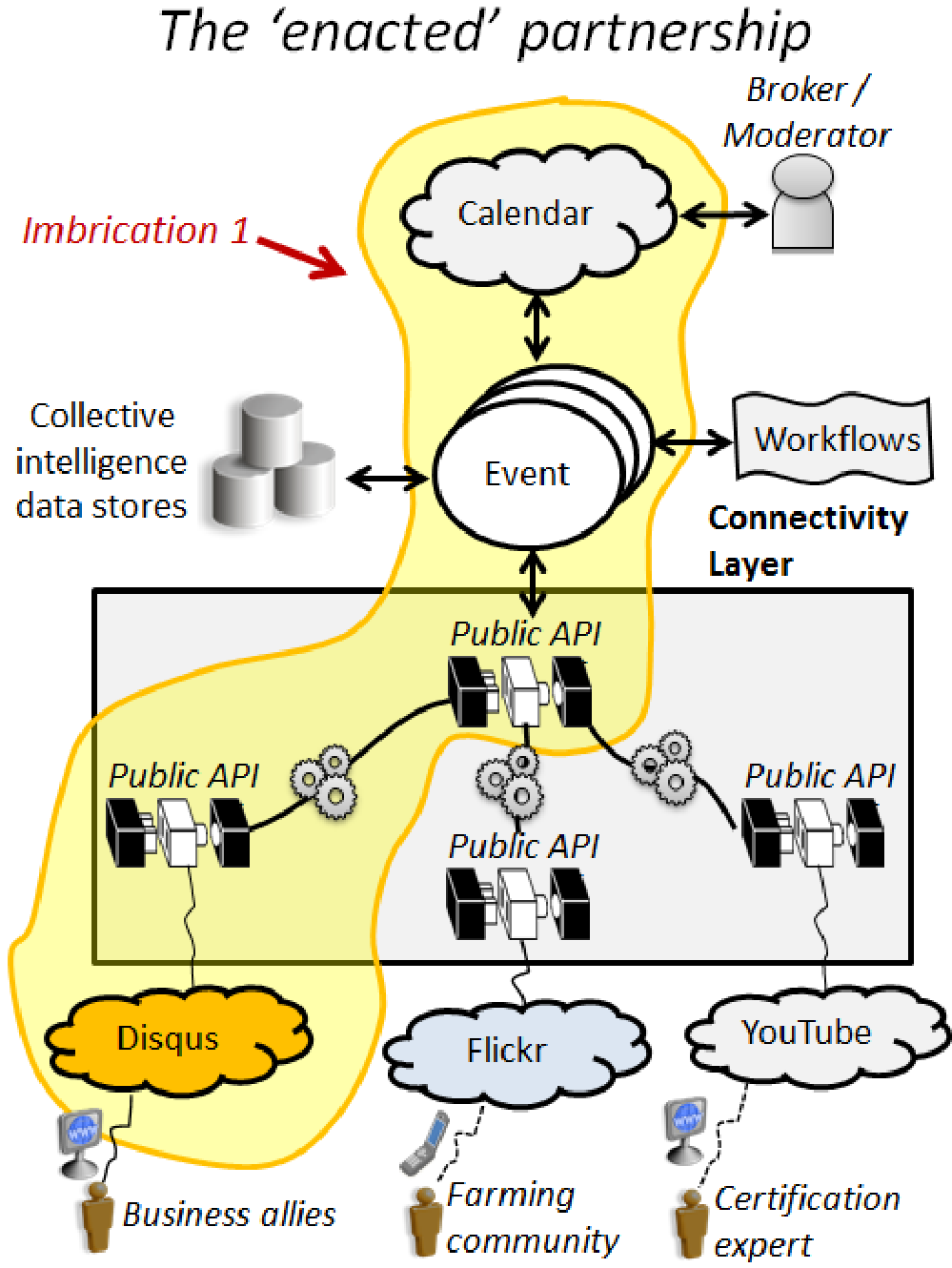
To realize this, the researchers did not build a monolithic app. Instead, they used an Architectural Pattern for Imbrications (Figure 3) that combined specialized cloud services:
- Google Calendar: For syntactic coordination (Schedules).
- Disqus: For semantic and pragmatic negotiation (Dialogue acts).
- Flickr: For anchoring evidence (Photos of field incidents/incidents).
Experiments & Results: Remediating Practice
Applying this to an organic farming alliance (Bio-DRASIS), the study revealed how digital traces replace paper-based farming books.
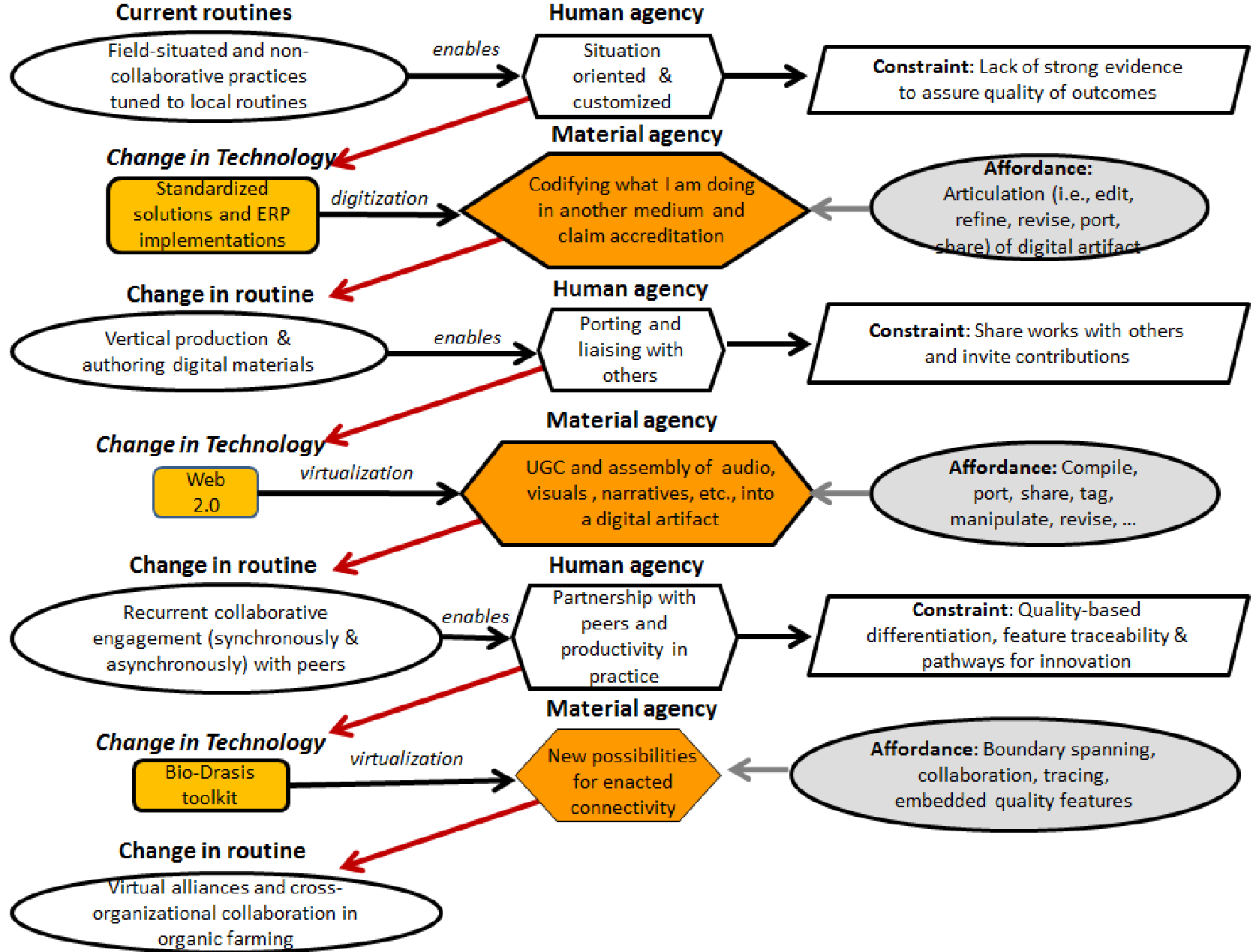
The results showed that:
- Visibility: Elements of practice previously invisible (like informal advice) became persistent and searchable assets.
- Discontinuity vs. Novelty: While switching to digital media initially disrupted familiar routines, it provided new "affordances" for peer collectivity that were previously impossible.
- Human-Material Agency: The partnership was "enacted" when the system enabled "porting and liaising"—allowing a producer's field photo to trigger a specialist's advice within a shared calendar event.
Critical Analysis & Conclusion
The value of this work lies in its rejection of "one-size-fits-all" software. It posits that a mix of flexible representations is required to smooth out discontinuities in practice.
Limitations: The study is in its early stages and acknowledges that "medium switching" creates friction. Adoption depends heavily on the practitioners' willingness to re-orient their professional identity around digital traces.
The Takeaway: For developers and architects of B2B platforms, the message is clear: Stop building silos. Success in cross-organizational collaboration comes from imbricating generic, high-utility services into a specific linguistic context that mirrors the nuances of the physical work environment.