
EnCore: Redefining Private Proximity-Based Networking Through Secure Encounters
EnCore: Private, Context-based Communication for Mobile Social Apps
EnCore is a privacy-preserving mobile communication platform that leverages "secure encounters" between devices via Bluetooth 4.0. It enables ad-hoc event-based sharing and discovery without relying on a trusted cloud provider, achieving SOTA performance in energy efficiency and cryptographic discovery.
TL;DR
EnCore is a decentralized communication platform for mobile social apps that eliminates the need for a "trusted" cloud broker. By utilizing Bluetooth 4.0 Low Energy (BLE) and a novel protocol called SDDR.4, it allows users to discover nearby friends or strangers, share content, and form "Events" without leaking their identity or location to third parties.
Background: The Privacy Paradox of Social Apps
In the current mobile landscape, "context-awareness" usually comes at a steep price: your privacy. Apps like Foursquare or Highlight require you to upload your GPS coordinates and social circles to a central server. This creates a "honeypot" of sensitive data prone to breaches or surveillance. While D2D (Device-to-Device) technologies like AirDrop exist, they lack the ability to organize interactions into persistent, searchable "events" or to protect users from hardware-level tracking via static MAC addresses.
The Core Innovation: Secure Encounters & SDDR.4
EnCore’s brilliance lies in its use of Secure Encounters. An encounter occurs when two devices come within Bluetooth range, automatically generating a unique ID and a shared secret key.
1. Breaking the Tracking Cycle
Most Bluetooth devices are trackable because their MAC address remains static. EnCore implements a protocol that rotates the MAC address and Diffie-Hellman keys every "epoch" (approx. 15 minutes).
2. Overcoming BLE Payload Limits
The Bluetooth 4.0 specification limits advertisement payloads to just 31 bytes—too small for a full cryptographic beacon. To solve this, the authors modeled the advertisement channel as a packet-erasure channel. They used Reed-Solomon (RS) coding to segment the Diffie-Hellman public key and Bloom filters across multiple broadcast packets.
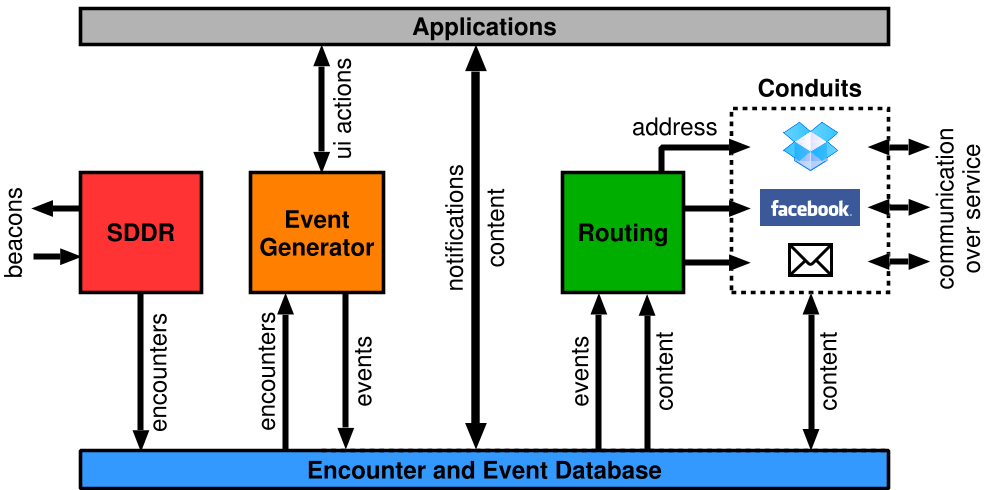 Figure 1: The EnCore Architecture, showing the flow from SDDR Handshake to the Event Generator and Conduits.
Methodology: From Encounters to "Events"
While an encounter is a raw D2D link, an Event is a socially relevant grouping.
- Ad-hoc Creation: Users can select recent encounters (identified by signal strength or nicknames) to form a group.
- Conduits: EnCore doesn't reinvent the wheel for data transport. It uses "Conduits" (Dropbox, Facebook, or SMTP) as encrypted storage/relay points. The "Router" decides whether to send data pairwise or via a shared cloud folder based on availability.
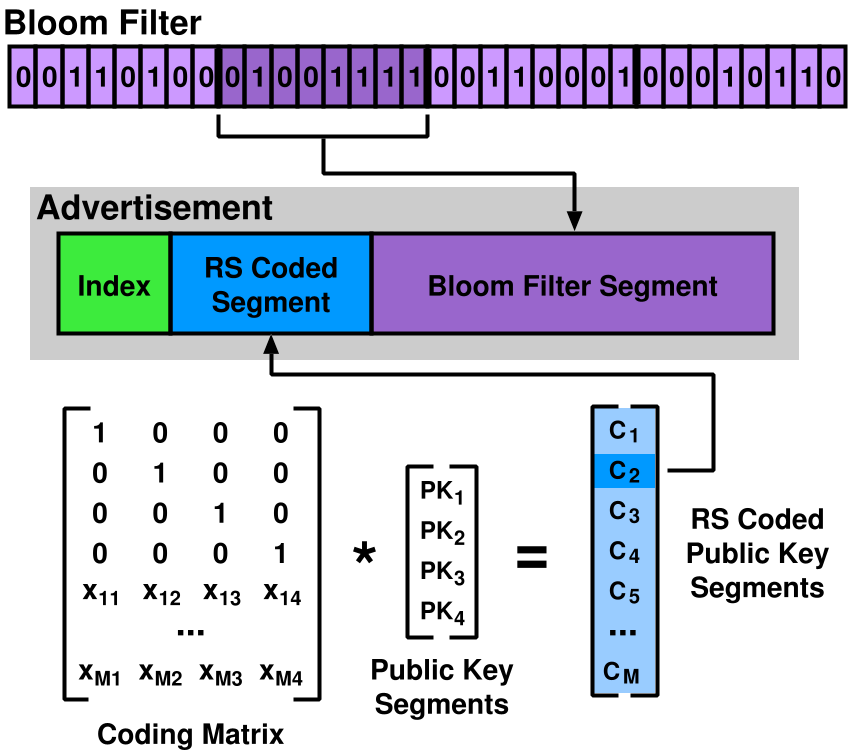 Figure 2: The RS-coded beacon structure allowing large cryptographic keys to be transmitted over tiny BLE advertisement packets.
Real-World Performance
The researchers deployed "Context" (an app built on EnCore) to 35 users over several weeks.
- Efficiency: Running the protocol in the background had a "negligible" effect on battery life. The power consumption of SDDR-4 discoveries was measured at ~236mW, significantly lower than active screen usage.
- Usage Patterns: Users didn't just use it for meetings; they used it to share leftover food at the office, coordinate coffee breaks, and exchange notes after karaoke nights.
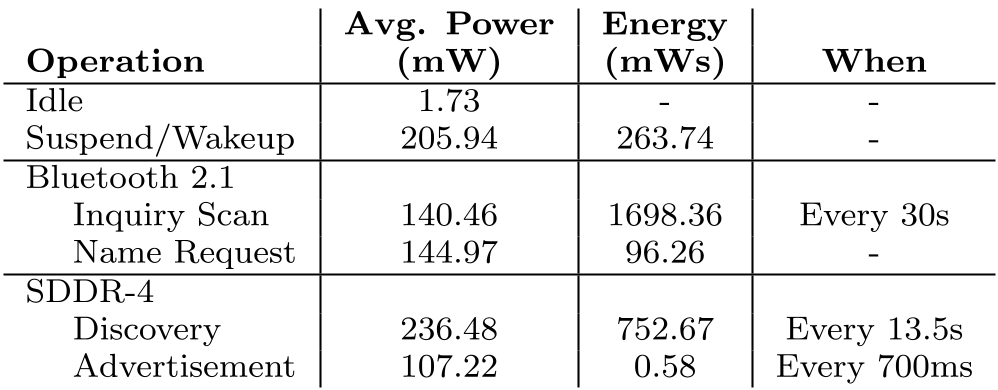 Table 1: Detailed breakdown of the energy cost for SDDR-4 operations.
Critical Insight: The "Stranger" Problem
One of the most challenging aspects of D2D social networking is identifying "who is who" in a crowd. EnCore uses Selective Linkability. If you are already "friends" with someone, your Bloom filter matches theirs, revealing their identity. To others, you remain a one-time pseudonym.
The paper honestly addresses the "dense environment" challenge—distinguishing someone in the next room from someone across the table. They suggest using "audio chirps" (fast-attenuating signals) as a future mechanism to verify physical co-presence in the same room.
Conclusion
EnCore proves that we don't have to sacrifice our "whereabouts" to enjoy the benefits of proximity-based social networking. By combining robust cryptographic primitives with the lightweight broadcast capabilities of Bluetooth 4.0, it sets a new standard for decentralized, privacy-first mobile platforms.
Takeaway: Future social protocols should prioritize "Identity at the Edge," where the user's device, not a cloud server, owns the context of the social interaction.