
Revitalizing Small SNS: Why Retention Trumps Acquisition
Encouragement Methods for Small Social Network Services
The paper proposes an agent-based simulation model to analyze user behavior in small-scale Social Networking Services (SNS). By modeling "Login Frequency" and "Communication Frequency," the researchers compare the effectiveness of two growth strategies, identifying that encouraging existing users' logins is significantly more successful than inviting new users.
TL;DR
Building a social network is easy; keeping it alive is the real challenge. This paper utilizes agent-based modeling to prove that for small-scale SNSs (like campus or corporate portals), the key to survival isn't a massive influx of new users, but rather a strategic nudge to keep current users logging in.
The "Ghost Town" Dilemma
We have all seen it: a promising regional or corporate SNS starts with a bang but quickly turns into a digital graveyard. The authors identify a "decrement of user utilization" as the fatal disease of small SNSs. Traditional wisdom suggests "inviting more people" to solve the problem, but this research suggests that without a healthy core of active users, new invites are just more people joining a silent room.
Methodology: Modeling the Social Pulse
The researchers built an agent-based model where each user (agent) is defined by two critical variables:
- Login Frequency (): The probability an agent checks the site.
- Communication Frequency (): The probability an agent actually posts something.
The "secret sauce" of their model is the feedback loop: an agent’s motivation to return () and post () is directly tied to the rewards (comments/responses) they receive from their "links" (friends). This creates a realistic simulation of Social Capital.
 Table: The proposed model accurately mirrors the structure of the real-world Academic Community System (ACS), outperforming Random Graph and BA models in replicating cluster values and power indices.
Experiments: Encouragement vs. Invitation
The study compared two primary interventions:
- Encouraging Existing Users: Forcing a percentage of current users to log in for a fixed period (simulating a campaign or mandatory task).
- Inviting New Users: Artificially increasing the node count of the network.
Key Insight: The Failure of the "Invite-Only" Growth
Counter-intuitively, simply doubling or even ten-folding the user base had almost zero impact on the long-term health of the network. Why? Because new users arrived at a network where no one was talking. Finding no responses to their initial forays, their own login frequency plummeted, and they became "ghost" agents.
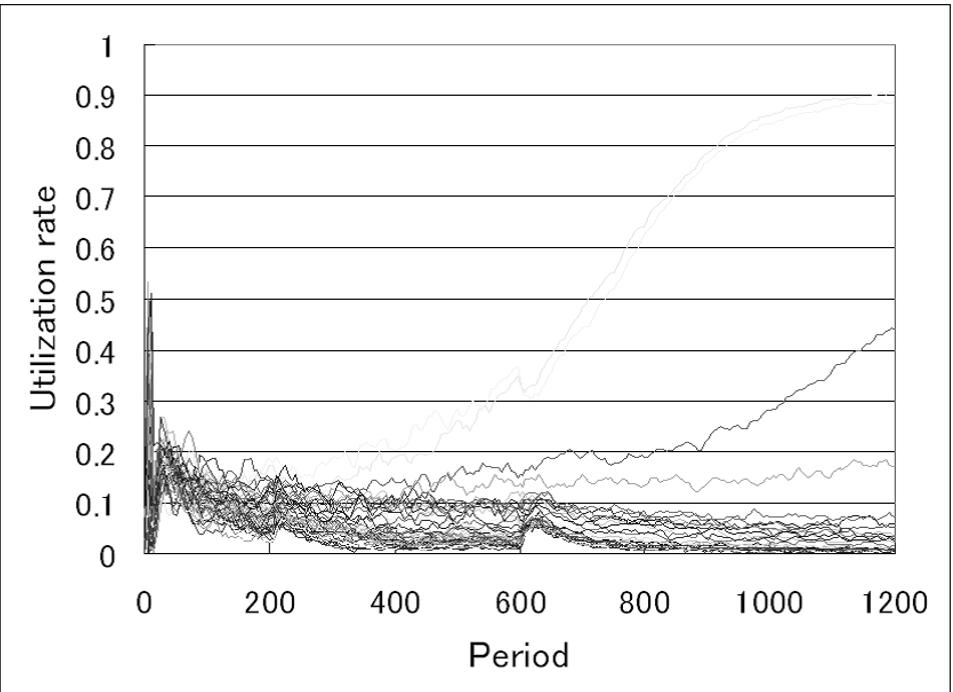 Figure: The success rate of the SNS spikes when more than 60% of existing users are encouraged to stay active.
Deep Insight & Conclusion
The core takeaway for community managers and developers is clear: Network Effects are a double-edged sword. In a small network, inactivity is as contagious as activity.
If you want to save a struggling platform, don't spend your budget on ads to get new sign-ups. Instead, create "internal triggers" (like the university exercises mentioned in the paper) that force a critical mass of existing users to interact. Once the "utilization rate" () crosses a certain threshold, the network becomes self-sustaining through natural social feedback.
Limitations
While robust, the model currently lacks a "Group/Community" function—where users interact outside of their direct friend links. This "weak tie" interaction is often what bridges disparate clusters in a network and remains a vital area for future expansion of this research.