
Beyond Centralization: Optimizing Encryption for P2P Social Networks
Encryption for Peer-to-Peer Social Networks
This paper explores encryption-based access control for Peer-to-Peer Online Social Networks (P2P OSNs) to eliminate reliance on central providers. The authors analyze existing architectures like Diaspora, Persona, and Safebook, ultimately proposing a dynamic Identity-Based Broadcast Encryption (IBBE) scheme to achieve efficient, privacy-preserving data sharing.
TL;DR
In the quest to reclaim data ownership from social media giants, Peer-to-Peer (P2P) Social Networks face a massive technical hurdle: how to enforce access control without a central server. This paper evaluates the cryptographic "debt" of existing P2P architectures and argues that Dynamic Identity-Based Broadcast Encryption (IBBE) is the missing link for efficient, private, and scalable decentralized social interaction.
Background: The Price of Decentralization
In a centralized OSN (like Facebook), the server acts as an all-powerful gatekeeper. In a P2P network, data sits on untrusted or semi-trusted nodes (friends' computers, DHTs). Therefore, encryption IS the access control.
The authors identify three critical dimensions for P2P encryption:
- Efficiency: Minimizing storage (headers), computation (CPU), and communication (bandwidth).
- Functionality: Supporting group logic (AND/OR), "friends-of-friends," and easy revocation.
- Privacy: Protecting not just the content, but the "access structure" (who has permission to see what).
The Problem with Current SOTA
The paper critiques several influential projects:
- Diaspora / Early PeerSoN: Uses "Trivial Broadcast Encryption." It encrypts a symmetric key for each recipient using their public key. If you have 500 friends, your message header is 500 times larger than necessary.
- Persona: Uses Ciphertext-Policy Attribute-Based Encryption (CP-ABE). While powerful for logic, it's slow. Decryption time grows with the number of attributes, and the "access policy" is usually visible in the header, leaking social metadata.
- Safebook: Relies on a "Matryoshka" (nested trust rings) approach, but suffers from high latency due to hop-by-hop asymmetric encryption.
Methodology: The IBBE Alternative
The authors propose shifting to Dynamic Identity-Based Broadcast Encryption (IBBE). In this model, the profile owner acts as the "Private Key Generator" (PKG).
Why IBBE?
- Constant Size: The "Header" (the encrypted symmetric key) remains at a constant size regardless of whether you are sharing with 5 friends or 5,000.
- O(1) Decryption: Unlike ABE, the computational cost to open a file doesn't increase with complexity.
- Hidden Access Structures: Some IBBE variants allow the sender to hide who the recipients are, preventing network-wide traffic analysis.
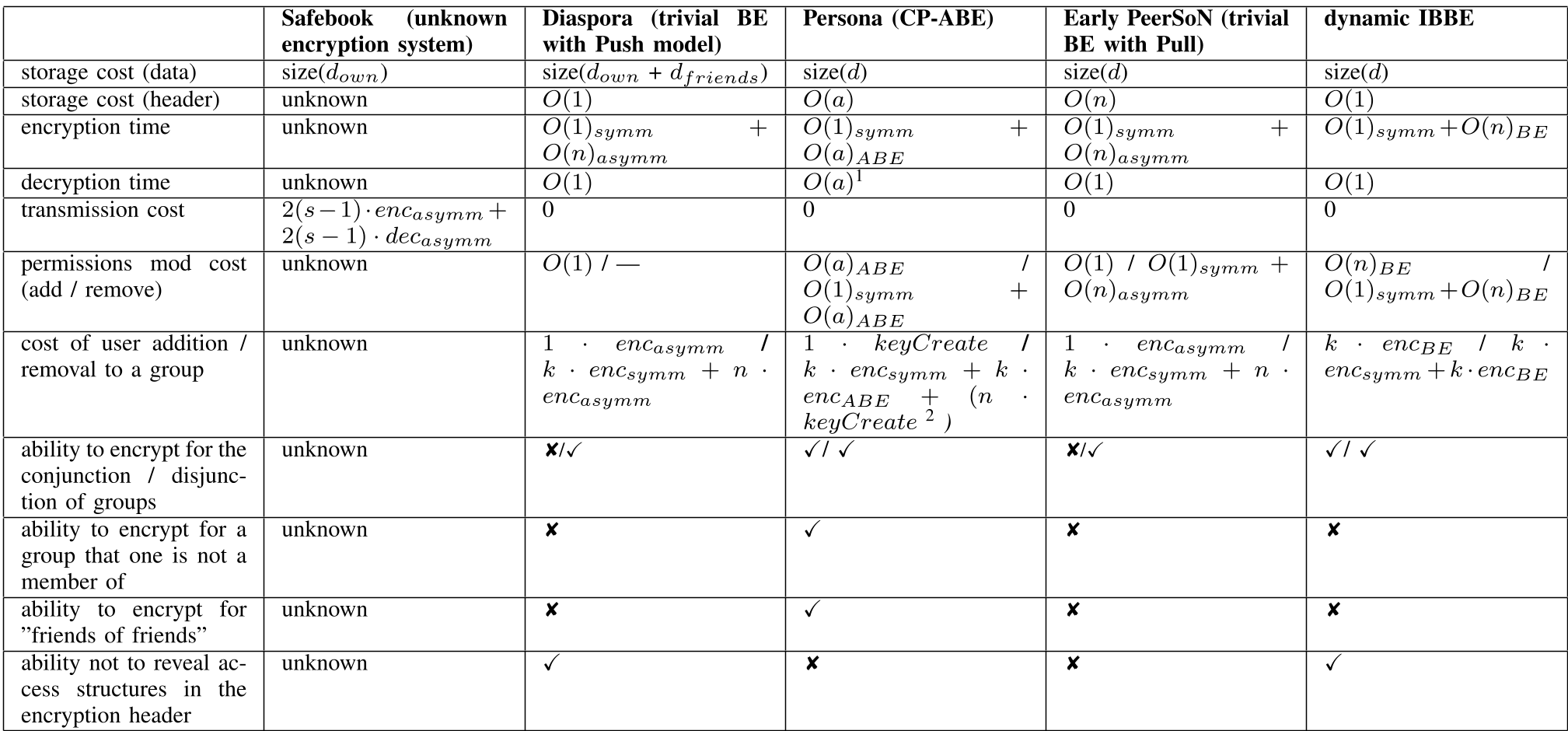 Note: The table highlights that IBBE achieves O(1) header size and decryption time, outperforming Persona's CP-ABE in efficiency.
Detailed Comparison
The authors provide a rigorous breakdown of trade-offs. While CP-ABE excels at complex functionality (like "friends-of-friends" logic), it fails at privacy and speed. Conversely, IBBE is significantly more efficient for the most frequent social task: sharing data with a specific, dynamic set of people.
| Metric | CP-ABE (Persona) | dynamic IBBE (Proposed) |
|---|---|---|
| Header Storage | Linear O(a) | Constant O(1) |
| Decryption Time | Linear O(a) | Constant O(1) |
| Recipient Privacy | No (Visible) | Yes (Hidden) |
| Revocation | Difficult | Easy (Stateless) |
Critical Insight & Conclusion
The "holy grail" of P2P social security is a system that is as fast as a central server but as private as a cold vault. This paper concludes that while no current architecture is perfect, IBBE provides the best balance of performance and privacy for 24/7 access control in an untrusted environment.
Limitations: The authors admit that current IBBE schemes struggle with "friends-of-friends" permissions unless the owner is directly involved in key management. Solving this while maintaining O(1) efficiency remains the final frontier for encrypted P2P social graph research.