
Decentralized Privacy: Why Broadcast Encryption is the Key to P2P Social Networks
Encryption for Peer-to-Peer Social Networks
The paper investigates encryption-based access control for Peer-to-Peer (P2P) Online Social Networks (OSNs). It proposes the use of Dynamic Identity-Based Broadcast Encryption (DIBBE) to achieve O(1) decryption complexity and constant-size headers while maintaining user privacy in decentralized environments.
TL;DR
As the demand for data sovereignty grows, P2P social networks aim to replace centralized giants. However, managing access control on untrusted storage is a cryptographic nightmare. This paper analyzes why current solutions (like Diaspora and Persona) fail to scale and proposes Dynamic Identity-Based Broadcast Encryption (DIBBE) as a superior alternative, offering O(1) decryption and hidden recipient lists.
The "Centralization" Trap and the P2P Challenge
In a standard social network, the service provider (Facebook, X, etc.) acts as the "God-mode" administrator. They enforce who sees what, but they also see everything. P2P social networks move data to "untrusted" or "semi-trusted" peers. Since we cannot trust the storage host's operating system to enforce access, we must use encryption as the enforcement mechanism.
Problem: The Scalability-Privacy Paradox
The authors identify that existing P2P architectures fall into three traps:
- The Metadata Leak: Many schemes include an Access Control List (ACL) in the file header. This allows anyone to reconstruct your social graph just by looking at the encrypted files.
- The Header Bloat: In systems like Diaspora, if you share a photo with 100 friends, the header often grows linearly, becoming larger than the actual message.
- The Computational Wall: Attribute-Based Encryption (ABE) allows for complex rules but is "heavy" on the CPU, making it slow for mobile devices.
Methodology: Evaluating the Cryptographic Candidates
The authors propose a rigorous framework covering Efficiency, Functionality, and Privacy. They compare traditional Public Key Infrastructure (PKI), Ciphertext-Policy Attribute-Based Encryption (CP-ABE), and Broadcast Encryption.
Architecture Analysis
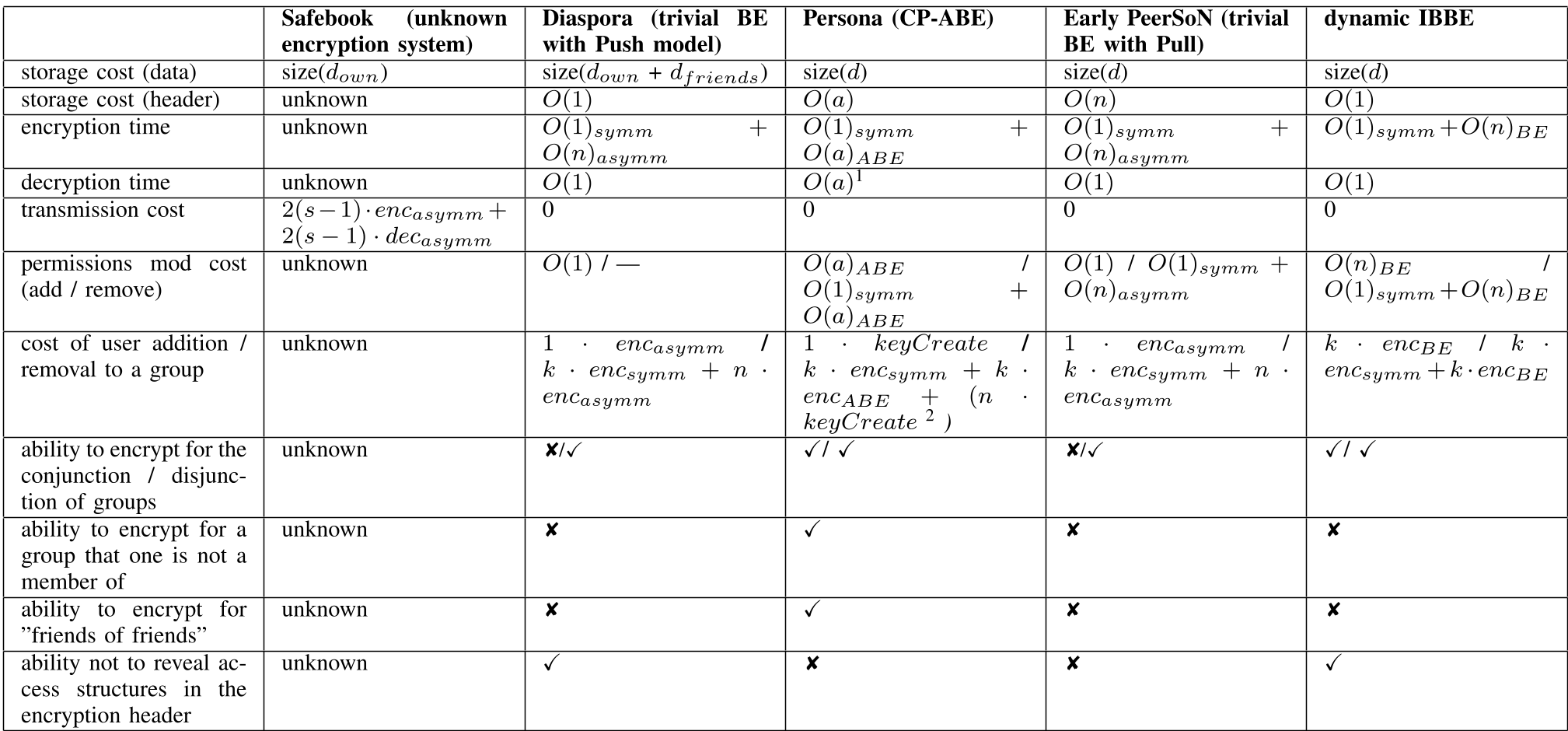
The paper highlights the structural differences between leading P2P projects:
- Diaspora: Uses a "Push" model—data is encrypted and sent to every friend's server (high storage redundancy).
- Persona: Uses CP-ABE—flexible, but slow and leaks access structures.
- PeerSoN: Early versions used a "Pull" model with trivial asymmetric encryption, leading to massive headers.
The Solution: Dynamic Identity-Based Broadcast Encryption (IBBE)
The paper advocates for IBBE as the optimal compromise. In this setup:
- The Profile Owner is the Authority: You (the user) generate the master key.
- Constant Header Size: No matter if you have 10 friends or 1,000, the data header remains the same size.
- Recipient Privacy: Only authorized users can even tell they are authorized. To an outsider, the header reveals nothing about who can decrypt it.
Experimental Insights
Comparing the complexity (as seen in the table above), the authors demonstrate that while CP-ABE is "feature-rich" (allowing for "friends of friends" logic), the DIBBE approach wins on the crucial P2P metric: Decryption Speed (O(1)). In a feed with hundreds of posts, an O(1) decryption cost is the difference between a smooth user experience and a frozen app.
Critical Analysis & Conclusion
Takeaway
The shift towards IBBE represents a pivot from "expressive but slow" (ABE) to "scalable and private" (BE). For social networks where "following" and "friending" are the primary actions, the ability to hide the recipient list is a massive privacy win.
Limitations
The primary drawback identified is that IBBE makes it harder to support "Friends of Friends" (FoF) access without the user being online to issue keys. Furthermore, addition/removal of users still requires some re-encryption of headers (O(n) at the encryption stage).
Future Outlook
The next frontier is finding a hybrid scheme that maintains the O(1) efficiency of Broadcast Encryption while allowing the "transitive trust" logic found in ABE. As decentralized storage (IPFS/Arweave) becomes more common, the cryptographic primitives defined in this paper will be essential for real-world adoption.