
LCLM: Reaching the New Pareto Frontier of Long-Context Compression
End-to-End Context Compression at Scale
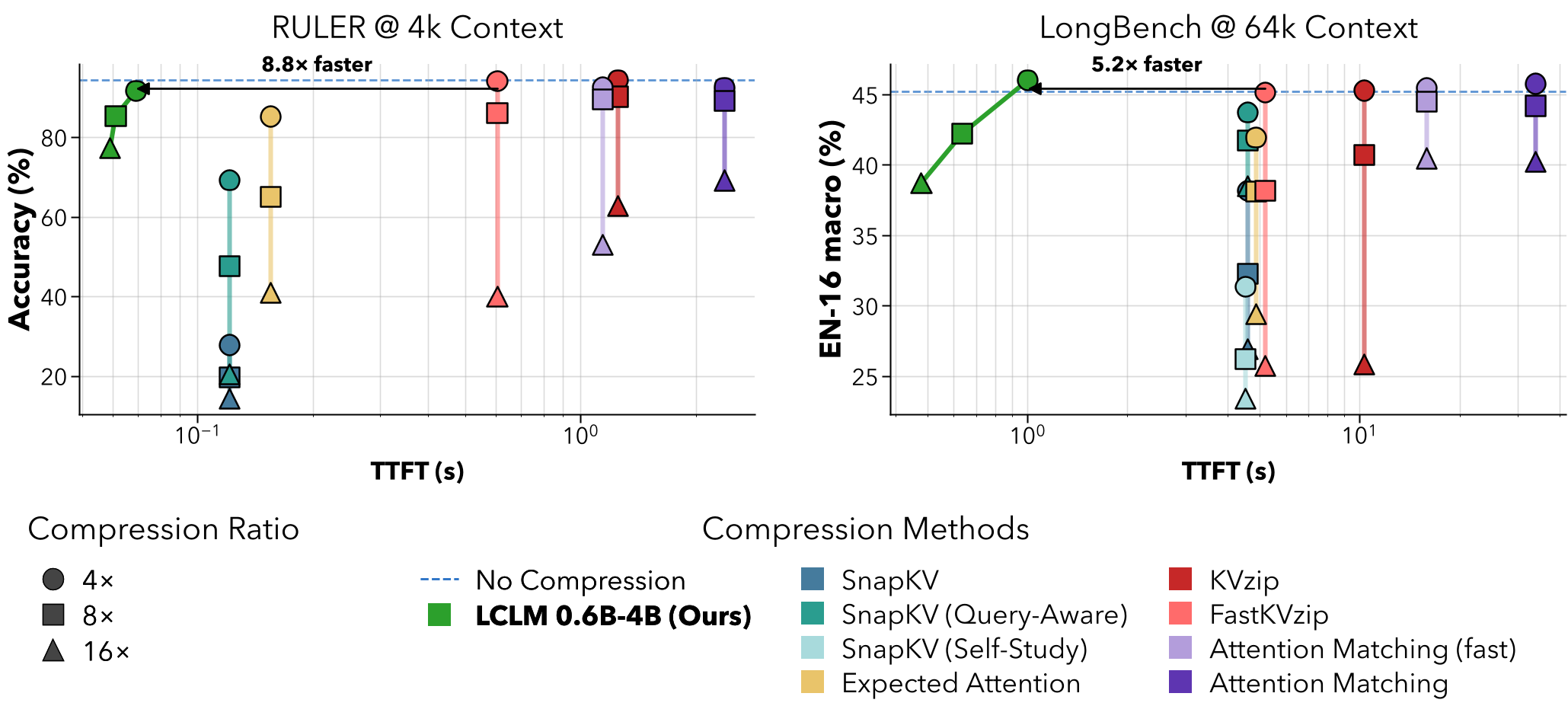
The paper introduces Latent Context Language Models (LCLMs), an end-to-end encoder-decoder framework for extreme context compression (up to 16x). By mapping long token sequences into a short sequence of latent embeddings, LCLMs achieve a new Pareto frontier in long-context tasks (RULER, LongBench), significantly outperforming KV cache eviction methods in both speed and memory efficiency.
The "context window war" in Large Language Models (LLMs) has moved from simply increasing window sizes to managing the massive memory overhead they create. While the community has focused heavily on KV Cache eviction (dropping keys/values), a new heavyweight contender has emerged: Latent Context Language Models (LCLMs).
By revisiting the encoder-decoder architecture, the authors demonstrate that we can "skim" 1,000,000 tokens as effectively as we read 64,000, provided we train the compressor the right way.
TL;DR
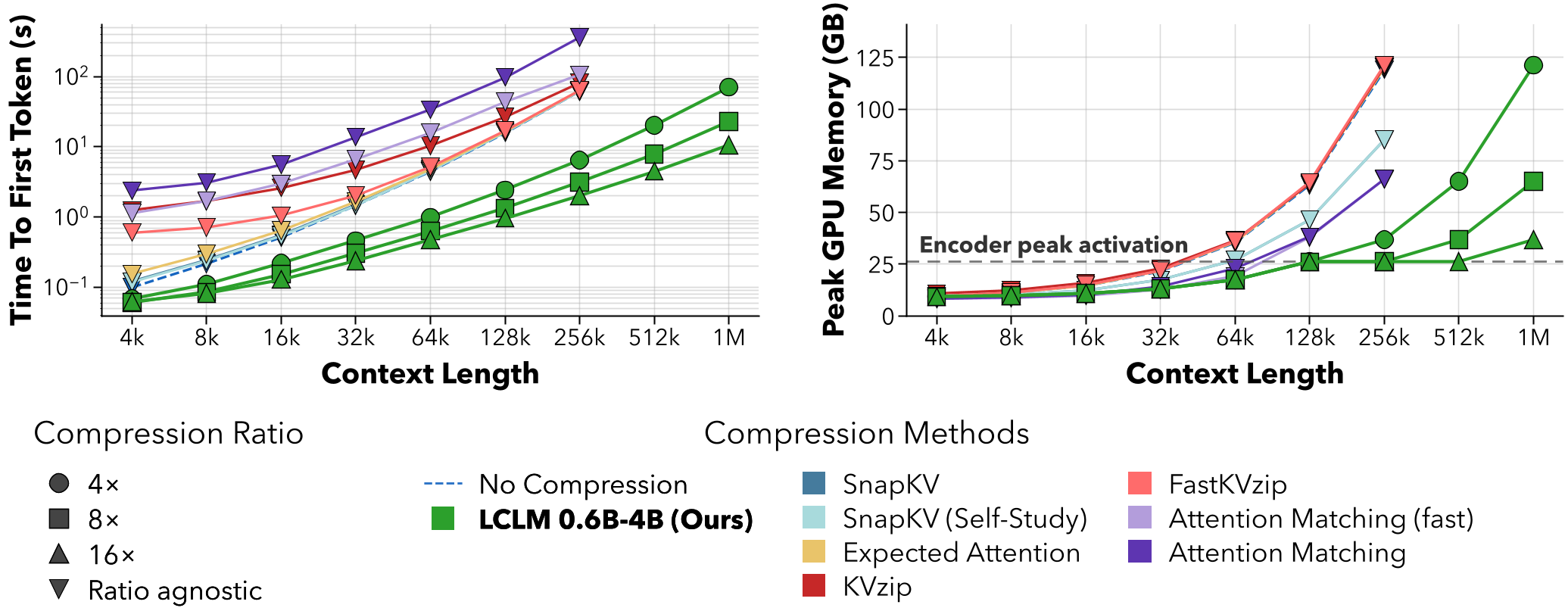
LCLMs transform long text into a far shorter sequence of "latent embeddings" (compressed 4x, 8x, or 16x). Unlike KV cache pruning, which requires you to process the whole prompt first, LCLMs compress as they go. The result? Faster Time-to-First-Token (TTFT), lower peak memory, and SOTA performance on long-context benchmarks.
The Bottleneck: Why KV Eviction is Not Enough
Most modern long-context strategies rely on KV Cache compression. However, these methods suffer from a "Prefill Paradox":
- The Cost of Entry: To decide which KV pairs to keep, many methods must first materialize the entire cache. This leads to massive memory spikes during the prefill stage.
- System Friction: Methods that evict non-uniformly across layers or heads (like KVzip) are notoriously hard to implement in production engines like vLLM.
LCLMs bypass this by shifting the burden to a small, efficient encoder.
Methodology: Scalable Soft-Token Compression
The LCLM architecture consists of three parts: a 0.6B Encoder, an Adapter, and a 4B Decoder.
1. The Architecture Move
Through an exhaustive "from-scratch" architecture search, the team found that:
- Causal Masking > Bidirectional: Surprising in an encoder, but causal masking in the encoder yielded lower pre-training loss.
- Mean Pooling: Averaging hidden states over a window proved more robust than using special [CLS] or [EOS] tokens for high compression ratios.
- Encoder Window (W=1024): Instead of encoding one block at a time, looking at a 1024-token context allows the encoder to capture better local semantics.
2. The Multi-Stage Recipe
You can't just slap an encoder on a frozen LLM and expect it to work. LCLMs use a 4-stage training pipeline:
- Stage 0-1: Warm up the adapter and encoder.
- Stage 2: Continual pre-training on 350B tokens with interleaved compressed/uncompressed blocks.
- Stage 3: SFT (Supervised Fine-Tuning) with an auxiliary reconstruction task—asking the model to "repeat back" the original text from the compressed latent.
Performance: Speed Meets Accuracy
LCLMs define a new Pareto frontier. As context length grows toward 1 million tokens, LCLMs maintain significantly lower peak memory because the heavy-duty decoder only sees the 1/16th compressed representation.
In the RULER benchmark (a stress test for context retrieval), LCLMs at 16x compression maintain higher accuracy than KV cache methods that are drastically slower to execute.
The Agentic "Zoom": Adaptive Expansion
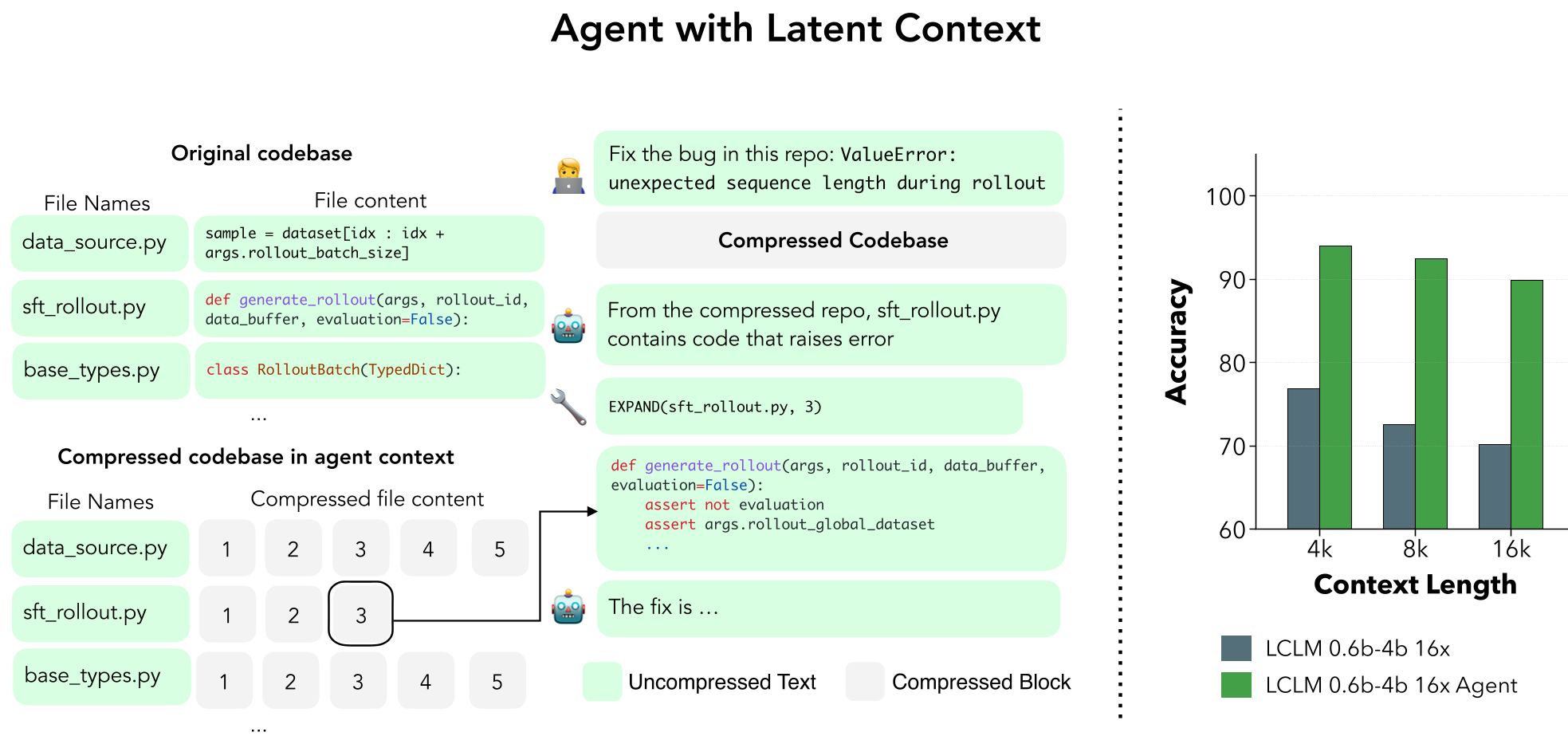
One of the most exciting contributions is the LCLM Agent. When faced with a "Needle-in-the-Haystack" task where exact string matching is required, the agent uses the compressed context as a global map. If it identifies a relevant section, it uses an EXPAND(i) tool to retrieve the uncompressed raw text.
This "skim-then-zoom" approach approximates human reading patterns and solves the inherent lossiness of high-ratio compression.
Critical Insight: The Future of "Active Memory"
LCLMs prove that we don't need to store every single KV pair to maintain reasoning capabilities. The shift from sparse eviction to latent encoding represents a fundamental move toward LLMs having a "working memory" similar to biological systems—summarizing the past to act in the present.
Limitations: 16x compression still incurs a "semantic tax" on extremely dense reasoning (like math). Future work on adaptive compression rates—compressing boring text at 32x while keeping code at 2x—will likely be the next breakthrough.
Main Takeaway: For anyone building long-horizon agents or processing massive document repositories, LCLMs offer a production-ready path to 1M+ token contexts without the H100-sized price tag.