
Beyond the Black Box: Democratizing Innovation through EUD and Human-Centered AI
End-User Development: Empowering Stakeholders with Artificial Intelligence, Meta-Design, and Cultures of Participation
This paper explores the integration of End-User Development (EUD) and Human-Centered AI (HCAI) to empower stakeholders in solving "wicked problems." It defines EUD not merely as a technical task but as a cultural transformation, utilizing meta-design and cultures of participation to democratize innovation.
TL;DR
In an era where Artificial Intelligence is often seen as a magical deus ex machina, Gerhard Fischer’s research serves as a critical reminder that technology should empower, not replace, human agency. By bridging End-User Development (EUD) with Human-Centered AI (HCAI), the paper outlines a path toward "Meta-Design"—creating systems that aren't just finished products, but "seeds" that grow through active participation.
The "Suitcase Word" Problem: Motivation
Both AI and EUD are what the paper calls "suitcase words"—terms packed with multiple, sometimes conflicting, meanings.
- The Failure of AISP: AI for Specific Purposes (AISP) often treats problems as "tame," creating efficient but opaque black boxes. This leads to a loss of user control and autonomy.
- The EUD Bottleneck: Traditional EUD often struggles with the "learning burden" or "participation overload," where users are forced to be designers for tasks they don't care about.
The author's insight is that we need to move toward AI Realism, focusing on "wicked problems"—those complex, evolving challenges (like climate change or urban planning) where the solution isn't a fixed algorithm but a continuous process of social and technical co-evolution.
Methodology: Meta-Design and the SER Model
The core of the paper is the Meta-Design framework. Unlike traditional design, which tries to predict all needs at "design time," Meta-Design focuses on "design for designers."
The SER Model: Seeding, Evolutionary Growth, and Reseeding
- Seeding: Designers create a flexible "seed" rather than a complete system.
- Evolutionary Growth: Users modify the system at "use time" as they encounter real-world breakdowns or new needs.
- Reseeding: A deliberate period where professional designers and users collaborate to restructure and enhance the evolved system.
 Figure 1: Characterizing EUD and AI as complementary forces in socio-technical environments.
Adaptive vs. Adaptable: Finding the Synergy
The paper makes a brilliant distinction between Adaptive (system-driven, AI-focused) and Adaptable (user-driven, EUD-focused) systems.
| Feature | Adaptive (AI) | Adaptable (EUD) |
|---|---|---|
| Control | System-driven (Black box) | User-driven (Glass box) |
| Knowledge | Predetermined by data/logic | Extended by local expertise |
| Strength | Low effort for the user | High situational relevance |
The paper argues for a hybrid approach. Take a modern GPS: it is adaptive (calculating routes), but it should be adaptable (allowing the user to explain why a specific shortcut is better due to local context, such as a temporary unmapped parade).
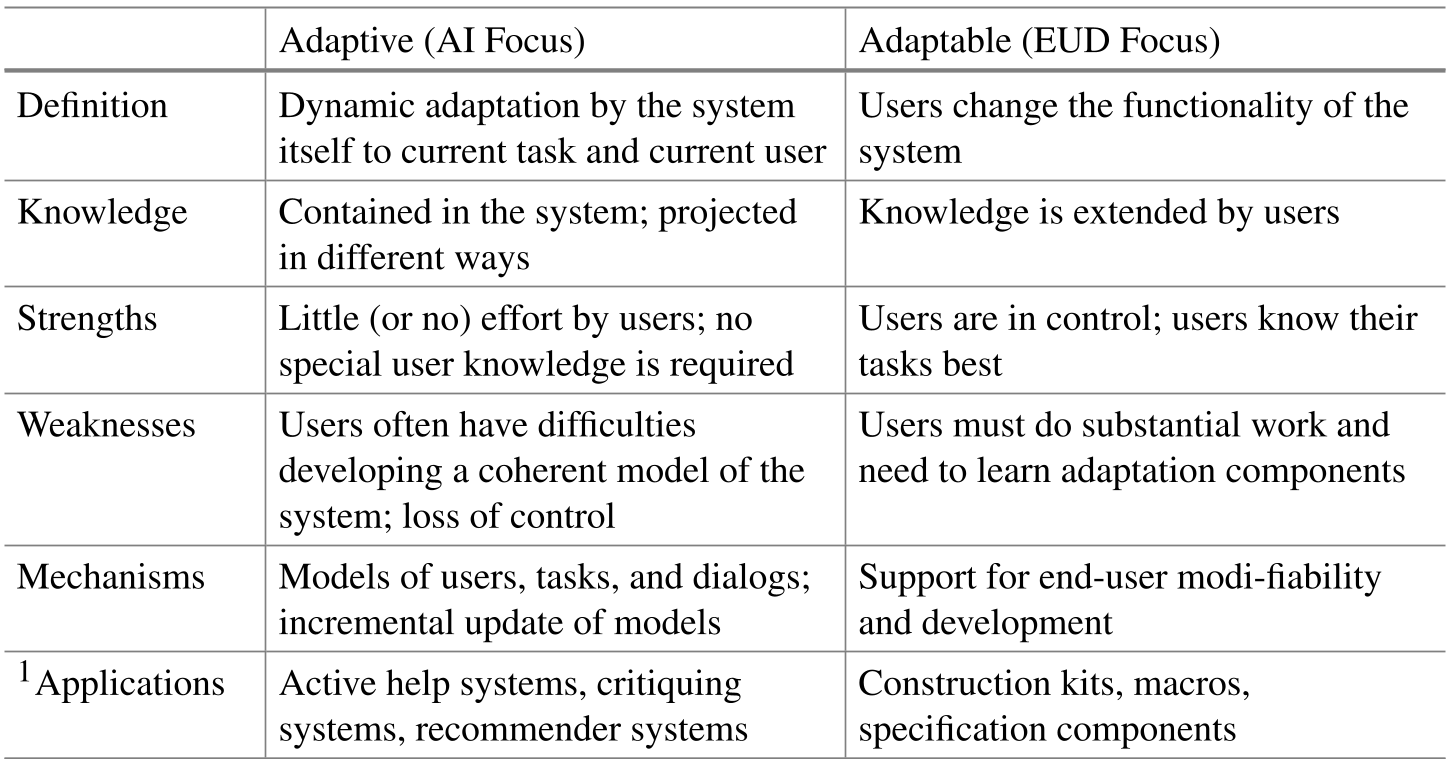 Table 1: The trade-offs between automated AI adaptation and manual user adaptation.
Domain-Oriented Design Environments (DODEs)
To ground these theories, the author discusses DODEs. These are environments tailored to specific fields (e.g., kitchen design or medical records). They use AI "Critics" to suggest improvements, but they use EUD tools to allow the specialist (the chef or the doctor) to override and evolve the domain language itself.
Critical Insight: The Cultural Transformation
The most profound takeaway is that EUD and AI are not just software engineering challenges—they are cultural transformations.
- Libertarian Paternalism: We need "nudges" (presets) to avoid participation overload in irrelevant tasks, but we must maintain "libertarian" control (the ability to override) in meaningful ones.
- Deskilling: If we rely solely on AI, we risk losing the cognitive skills to solve problems when the technology fails.
Conclusion & Future Outlook
Fischer concludes that we must transition from a "Read-Only" culture (where we consume AI output) to a "Read-Write" culture (where we co-author the world). The synergy between AI and EUD ensures that technology enhances human performance in ways that are reliable, safe, and, most importantly, meaningful.
Limitations: The paper acknowledges that the burden of learning complex HCAI technologies remains a significant barrier for average users, suggesting that future research must focus heavily on lowering the "floor" for engagement while raising the "ceiling" for creation.