
EnDiCE: Revolutionizing the Museum Experience with Smart AR and Machine Learning
EnDiCE: Enhanced digital cultural experience
EnDiCE (Enhanced Digital Cultural Experience) is a holistic personalized cultural framework integrating Mobile Augmented Reality (AR) and Machine Learning-driven recommender systems. It aims to revitalize the museum experience by delivering adaptive content and interactive digital documentation to visitors.
TL;DR
The EnDiCE (Enhanced Digital Cultural Experience) system is an ambitious framework designed to bridge the gap between static museum exhibits and the digital expectations of modern visitors. By weaving together Augmented Reality (AR), Machine Learning (ML), and WLAN-based indoor tracking, it creates a personalized "living" museum where content adapts to the individual’s interests and movements in real-time.
Context: Beyond the "Mausoleum" Model
In an era dominated by social media and instant digital gratification, traditional museums are facing a crisis of relevance. The authors argue that cultural institutions must transition from "restricted high-class mausoleums" to dynamic, socio-economic attractions. The challenge lies in Personalization: how do you provide a unique experience to thousands of different visitors simultaneously?
Existing solutions often fail because they are either "one-size-fits-all" audio guides or rely on specialized hardware (like the now-deprecated Google Tango) that global visitors do not possess.
Methodology: The EnDiCE Architecture
The strength of EnDiCE lies in its modularity across five distinct subsystems. It doesn't just display information; it listens to the visitor's behavior.
1. High-Precision Tracking & Orientation
To deliver AR content, the system must know exactly where a visitor is standing and what they are looking at.
- Positioning: Instead of unreliable GPS, EnDiCE uses WLAN Triangulation. By placing at least three routers per area, the system calculates coordinates based on signal intensity.
- Orientation: It leverages the internal IMU (Inertial Measurement Unit) of smartphones—accelerometers and gyroscopes—to determine the "facing direction" of the user.
2. The Machine Learning Core
The system doesn't just provide facts; it builds a User Profile. By monitoring which exhibits a visitor lingers at and their initial social registration, the ML subsystem clusters users into personas. This allows for:
- Adaptive Content: Showing more technical details to an expert and gamified stories to a child.
- Dynamic Route Planning: Suggesting alternative paths through the museum to avoid crowds or match interests.
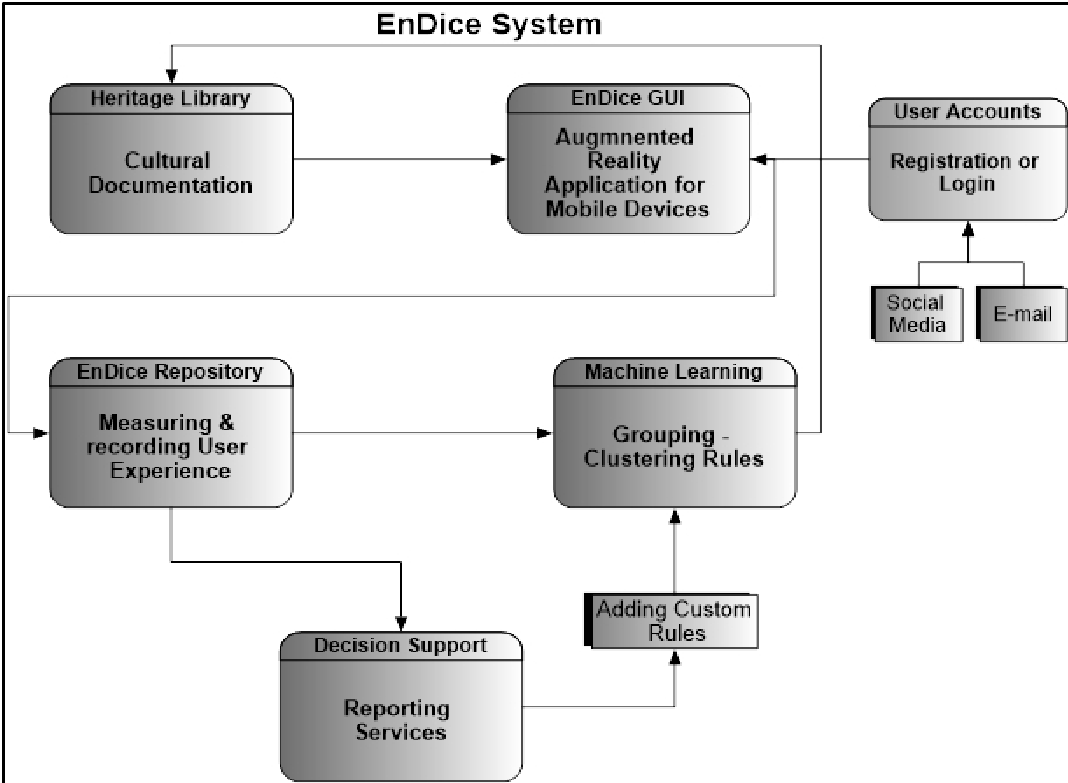 Figure 1: The logic flow of EnDiCE, illustrating the loop between Cultural Documentation, AR interaction, and ML-driven Decision Support.
Impact: Culture as a Strategic Asset
The paper emphasizes the "Economy of Culture." In Greece, where tourism contributes over 10% to the GDP, the digitizing of cultural products is no longer optional—it is a survival strategy.
The EnDiCE system provides Decision Support for museum managers. By analyzing heatmap data and interaction metrics (like the Net Promoter Score), curators can scientifically decide on exhibit placement and marketing strategies, shifting from intuition-based to data-driven curation.
Critical Insight & Future Outlook
While the paper provides a robust blueprint for a universal AR platform, the reliance on WLAN triangulation may face challenges in environments with heavy physical shielding (thick stone walls in ancient buildings).
The Takeaway: EnDiCE represents a shift towards Inductive Culture. Instead of the museum telling the visitor what is important, the visitor’s behavior induces the museum to reveal what they find interesting. The future of cultural dissemination lies in this "Interactive Loop," where the visitor is both a consumer and a data source for future excellence.
Conclusion
The EnDiCE framework is a significant step toward "Smart Heritage." By moving beyond marker-based AR and static apps, it proposes a world where the museum experience is as fluid and personalized as a Netflix feed, yet as tangible as a 2,000-year-old artifact.