
Trusting the Crowd: Predicting Contribution Quality via Worker Endorsements
An endorsement-based reputation system for trustworthy crowdsourcing
The paper introduces an endorsement-based reputation system for crowdsourcing that predicts the Trustworthiness of Contributions (ToC) before tasks are executed. By combining matrix factorization for expertise prediction with a social-network perspective of worker endorsements, the system achieves a proactive quality control mechanism that outperforms reactive ex-post assessments.
TL;DR
In the world of crowdsourcing, verifying the quality of work after it's done is often too late—leading to wasted effort and frustrated requesters. This paper proposes a reputation system that predicts the trustworthiness of contributions before a single line of work is performed. By leveraging Matrix Factorization to understand task-specific expertise and a social Endorsement mechanism to capture peer trust, the system creates a robust framework for high-quality, trustworthy crowdsourcing.
The "Post-Mortem" Fallacy in Crowdsourcing
Most crowdsourcing platforms (like Amazon Mechanical Turk) operate on a "submit-then-verify" model. This creates a significant pain point: Irreversible Effort. If a worker spends hours on a task only to be rejected because their reputation was unknown or the task was a poor fit for their skills, energy is wasted. Conversely, requesters risk receiving "distorted utility" from malicious actors.
The authors argue that two things are missing from modern platforms:
- Task & Worker Heterogeneity: Not all tasks require the same skills, and not all workers are equally good at everything.
- Social Context: Workers aren't islands; their professional relationships (endorsements) carry predictive power about their reliability.
Methodology: The Core of Trust Prediction
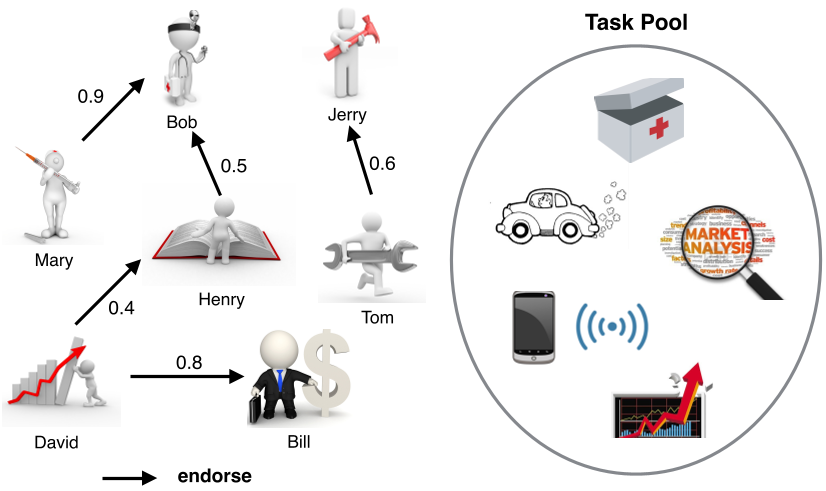
The system workflow hinges on a proactive selection process. Instead of letting anyone join, the platform calculates a Trustworthiness of Contribution (ToC) score.
1. Expertise Estimation (Matrix Factorization)
To handle the fact that we don't have a history for every worker on every type of task, the authors use Matrix Factorization. By decomposing the worker-task rating matrix into latent vectors ( and ), the system can "infer" how well a worker would perform on a new task based on similar tasks and similar workers.
2. The Endorsement Impact
The true innovation lies in the ToC formula:
- : The worker’s own reputation.
- : The "Endorsement Impact." If high-reputation peers () with high expertise in task () vouch for you (), your ToC goes up.
This effectively solves the Cold-Start Problem: a new worker with no history can still get tasks if they have strong endorsements from established "experts."
Dynamic Trust: Modeling Human Relationships
Trust isn't static. The paper models the weight of endorsements using a generalized logistic function (S-curve).
- Slow Start: Initial trust grows slowly between strangers.
- Acceleration: As performance improves, trust builds quickly.
- Saturation: Trust eventually plateaus at a stable "intimate" level.
The evolution of this weight depends on the worker's performance relative to the crowd average, ensuring that endorsers are held accountable for whom they support.
Experiments and Results
By sorting workers by their predicted and selecting only the top candidates (as shown in Algorithm 1), the platform ensures a high probability of success.
- Expertise Accuracy: The Matrix Factorization approach allows the system to predict performance even in the absence of direct historical data.
- Trustworthiness Boost: The inclusion of (endorsement weight) allows the system to distinguish between a "quiet expert" (new but endorsed) and a "noisy novice."
Deep Insights & Concluding Thoughts
The genius of this work is treating crowdsourcing as a Social Network rather than a mere marketplace. By mathematically modeling "reputation inheritance" through endorsements, the authors provide a way to scale trust without requiring massive amounts of historical data for every single participant.
Limitations: The current model assumes that "endorsements" are truthful. While the S-curve adjustment penalizes bad endorsements over time, a massive collusion attack (sybil attack) where many malicious workers endorse each other could potentially trick the system in its early stages.
Future Outlook: In the era of Decentralized Autonomous Organizations (DAOs) and Web3, this endorsement-based logic could be implemented via smart contracts to build "Trust Graphs" that span across different platforms, allowing reputation to become truly portable and predictive.