
EndorTrust: Predictive Reputation through the Power of Social Endorsement
EndorTrust: An Endorsement-Based Reputation System for Trustworthy and Heterogeneous Crowdsourcing
This paper introduces EndorTrust, a novel reputation system for crowdsourcing that utilizes inter-worker "endorsement" relationships to predict the Trustworthiness of Contribution (ToC). By integrating Matrix Factorization (a collaborative filtering technique) with social network dynamics, the system allows requesters to identify high-quality workers before they exert irreversible effort.
TL;DR
Crowdsourcing often falls into a "participation trap": workers must exert effort before knowing if their quality meets the requester's pay-grade. EndorTrust breaks this cycle by predicting the Trustworthiness of Contribution (ToC) before work begins. By leveraging a "social-network" perspective—specifically peer endorsements—the system identifies qualified workers even when they are new to the platform, effectively solving the cold-start and discrimination problems that plague traditional reputation systems.
Problem & Motivation: The "Irreversible Effort" Trap
In standard crowdsourcing (like Amazon Mechanical Turk), quality is reactive. You work, you submit, and then you get rated. This creates two major failures:
- Negative Utility: If a worker's effort is rejected, their spent time is gone forever—a massive disincentive for high-skill contributors.
- The Newbie Wall: Peerless workers with high skills but zero history are ignored because they lack "Reputation Score" (RS), while mediocre veterans dominate the market.
The authors' insight is simple but profound: Trust is transitive. If an expert doctor endorses a nurse for a medical task, that nurse’s "predicted quality" should be higher than a veteran writer with no medical background.
Methodology: Fusing Social Trust with Machine Learning
The core of EndorTrust is the ToC (Trustworthiness of Contribution) formula. It isn't just a historical average; it's a weighted sum of self-reputation and "Endorsement Impact."
1. The ToC Architecture
The system treats workers as nodes in a directed graph where edges represent "endorsement degrees." To predict success in a specific task , the system calculates: Where is the trust level and is the expertise of the endorser in that specific task domain.
2. Inferring Heterogeneous Expertise
How do we know if an endorser is an "expert" in a new task? The authors use Matrix Factorization (MF). By mapping workers and tasks into a latent factor space (similar to how Netflix predicts movie preferences), the system can "hallucinate" a worker's skill in a domain they've never touched based on their performance in similar sub-categories.
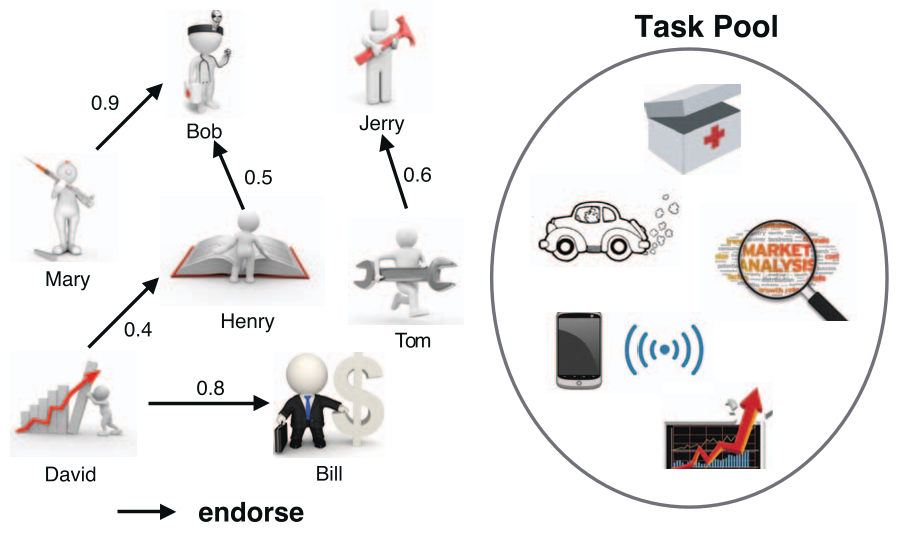 Fig 1: The EndorTrust platform concept, showcasing how endorsement links bridge workers across different task categories.
3. Asymmetrical Trust Evolution
EndorTrust models human relationships using a S-curve (Generalized Logistic Function). Crucially, it implements an asymmetrical update rule: trust is built slowly through good performance but "torn down rapidly" after bad behavior. This "hard to earn, easy to lose" logic prevents malicious collusion.
Experiments & Results: Crushing the Cold-Start
The authors simulated 20 workers and 50 tasks across 50 rounds, comparing EndorTrust against a "Benchmark" (standard reputation scores).
- Requester Satisfaction: EndorTrust consistently maintained higher average ratings because it filtered out "lucky" low-skill workers faster.
- The Newbie Breakthrough: In Fig 4, a high-competence new worker is introduced. In the Benchmark, their reputation stays at zero forever (the Discrimination Problem). In EndorTrust, their reputation climbs immediately because their peers' endorsements provide the initial "thrust" needed to get selected for tasks.
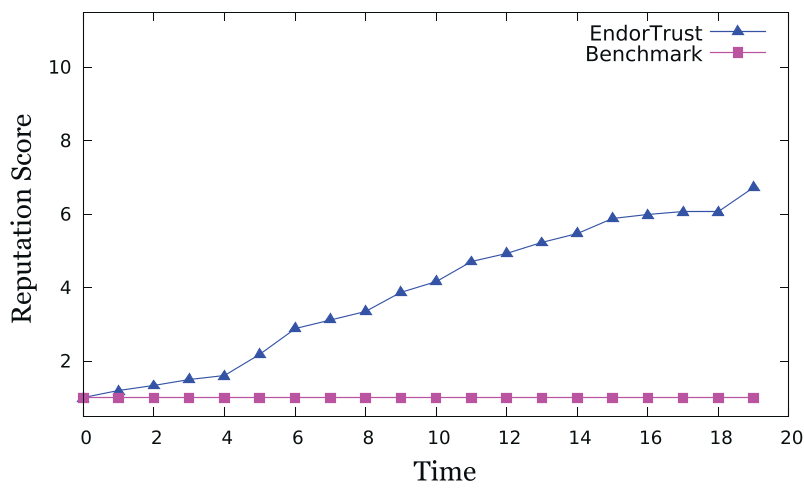 Fig 2: Comparison of Reputation Score accumulation for new workers. EndorTrust (red) allows talent to be discovered instantly.
Critical Analysis & Conclusion
EndorTrust successfully moves crowdsourcing from Post-hoc Assessment to Ex-ante Prediction. By treating human skills as "heterogeneous" (one size does not fit all), it mirrors the real-world complexity of specialized labor.
Takeaway: This work suggests that future "Gig Economy" platforms should stop treating workers as isolated islands. By encoding the social fabric of "who trusts whom" into the algorithm, we can create fairer markets where talent is recognized by proxy, even without a decade of history.
Limitations: The model assumes endorsements are honest. While the "rapid breakdown" penalty discourages bad endorsements, a massive "sybil attack" (where one person creates 100 fake accounts to endorse themselves) would still require robust identity verification to fully neutralize.